Reka's Rho-1 puts text, video and robot actions in one 19B model
Reka released a research preview of Rho-1 on 5 October, a 19B model that generates text, images and video and outputs robot actions inside a single network, the company says.
 Grace OkonkwoAI, models and technology
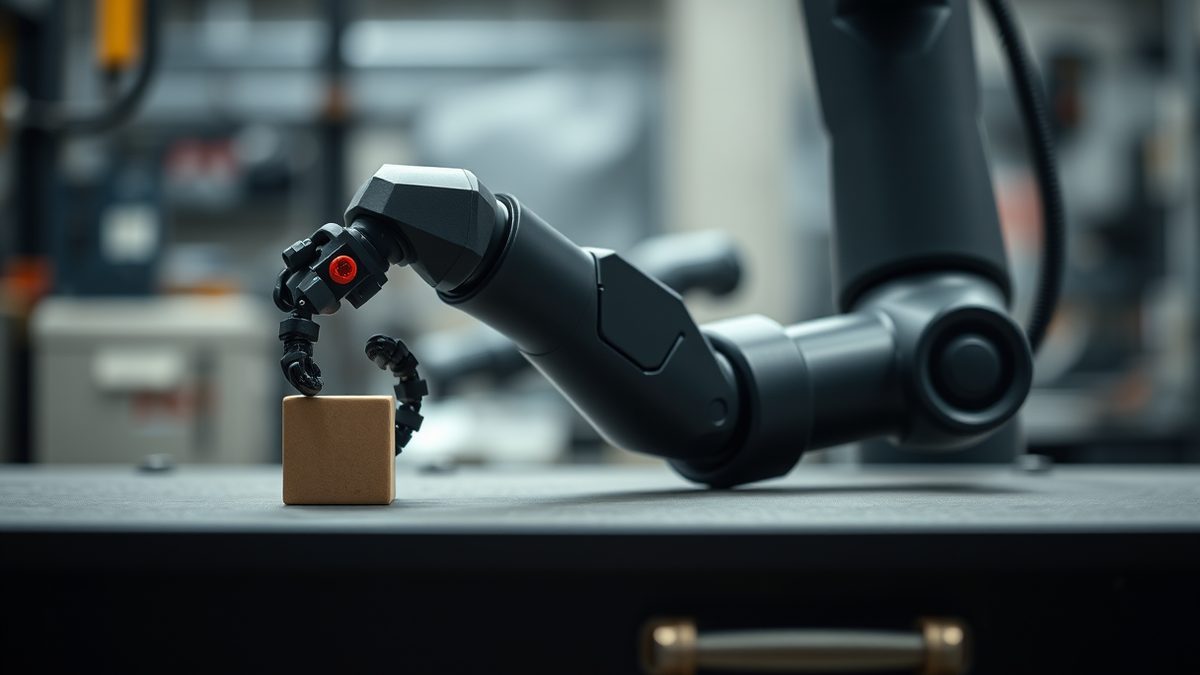
Reka published the Rho-1 research preview on 5 October. The model has 19B parameters and was trained from scratch. It handles text, images, video and motor policies in one context window, according to the company's research post. This is a preview, not a shipping product. Reka gives no release date for the weights.
Why it matters: most multimodal products are pipelines. A central model plans, then hands work to separate image, video or speech specialists, and every handoff adds latency. Rho-1's pitch is that one network removes those seams. That would matter to anyone building agents that read a scene, change it and then act on it. What is still unknown is whether the approach holds up outside Reka's own demos, and what it costs to run.
Reka's post describes a five turn session. The model draws a static scene, locates an object in it, animates the scene into a video, edits the weather and then explains what changed. Each turn reads from and writes to the same KV cache, which Reka calls a persistent world state. Requests for an image route to a diffusion tower. A request for a bounding box stays on the understanding side, the company says.
The speed numbers are the concrete part. Reka says the base model generates video at 0.79x real time, median, with a watchable stream starting in roughly 6 seconds. A distilled variant cuts the denoising trajectory from 99 steps to 8, with what Reka describes as minimal quality loss. In Reka's internal testing, that variant returned a 5.3 second clip in about a second. The company says that is faster than any other video model it timed. Those are Reka's own measurements, on its own hardware, and nobody outside the company has reproduced them.
One model, or a stack with the joins hidden
The claim that Rho-1 collapses the multimodal stack runs against the direction most labs took this year. Interfaze's 1.1 Lite, posted to Hugging Face on 5 October, is explicitly the opposite design. It is a reasoning core that calls specialist architectures for document reading, speech, segmentation and forecasting. It runs on one 80 GB GPU with no external services. Its model card lists component by component what each specialist does.
Liquid AI's d1, also introduced on 5 October, goes further in the other direction. It is a decision model: it reads text, images or both in one forward pass and returns probabilities, generating no tokens at all. Liquid says a text decision takes 200 to 300 ms. The company claims d1 matches or beats GPT-6.1 Sol on four of six test applications. It also says d1 costs 19x to 200x less than both GPT-6.1 Sol and Claude Opus 5.5. Those comparisons come from Liquid itself.
So the market is splitting. Some vendors sell one big model that does everything. Others sell a small router plus specialists. Liquid sells a model that answers yes or no. All three camps published within hours of each other on 5 October. That suggests the architecture argument is far from settled.
Reflection's Beam, announced the same day, is a reminder that scale is still a lever. Beam is a sparse mixture-of-experts model with 501 billion total parameters and 23 billion active. It was pretrained on 23.8 trillion tokens, per the company blog. Reflection says a high-compute reinforcement learning run generated over 100 million rollouts on 10.5K NVIDIA GB300 GPUs over four weeks. Beam is not a video model. It shows what frontier labs are spending to stay competitive on coding and agentic tasks.
Beam is still undergoing final red-teaming and evaluations. Reflection says it will release weights, a technical report, a model card and developer artifacts later this month. That pattern, announce first and ship weights later, is now common. It makes independent verification slow.
Agent harnesses are where the numbers bite
The more useful comparison for buyers is not benchmark tables but what a model costs per task in an agent loop. A GitHub project called Jeff-Code, published on 5 October, pairs a 0.8B decision model with Qwen 3.8-27B. It reports coding tasks finishing 47% faster, 32% less time, at the same pass rate. Pass rate was 62.4% against 62.8% for Qwen alone. That is a paired difference of minus 0.2 points, with a 95% interval of minus 2.6 to plus 2.1, across 1,242 paired tasks.
The author is careful about the limits. Total time across all tasks drops only to 0.86x, because in about 5% of tasks the setup runs more than 30 minutes longer than Qwen alone. Turning thinking off on every turn was faster still but cost 7.6 points. That is the kind of trade-off Rho-1's single-network design would have to beat. Reka has not published per-task agent numbers.
Reika, another coding agent CLI published on 5 October, takes the small-model route and publishes its findings. It says 14 to 35B models handled multi-file tasks most reliably. Models of 8 to 9B managed simple, well-scoped ones, and models below 7B rarely got far. It also reports that one mid-context rewrite re-processed 8,453 tokens of prompt, 7.9 minutes of prefill. An append in the same session cost 25 tokens and 3.5 seconds.
None of this settles whether one omni-model is better than a stack. It does show that the cost of a pipeline is measurable, and that the people building agents are measuring it.
Ads arrive in the image generator
On the product side, OpenAI said it will test visual ads inside ChatGPT during image generation. The test starts later this month in the U.S. with an initial group of advertisers, BleepingComputer reported on 5 October. OpenAI says the ads will be clearly labeled and remain separate from the image being created. It also says ads do not influence ChatGPT's answers. The company says ChatGPT reaches 1.2 billion people every week.
OpenAI is also adding conversion measurement through Hightouch, Tealium and LiveRamp, and brand suitability work with DoubleVerify and Integral Ad Science, per the same report. The company says those partners will not get access to private user conversations.
For anyone shipping a generative image feature, that is the commercial direction of travel: the output surface becomes inventory. Rho-1's interactive video demo and OpenAI's ad slot are different products. Both assume generation happens inside a session the vendor controls.
What remains open is verification. Reka has published a research post with videos and figures, not weights. Interfaze's model card is public, but the model is a download, not a benchmark run anyone can audit. Liquid's comparison rests on six applications it chose. Until independent evaluations land, the safest reading of 5 October is that multimodal generation got several plausible architectures and no clear winner.
Sources
8- 01Reka Rho-1: Collapsing the multimodal stackEN
- 02Interfaze-1-lite: the first open-weight model for deterministic taskEN
- 03d1: The most capable decision model, now with visionEN
- 04Beam: Reflection's 501B open-weight modelEN
- 05Jeff-Code: a 0.8B model makes Qwen 3.8-27B coding 47% faster, same pass rateEN
- 06Reika - A coding agent CLI designed around small local models firstEN
- 07OpenAI will show visual ads in ChatGPT while you generate imagesEN
- 08System One models like Jev can train their own replacementsEN
All figures and quotations in this text come from the sources listed below.
Content prepared by the editorial team with AI assistance.
Grace Okonkwo
Comments
0- No comments yet — be the first.