FirstQFM reports 56.1% win rate for quantum forecasting system
FirstQFM announced in early November 2026 that its quantum reservoir computing system posted a 56.1% series-level win rate against classical time-series models in zero-shot tests, with final Rigetti hardware runs reaching 54.74% directional accuracy.
 Grace OkonkwoAI, models and technology
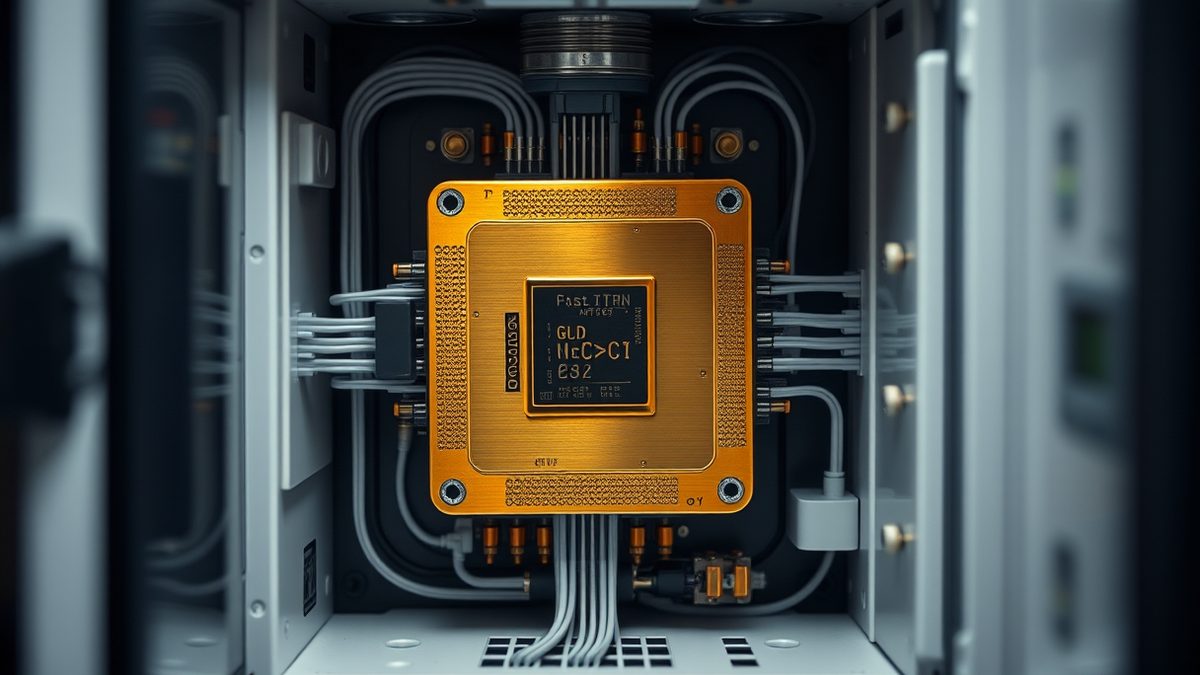
FirstQFM reports a 56.1% win rate
FirstQFM announced in early November 2026 that its quantum reservoir computing system posted a 56.1% series-level win rate in zero-shot predictive accuracy against leading classical time-series models, Yahoo Finance reported. The benchmark covered 41 daily financial return forecasting tasks across individual equities, global indices, crypto assets and commodities.
The win rate is a majority, not a rout. It means the system beat the classical baselines on 56.1% of the 41 held-out series, a small sample against the breadth of financial markets. FirstQFM reported a mean squared error of 0.000485. On its chart, scaled by 10,000, FirstQFM's figure was 4.85 and the classical baselines were 9.20 or higher. The baselines were time-series foundation models from Google, Amazon and Salesforce.
Simulated reservoirs, then Rigetti hardware
The first reservoirs were simulated, not run on a chip. FirstQFM generated them at the edge of classical simulability with NVIDIA's cuQuantum SDK and cuTensorNet libraries on the Leonardo supercomputer, a EuroHPC-backed machine. The 56.1% win rate came from that zero-shot benchmark.
Final benchmarking runs took place on Rigetti's multi-chip superconducting hardware. There, FirstQFM reported average directional forecasting accuracy of 54.74% and a peak single-series MSE reduction of 52.95% on major indices including the DAX 30 and Dow 30.
How the system works
Quantum reservoir computing is a hybrid sequence-modelling setup. A low-depth quantum circuit acts as a high-dimensional feature generator, evolving under many-body dynamics. A lightweight classical readout layer turns measurements into a forecast. FirstQFM says its foundation models adapt the reservoir to the processor's physical state and to the data stream's structure, rather than using one fixed reservoir for every task. The company presented the approach as an application for noisy intermediate-scale quantum devices, the hardware that exists before error correction arrives.
FirstQFM has opened beta system applications for selected pilot partners to address multi-variable enterprise time-series with irregular data sampling, missing variables and shifting operational constraints.
Why Rigetti matters
Rigetti supplies the processors that outside developers such as FirstQFM access. It does not sell financial software of its own, Yahoo Finance reported. That makes the pilot a reference case for Rigetti's hardware in financial services, a large pool of potential customers that already pay for forecasting tools.
Rigetti's 108-qubit Cepheus-1-108Q has a median two-qubit gate fidelity of 99.1%. The company says that leaves room for improvement before error-sensitive commercial workloads. The pilot matters because Rigetti's revenue base is still small: it booked $5.1 million of revenue in the second quarter of 2026 and an operating loss of $28.1 million. It held $541.3 million in cash, cash equivalents and available-for-sale investments at 30 June, with no debt.
What to watch
Yahoo Finance named the signal to watch: whether Rigetti reports further commercial or research contracts that reference quantum reservoir computing or similar finance workloads over its next earnings updates. Concrete mentions of new paying users building on Cepheus-1 or Novera systems would show that the work has moved past a single pilot.
Rigetti is already shipping smaller machines into research settings. It will deliver a 9-qubit Novera system to the Pittsburgh Supercomputing Center's TangleLab testbed, funded by a National Science Foundation grant. It is also fulfilling on-premises systems, including a 108-qubit programme for C-DAC in India. The benchmark is one reference case, not evidence of a product line.
Sources
28- 01Rigetti Computing (RGTI) Powered A Quantum Forecasting Breakthrough In FinanceEN
- 02FirstQFM and NVIDIA Deploy Machine Learning Foundation Models to Accelerate Quantum Reservoir ComputingEN
- 03Rigetti Computing Reports Second Quarter 2026 Financial ResultsEN
- 04Quantum Computing Price Prediction: IonQ at $43.91, Rigetti at $15.74EN
- 05Not IonQ. Not Rigetti Computing. This Quantum Computing Stock Is the One I'd Buy and Hold Through 2030.EN
- 06Amazon Quantum Forecast Ignites Rally: D-Wave, Rigetti and IonQ Race for Commercial BreakthroughEN
- 07Not IonQ. Not Rigetti Computing. This Quantum Computing Stock Is the One I'd Buy and Hold Through 2030.EN
- 08Cologne and RWTH Aachen Researchers Test Predictions for Topological Quantum ComputingEN
- 09Claude can now analyze your spending with its new Personal Finance toolEN
- 10ORNL, IBM, and AMD Launch New Co-Design Platform for Quantum Error CorrectionEN
- 11Quint Computing raises €9.1 million for development of fault tolerant quantum computing architectureEN
- 12Universal Quantum launches iQPU to help efficiently scale quantum computersEN
- 13 SpaceX's plan to build more data center compute than Google's entire lifetime capacity in just 1.5 years is possible, say analysts EN
- 14Turning Conv2D Into A Practical GPU Compute PatternEN
- 15FINCOSMOS: An Open-World Evaluation Paradigm for Agents in FinanceEN
- 16FARR: Forecast-Aware Residual Refinement with Matched Endpoint Evidence for Long-Horizon Time-Series ForecastingEN
- 17Big Models, Small Gains: Frozen Forecasters as Classifiers on MONSTEREN
- 18Scenario Augmentation for Rare Financial Events via Multimodal Latent DiffusionEN
- 19Two-stage residual learning for calibrated uncertainty in solar irradiance forecastsEN
- 20Echoes of Error: Residual-Directional Local Rollout Consistency for Timeseries ForecastingEN
- 21Trump’s Crypto Vehicle World Liberty Financial to Buy Back Tokens After Post-Election Nose DiveEN
- 22Claude’s new Personal Finance tool aims to help analyze your spending – read-only, of courseEN
- 23IEEE Computer Society Chapter Offers Webinars With Industry ExpertsEN
- 24Federal Reserve Board announces termination of enforcement action with Allegiant United Holdings, LLC, Nano Financial Holdings, Inc., and Nano BancEN
- 25What Makes a Quantum Company Valuable?EN
- 26Optimum forms group to explore 'potential strategic and financial transactions'EN
- 27Will Islamic Finance Expand Financial Inclusion in Uzbekistan?EN
- 28Lumen redefining networking for AI and quantum eras with three new initiativesEN
All figures and quotations in this text come from the sources listed below.
Content prepared by the editorial team with AI assistance.
Grace Okonkwo
Comments
0- No comments yet — be the first.