Private fusion hits a batch of firsts in 2026, but net power stays out of reach
Helion said its Polaris prototype became the first privately developed fusion machine to run on deuterium-tritium fuel and reached plasma temperatures of 150 million degrees Celsius, one of at least four firsts claimed by private fusion companies in 2026.
 Sofia MarchettiScience and health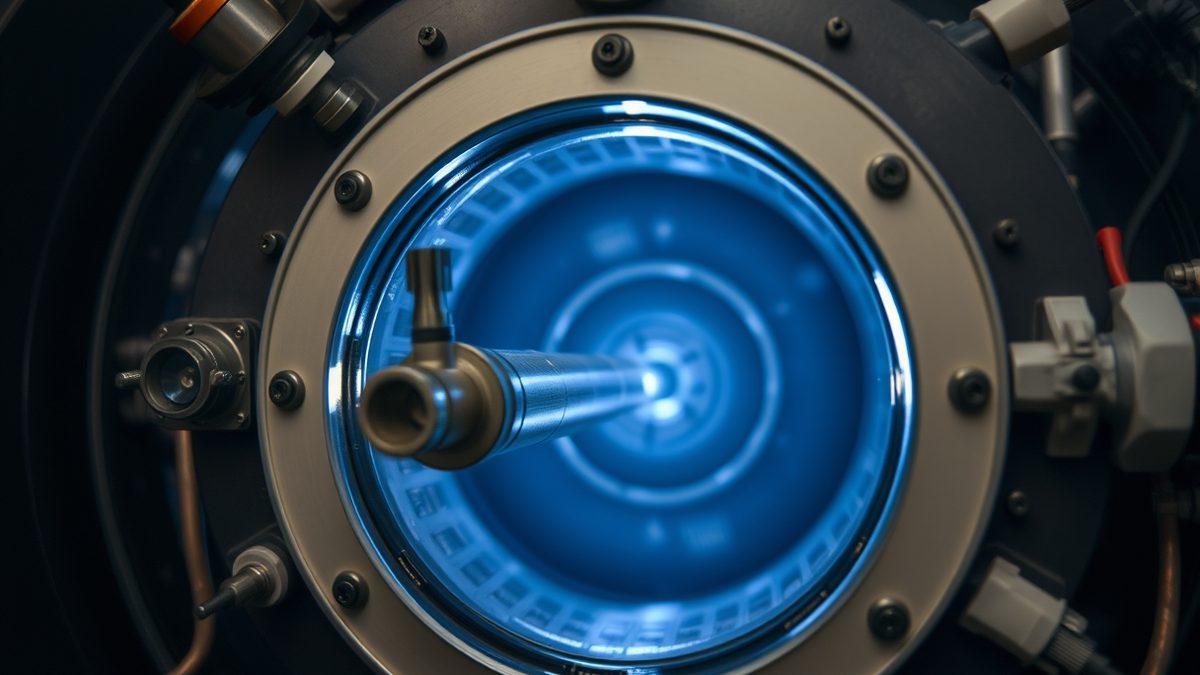
Helion's announcement, published on its newsroom on 14 February 2026 and dated 13 February, says Polaris is the first privately developed fusion energy machine to demonstrate measurable deuterium-tritium (D-T) fusion and to hit 150 million degrees Celsius. That second figure beats the 100 million degrees Celsius Helion's sixth-generation Trenta prototype set, a record the company also held. Within the industry, 100 million degrees Celsius is treated as the threshold temperature for a commercially relevant machine.
Numbers first, because they are the part that is checkable. 150 million degrees Celsius. 100 million degrees Celsius from Trenta. Helion says it began operating Polaris, its seventh-generation prototype, at the end of 2024, and that in January 2026 it became the first and currently only private machine to use deuterium-tritium fuel.
What the company actually claims
Helion is careful in its own write-up about what D-T operation means. The company calls thermonuclear fusion with D-T fuel "one step in Polaris' testing program." The fuel it intends to use commercially is deuterium-helium-3, not D-T. So the milestone that generated the headline is a stepping stone, not the destination, and Helion says so.
The company also notes it was the first to receive regulatory approval to possess and use tritium for demonstrating fusion energy production. That is a licensing fact, not a physics result, and it matters for a different reason: tritium handling is one of the practical bottlenecks that separates laboratory demonstrations from power plants.
Two outside experts are quoted in the Helion release. Ryan McBride, described as an expert in inertial confinement fusion, pulsed power and plasma physics, with experience as a department manager at Sandia National Laboratories and as a professor at the University of Michigan, said: "It is exciting to see evidence of D-T fusion and temperatures exceeding 13 keV or 150 million degrees Celsius, and I look forward to seeing more progress." Dr. Alan Hoffman, who the release describes as a leading expert on FRC plasmas with over 40 years' experience, said he continues to see the technology scaling and Helion's plasma energy recovery enabling the technology for commercial scale.
Jean Paul Allain, Associate Director for Fusion Energy Sciences in the Department of Energy's Office of Science, is also quoted. He said the data indicates "strong progress" and that getting fusion on the grid requires approaches enabling rapid turnaround in design and testing.
"We believe the surest path to commercializing fusion is building, learning and iterating as quickly as possible," said David Kirtley, co-founder and CEO of Helion.
Kirtley's quote is the strategy statement behind the whole release: seven prototypes built and operated, each with more ambitious goals than the last. That is an argument about method, and it is worth separating from the measurements themselves.
Three other firsts, three other companies
Helion is not alone in claiming a first this year. On 27 May 2026, Thea Energy announced a $100 million Series B led by Thomas Tull's US Innovative Technology Fund, with participation from General Innovation Capital Partners, Linse Capital and others. Thea is commercializing the stellarator, the twisted magnetic confinement architecture that spun out of Princeton University and Princeton Plasma Physics Laboratory in 2022.
Thea's claim to a first is narrower and technical: it says it built and operated the world's first superconducting magnet array capable of making the complex and precise magnetic fields required for commercial stellarator systems. The company also says it was the first awardee to receive the Department of Energy's certification of a preconceptual design milestone, for its Helios plant. The funding will add a second magnet manufacturing facility in Northern New Jersey and support siting and construction of Eos, a large-scale integrated stellarator. Thea says it will pick a site for Eos later this year and double its team.
The pitch from Gaetano Crupi, a managing director at USIT, is that prior 3D stellarator magnets made the system impractical to build, and that Thea's approach shifts complexity from precision mechanical fabrication to software-defined controls. That is a claim about manufacturing economics, not plasma physics, and it is the kind of claim that only gets settled by building the machine.
Then there is Realta Fusion. On 19 June 2026, Realta said it became the first private fusion company to demonstrate direct energy conversion (DEC) of plasma kinetic energy into electricity, working with the University of Wisconsin-Madison on the Wisconsin HTS Axisymmetric Mirror (WHAM) device.
The detail here is unusually honest for a press release. Realta states plainly what the demonstration was not: neither net electricity production nor large-scale conversion of fusion-born power. The converter, a single-stage device with three meshed grids, drew multiple amps at around 100 volts, which Realta says is enough to illuminate a few lightbulbs. A Qsci = 5 DT plasma would make alpha power equal to the input power needed to keep the plasma running, but WHAM uses only deuterium, so most of the converted energy came from input power the team supplied.
The international baseline
Against all this, ITER. CNET reported on 26 May 2026 that the international project in southern France carries an estimated cost of $22 billion and is designed to contain plasma at 150 million degrees Celsius, the same temperature Helion says Polaris reached. Cracks in the piping of ITER's heat shield were found in 2020, along with welding distortions and COVID-19 disruptions, leading to a years-long delay and an additional $5 billion in repair costs.
Laban Coblentz, ITER's chief strategic advisor, told CNET that the collaboration between China, Russia, the US, Europe, Korea, India and Japan was "either genius or insane." Javier Artola, a scientist modeling ITER's plasma behavior, framed it differently: "This is a publicly funded project. It is the knowledge of the world."
That framing points at something the private announcements tend to leave out. ITER is not a competitor racing Helion to a grid connection in the way headlines suggest. Every problem ITER publishes is one fewer problem for private companies, and every member state of the agreement, more than 30 countries, gets access to the science. The CNET piece makes the case that publicly funded work de-risks the research and development that commercial fusion needs.
What is still missing
No company in this batch has demonstrated net electricity from fusion. Realta says so explicitly about its own result. Helion's 150 million degrees Celsius is a temperature, not a power balance, and its commercial fuel, deuterium-helium-3, has not been the subject of a comparable announcement. Thea's magnets are hardware, not a working power plant.
The commercial timelines are public and aggressive. TechCrunch reported on 28 September 2026 that Helion is developing Orion, a 50-megawatt fusion power plant intended to supply electricity to Microsoft beginning in 2028, and that Helion announced a key regulatory milestone in June. Helion began building on the Orion site in Malaga, Washington, in July 2025, according to its own release. Its Series G round, initially announced at $465 million in June, closed at $500 million in September, TechCrunch reported.
Commonwealth Fusion Systems, working toward its ARC plant through the SPARC demonstration machine, applied to PJM Interconnection in April, the first fusion company to do so, and raised another $1 billion in July for a total of $4 billion. Both companies' leaders are scheduled to speak at TechCrunch Disrupt 2026 in San Francisco from 13 to 15 October.
Read together, the 2026 results describe a field that has gotten good at announcing specific, defensible technical firsts while the thing that would actually matter, electricity on the grid at a cost someone will pay, remains ahead. The temperature records and licensing approvals and magnet arrays are real. So is the gap between them and a power plant.
Sources
5- 01Helion Achieves New Fusion Energy MilestonesEN
- 02A look inside ITER, the world's largest fusion energy projectEN
- 03Thea Energy Raises $100M Series B Funding to Build Scalable Fusion Power PlantsEN
- 04A Fusion First: Realta Demos Direct Energy ConversionEN
- 05Commonwealth Fusion Systems' Brandon Sorbom and Helion's David Kirtley on bringing fusion to the grid at TechCrunch Disrupt 2026EN
All figures and quotations in this text come from the sources listed below.
Content prepared by the editorial team with AI assistance.
Sofia Marchetti
Comments
0- No comments yet — be the first.