AI speeds chip work as advanced production stays concentrated at TSMC
NVIDIA's 3 November blog post describes an AI-defined fab and says Applied Materials' ACE+ platform runs topography simulations up to 35 times faster with PhysicsNeMo. TSMC puts advanced processes at 79% of wafer revenue in the third quarter of 2026.
 Dr. Amara PatelEconomy, business and world
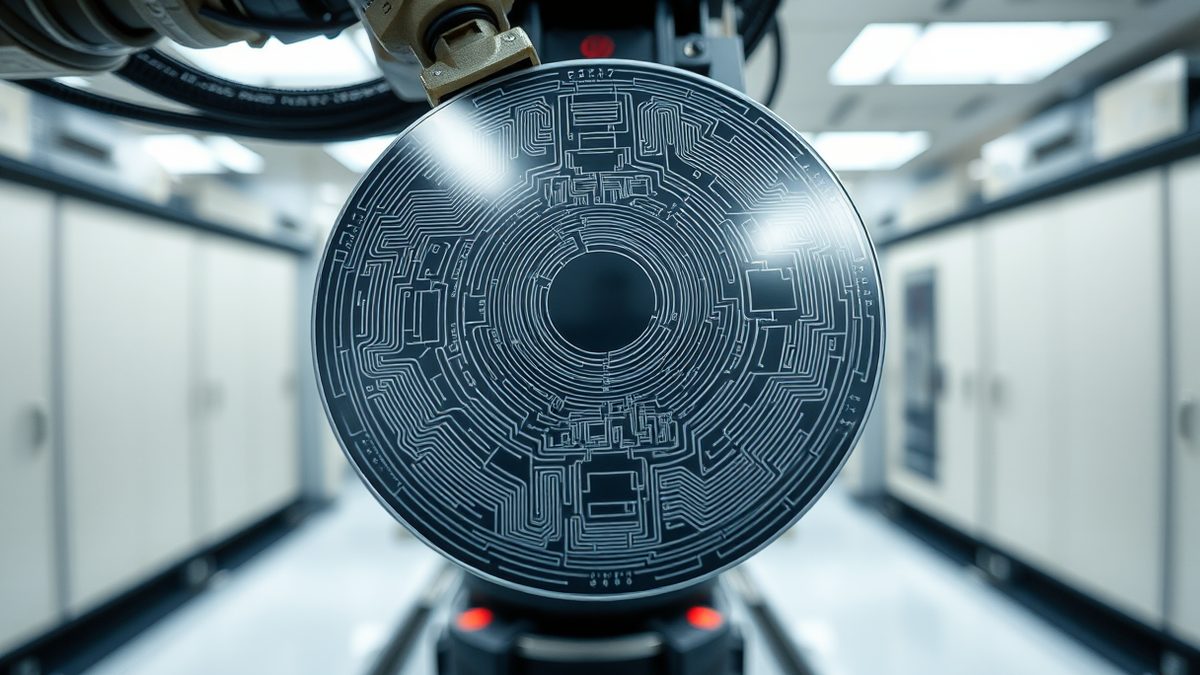
AI tools move onto the fab floor
NVIDIA published a blog post on 3 November describing what it calls an AI-defined fab. The short version: AI helps engineers optimize processes and catch problems earlier. It also helps them make decisions across the manufacturing lifecycle.
The post lists a series of speed-ups. COMSOL is accelerating multiphysics simulations for semiconductor manufacturing by up to 10x using NVIDIA's cuDSS library. Applied Materials' Ginestra simulation platform runs up to 10x faster than CPU-only approaches with cuDSS. Its ACE+ platform delivers topography simulations up to 35x faster using PhysicsNeMo. Siemens is integrating cuLitho into its Calibre lithography software. NVIDIA says that brings up to 17x acceleration on key simulation workloads. The case rests on a simple constraint. Physical experiments on a fab line are slow and expensive. A wrong call on yield or process quality has real consequences.
NVIDIA also describes digital twins. They let teams test changes in a virtual environment before committing to physical trials. The company says engineers still direct the work and decide from their own expertise. They spend less time waiting for answers.
Faster simulation changes how many alternatives an engineer can test. The engineer can test them before committing to a physical trial.
Why simulation speed matters
Computational lithography defines how circuit patterns are printed onto silicon. It involves calculations too intensive to finish on a CPU at production scale, according to NVIDIA. Accelerating them expands what engineers can verify before a wafer goes to print. In some cases, acceleration does not just shorten a calculation. It makes it possible at all, the post says. The post also says AI trained on physics can predict how materials and processes will behave. It can do so without running a full simulation each time. NVIDIA says Lam Research demonstrated that its PhysicsNeMo framework can predict plasma behaviour. That is one of the costlier modelling problems in etch. Multiphysics simulations model interactions among heat transfer, electrical behaviour and mechanical stress. That is why solver speed matters. NVIDIA's examples span simulation, materials discovery and lithography.
Where those tools land matters because the most advanced production is concentrated. TSMC said advanced manufacturing processes accounted for 79% of its wafer revenue in the third quarter of 2026.
The figure covers wafer revenue only, as TSMC reported it.
The AI demand is concentrated at TSMC
TSMC's third-quarter revenue rose 41.2% year over year to $46.7 billion. High-performance computing includes AI applications. It accounted for 68% of total revenue, up from 57% a year earlier. Intel reported $16.5 billion of revenue in the same quarter, up 21%. It is working to regain momentum after years of challenges. Its Data Center and AI division grew 78% to $7.3 billion. The PC-focused business fell 5% on softer consumer demand and competitive pressure. Motley Fool's comparison says Intel still faces an uphill battle. It faces the task of restoring manufacturing competitiveness and improving profitability. Substantial capital requirements add uncertainty. For buyers, the split matters less than capacity. Intel's PC business declined while its server chips grew. That points to demand shifting toward data centre silicon rather than disappearing.
Intel's Data Center and AI division grew faster than TSMC's whole business. It did so from a much smaller base.
Design is moving in the same direction, according to an industry figure. He spoke at a science forum in Shanghai on 30 October. Chen Yunji is co-founder of AI chipmaker Cambricon Technologies. He predicted that the integration between AI and chip design would eventually automate the chip design process entirely.
"In the [next] 10 years, the most important development ... is the RSI (recursive self-improvement) techniques for artificial intelligence, where AI models improve AI models, and AI chips improve AI chips." Chen Yunji, co-founder of Cambricon Technologies, at a forum in Shanghai on 30 October
Taiwan risk and fragmented planning
Motley Fool's comparison of the two chipmakers flagged a risk. TSMC's geographic concentration in Taiwan, amid geopolitical tensions, is worth acknowledging. It credited TSMC with a critical position in the AI supply chain. It also credited TSMC with the pricing power that comes with leading-edge manufacturing. Robin Saxby is Arm's founding chief executive. He described a related shift in how chip leaders plan. He spoke to EE Times in an interview published on 30 October. He said semiconductor design and manufacturing were inherently global during his career at Motorola, ES2 and Arm. Today's leaders face localized legislation and geopolitical tensions, he said. Those include the various CHIPS Acts and Brexit in the UK.
"Unfortunately for any CEO today, making decisions long-term, like investments and so on, is a lot more difficult than when I was a CEO." Robin Saxby, to EE Times
Saxby was knighted in 2002 and retired from Arm in 2007. He said modern silicon design has moved beyond flat layout sheets into 3D, multi-variable engineering problems. He argued that success depends on balanced, specialized teams. It does not depend on one engineer mastering the whole stack. 3D packaging, AI tools and large software integration raise the bar. He spoke at the TechWorks S2S Summit 2026 in West London.
The practical question for buyers is where the next generation of advanced chips gets made. TSMC's advanced processes accounted for 79% of wafer revenue. High-performance computing accounted for 68% of total revenue. Neither figure says how much of that output sits in Taiwan. Motley Fool does not break it down. What none of this settles is adoption. NVIDIA's post describes tools and speed-ups. It does not say how widely they run in mass production. TSMC's reported figures cover revenue mix. They do not say which simulation software sits behind it.
Sources
5- 01AI Is Changing How Semiconductor Fabs Work, and Engineers Are Moving Faster Because of ItEN
- 02Intel vs. Taiwan Semiconductor: The AI Boom Is Telling Two Very Different StoriesEN
- 03AI, fuelled by advanced chips, set to power semiconductor manufacturing: industry veteranEN
- 04Exclusive: Sir Robin Saxby Reflects on Impact of AI, Geopolitics, and RetirementEN
- 05Decouple Taiwan From China-Vatican NegotiationsEN
All figures and quotations in this text come from the sources listed below.
Content prepared by the editorial team with AI assistance.
Dr. Amara Patel
Comments
0- No comments yet — be the first.