Japan's rice glut drives an eighth straight weekly fall in retail prices
Japan's average retail price for a 5 kg rice bag fell to 2,860 yen in the week to 4 October, the eighth straight weekly decline, Mainichi reported on 16 October [6]. Two years after a nationwide shortage, a surplus is pushing farmgate prices down.
 Dr. Amara PatelEconomy, business and world
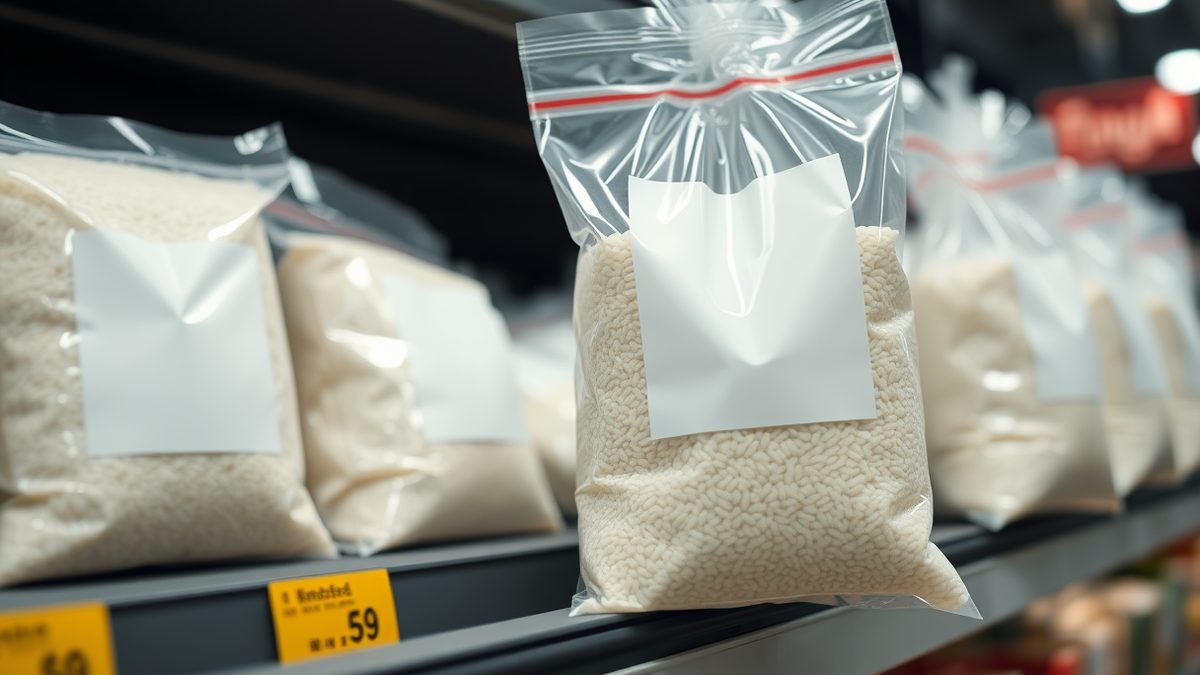
Eight weeks of falling prices
The survey covers about 1,000 supermarkets nationwide. The average fell 66 yen week on week and stayed in the 2,000 yen range for a fourth straight week, Mainichi reported [6]. The same bag peaked above 4,400 yen in January, according to Business Times [3].
Shoppers pay far less than at that January peak [3][6]. Growers do not. High prices in 2025 pushed farmers to plant more. The resulting surplus is now dragging farmgate prices down [2][3]. Two things remain open. The first is whether the ministry buys more than the 210,000 tonnes it has already committed to. The second is how far September rain cut this year's crop [5].
Supply remains large. The agriculture ministry forecasts the 2026 harvest at 7.4 million tons, down about 1% from 7.47 million tons in 2025 [5]. Production exceeded 7 million tons for the first time in four years in 2025 [5].
A ministry official said the actual harvest could be lower once the impact of prolonged rain is counted. The official added that supply is unlikely to fall short of demand [5].
How the shortage became a surplus
The shortage had a physical cause. In 2023, abnormal heat and drought damaged the rice crop during grain filling. This cut the volume of top-quality rice suitable for sale [2]. Demand rose at the same time. A tourism boom came first, then panic buying after an earthquake warning [2][4]. Private stocks fell from their usual level of around 2 million tonnes to about 1.5 million tonnes [2]. By mid-2026 they had climbed to 2.43 million tonnes, above the old normal [2].
Japan released emergency reserves in 2025 for the first time since the system was established in 1995 [2].
In February 2025, farm minister Taku Eto announced the release of 210,000 tons. Of that, 150,000 tons would go first. The remainder would be added as distribution conditions warranted, the Asahi Shimbun reported [4]. The ministry had refused to tap the stockpile even after the earthquake warning. It said prices would settle once the new harvest arrived [4]. The government ultimately sold off 590,000 tonnes, about a month's supply [3].
The internal affairs ministry's price data showed a 5 kg bag of Koshihikari rose from 2,414 yen in June 2024 to 3,775 yen by December that year [1].
The buyback and the farmers
In September, the government decided to buy 210,000 tonnes to restore the reserves it had used [2][5]. That matches, tonne for tonne, the volume Eto released in February 2025 [4]. Prices kept falling anyway. Producers and distributors asked for further buybacks [5].
Hiroshi Asano, who farms 38 hectares in Chiba, expects to make a loss in 2026 [3]. He worries smaller farmers will not survive [3].
Asano said JA is paying him less than 15,000 yen per 60 kg of unprocessed rice in 2026, down from 30,000 yen the previous year [3]. In Tochigi, Nobuyuki Okada shipped rice for as much as 35,000 yen per 60 kg last year, about twice the usual price, Mainichi reported [6]. This year JA's advance payment to him is about half the 30,000 yen range of 2025 [6].
Okada, 41, farms 20 hectares in Sakura, Tochigi [6]. Several wholesalers told him around June, after planting, that they could not buy rice this year [6].
Extremes of weather, including record rainfall in recent weeks, rising machinery costs and lower prices have compounded the problem, Business Times reported [3].
The workforce is shrinking too. The number of farmers dropped from 2.4 million in 2000 to less than a million in 2026, the agriculture ministry says [3]. About 70% of people whose primary occupation is farming are over 65 [3].
The average age of a rice farmer is 67.7 years. Only 1.2% are under 30 [2].
Why the market flipped
Business Times reported that official forecasts failed to predict how far consumption would fall as prices rose and eating habits changed [3]. The 2025 harvest exceeded demand as a result [3]. Government stockpiles are now far below the optimal level of around 1 million tons [5].
Private rice inventories had reached a record high because of releases since March last year and increased production, the Japan Times reported [5].
In parts of the market, 2025 rice is retailing above 2026 rice, as sellers try to trim losses on grain bought at high prices, Mainichi reported [6].
The 2026 forecast used the actual harvest and grain counts as of 25 September, when about 60% of the crop had been harvested [5]. Prolonged rain and a lack of sunshine delayed the survey in some areas [5].
A Note analysis published on 25 October argued the agriculture ministry misread demand and was slow to release reserves [7]. It also argued that JA's dual role, supporting farmers while setting the benchmark collection price, hid how prices form [7].
Heat-resistant varieties account for no more than 20% of plantings. Drought in western Japan this year is already linked to lower yields [2].
Kimio Inagaki, a fellow at Mitsubishi Research Institute, said prices are likely to keep declining even if the government replaces its reserves, Business Times reported [3].
What happens next
Agriculture minister Kazuo Yana said the government will work to restore the stockpile "without missing opportunities while carefully assessing the supply-demand balance" [5]. The ministry has not announced a date for buybacks beyond the 210,000 tonnes [5]. The detailed harvest figure as of 25 October is due in mid-November [5].
Sources
20- 01Massive rice reserves ready for release amid steep price hikesEN
- 02Japan went from a rice shortage to a record surplus in two yearsEN
- 03Japan veers from rice shortage to glut, dealing blow to farmersEN
- 04210,000 tons of government rice to hit stores in late MarchEN
- 05Japan's 2026 rice harvest projected to fall 1%EN
- 06In reversal of 2025 fortunes, Japan rice farmers face falling prices as new harvest arrivesEN
- 07Examining the Reiwa Rice Crisis: Production Adjustment, Subsidies, JA, and Farm ManagementEN
- 08Japan's Future Starting from a Single Stalk of RiceEN
- 09China wafer prices steady on firm polysilicon amid weak fundamentalsEN
- 10Baidu releases ERNIE 5.5 Flash Base with 280 billion parameters as an open-source foundation modelEN
- 11Tencent releases Hy4 with vision and computer use, claims second place among Chinese AI modelsEN
- 12Sierra Club Releases Post-Election Congressional Policy Blueprint to Reduce Costs, Preserve Public Lands, and Make Polluters PayEN
- 13High gas prices are pumping up used EV sales: these are FLYING off the lotEN
- 14Federal Reserve Board announces termination of enforcement action with Allegiant United Holdings, LLC, Nano Financial Holdings, Inc., and Nano BancEN
- 15What Bangladeshi Prime Minister Tarique Rahman Brought Home From JapanEN
- 16 Rocket Lab launches Japanese Earth-observing satellite on 99th mission to date (video) EN
- 17Red Hat Patches 9.8-Rated Linux TCP RCE Flaw While Ubuntu Releases Fixes for TestingEN
- 18On a Remote Island, Japan Puts Its Deep-Sea Mining Ambitions on DisplayEN
- 19Federal Reserve Board announces approval of application by The Bank of Nova ScotiaEN
- 20Federal Reserve issues FOMC statementEN
All figures and quotations in this text come from the sources listed below.
Content prepared by the editorial team with AI assistance.
Dr. Amara Patel
Comments
0- No comments yet — be the first.