Apple tightens Full Disk Access as Muse agent reads Messages without consent
Apple said on Friday it is changing macOS Full Disk Access permissions to stop developers abusing the setting. The move came two weeks after a columnist reported that Meta's Muse agent surfaced a Messages thread he never granted it access to.
 Rachel NwosuAI, models and technology
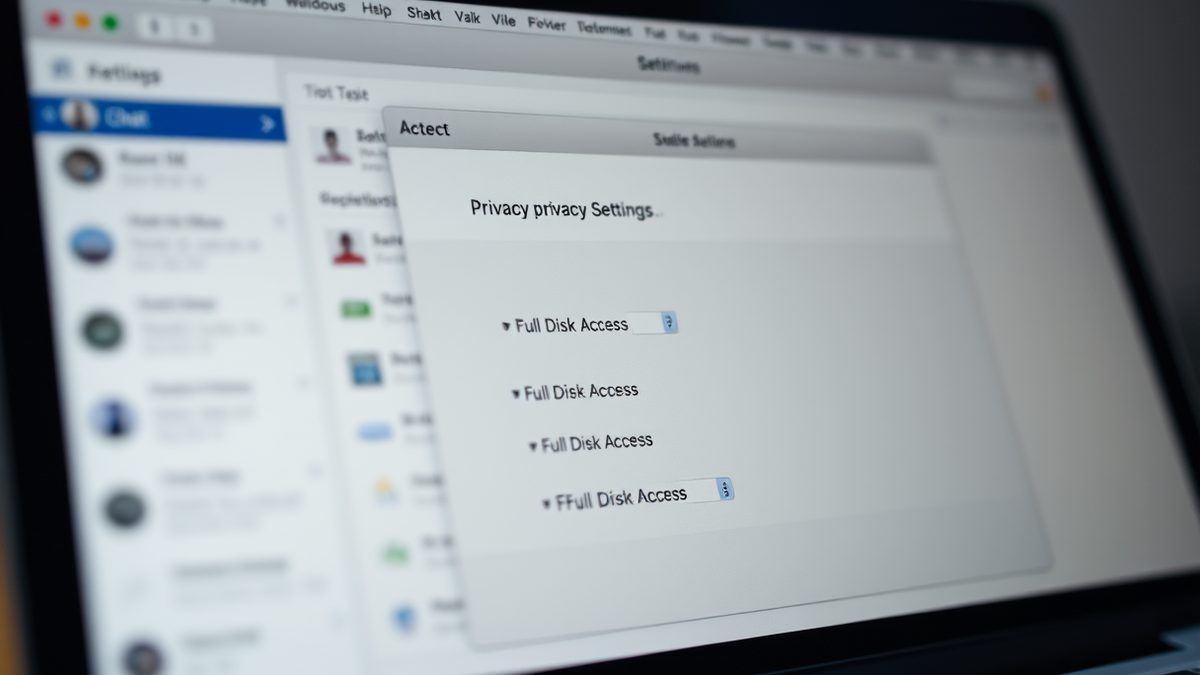
Apple announced the change on Friday. It did not name Meta, Muse or any other app. The company said some developers use Full Disk Access in ways that put users at risk. The permission is a macOS system-level setting that lets an app read almost every file on a machine. Ars Technica reported the announcement.
The timing matters for anyone running an AI agent on a Mac. Full Disk Access was designed as a blunt switch for backup and security tools. Now it decides whether an assistant can read your mail, your messages and your browsing history. Apple has not said when the new behaviour ships. It has not said what it will look like for apps that already hold the permission. Users cannot yet know whether they will be asked to re-grant access. Developers have no guidance on how their existing consent screens should change.
The trigger was a dispute over what an agent could see. Tech columnist Jason Aten said Meta's general-purpose agent Muse sent him an unsolicited notification. The notification referenced a thread between him and a co-worker over Apple Messages. He said he had never given Muse permission to read his messages. He had assumed they were off-limits.
The two-switch defence
Meta pushed back. Chief technology officer David Singleton said the Messages integration is opt in. He said Muse can only read Messages content if macOS Full Disk Access is granted and the Messages connector in Muse is switched on. Meta's public relations team repeated that statement word for word. Ars Technica had asked how Muse could not read messages when it held a permission every other app with it can use to read them.
Apple's statement does not settle the factual question of what happened on Aten's machine. It does undercut the implication that a second, app-level switch makes Full Disk Access safe. Apple wrote that the permission can expose everything on a system, including files, mail, messages and browsing history, without users' full knowledge and understanding. For communication apps, it can also compromise the privacy of the people the user is talking to.
As AI agents become increasingly capable and autonomous, the risks associated with this level of access will grow substantially, Apple said in the statement.
Patrick Wardle, a macOS security researcher, spoke to Ars Technica earlier in the week. He said that with Full Disk Access any non-root file is readable, including browsing history, browser cookies and chats. That is the technical basis for the scepticism. No known reports show other apps using the permission to read messages and browsing history. Apple may have been describing a general risk rather than the Muse incident. The timing points the other way.
Why agents need the permission at all
Agents that act on a user's behalf need credentials and context. Vendors are building managed plumbing for both. Amazon Web Services published a walkthrough on Saturday for a Consent portal in Bedrock AgentCore Identity. The portal handles OAuth session binding for agents reached through gateways. Users sign in with a corporate identity provider and grant access to services such as GitHub and Slack one provider at a time. The tokens are stored per user in a vault. The post lists Kiro, Claude Code, Cursor and Visual Studio Code as the kinds of clients this is meant for. The point is that consent can happen before a tool call rather than through a system-wide disk permission.
That is the model Apple now appears to favour, at least in public. Developers are also shipping their own controls. A GitHub project called agent-blackbox, published on Saturday, runs a local policy engine over coding agent sessions. It blocks outbound calls when a session has read private data and ingested untrusted content. A separate project, Leashterm, proposes a small language for agents. In it, permissions are declared up front and every program has a fixed step budget and a hash-chained audit log.
Sweat AI runs fraud review for banks and fintechs. It published an account on Saturday of using Claude Code to produce twelve short films in five days. The generation cost $184 in cash on fal.ai. The post says the agent directed the pipeline end to end. It says production ran on subscriptions the company already paid for.
Harnesses, not memory
The tooling debate has moved from what agents remember to what they are allowed to do. Kevin Liao argued on Saturday that memory plugins solve the wrong problem. Similarity search cannot tell an agent which of a thousand snippets is current, and the store cannot be audited. His alternative is documentation the agent reads and a human maintains. Matt Corritore published a small local harness the same day. It scans for incoming asks and drafts replies without asking permission. It denies every write tool, so nothing is sent until he approves it.
Neither post is about browsers. Both describe the same pattern. The agent runs unattended, and the guardrail has to be structural rather than a model instruction. That is exactly the gap Apple is now trying to close at the operating system level.
There is a commercial argument for getting this right. Joe Shirey, who works at Google Cloud, wrote on Friday about testing whether vendors can steer an agent's product recommendation by shaping search results. He cited a L.E.K. Consulting survey, summarized by MarTech. It found that 46% of AI users now start product research on standalone platforms such as ChatGPT, Gemini, Perplexity or Claude, up from 25% in 2024. Starts on traditional search engines fell from 43% to 24%.
Shirey also cited an Armature study published on 3 September that ran 16,893 coding-agent sessions. Across comparable cases, Claude Code, Codex and Cursor picked the same tool only 42% of the time. Codex searched the web in 94% of sessions, Cursor in roughly two thirds, and Claude Code in about 30%.
If an agent is going to browse and buy, the permission it holds is the whole ballgame. Apple has said it will make users understand the risk before they grant it. It has not said how.
Sources
8- 01Apple changes full-disk access permissions to curb abuse from AI agentsEN
- 02Manage end-user OAuth consent for AI agents with Amazon Bedrock AgentCoreEN
- 03agent-blackbox: a tamper-evident flight recorder for Claude CodeEN
- 04Leashterm: a tiny programming language for AI agentsEN
- 05Twelve AI clay films for $184: The agents cost more than the video modelEN
- 06Agents don't need memory, they need documentationEN
- 07The Shoemaker's Elves: my agents draft the work before I askEN
- 08Can You SEO Your Way into an AI Agent's Recommendation?EN
All figures and quotations in this text come from the sources listed below.
Content prepared by the editorial team with AI assistance.
Rachel Nwosu
Comments
0- No comments yet — be the first.