Beijing Extends AI Travel Curbs to Families as DeepSeek Opens Huawei Toolset
China has expanded overseas travel restrictions on top private-sector AI staff to cover their spouses and children, according to a Bloomberg report carried by Business Standard on 28 September, the same week DeepSeek open-sourced six modules for Huawei's Ascend chips.
 Dr. Amara PatelEconomy, business and world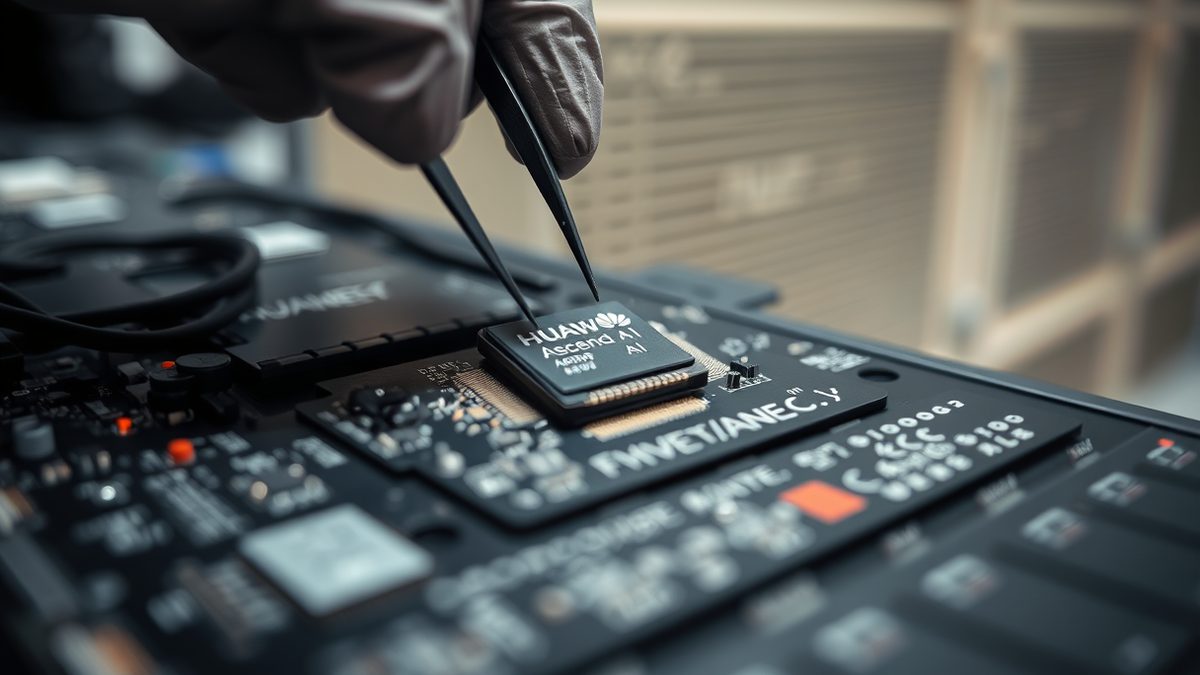
Government agencies have begun telling affected people that direct relatives of certain AI and chip executives now need approval from Beijing before going abroad, even for short trips. The people familiar with the matter spoke to Bloomberg, whose report Business Standard published on 28 September. It is not clear whether all such families fall under the new rules.
The measure widens curbs that already covered the executives themselves. Bloomberg reported in May that China had restricted foreign travel for top AI professionals at private firms including Alibaba and DeepSeek. Until now, the state's travel limits had mostly hit researchers at prominent colleges, nuclear scientists and executives at state firms, with families similarly affected. The shift targets private-sector talent, treated in Beijing as strategic assets.
DeepSeek builds a non-Nvidia stack
On Wednesday, DeepSeek open-sourced six software modules tailored for Huawei's Ascend AI chips. The Hangzhou company said in a post on its official WeChat account that the aim is an "independent and controllable" software ecosystem for GPUs, according to the South China Morning Post. One release is an Ascend-compatible version of TileLang, a language for building high-performance kernels. TileLang lists Nvidia as its primary back end but now officially supports Huawei's Ascend 950 accelerators, the project's GitHub page says, offering native code generation, automatic scheduling and synchronisation.
The timing is not accidental. DeepSeek is mirroring tools it previously published for Nvidia hardware. Its chips push sits inside a broader effort to insulate China's AI stack from US export controls, and it lands while Nvidia and AMD lobby the White House over prospective restrictions. Those lobbying efforts were reported by Politico and Benzinga in the days before the summit, but both sit outside this dossier's source list, so treat them as context rather than a confirmed peg.
Beijing's tolerance for the open-source world is selective. Regulators blocked Hugging Face in 2023, yet Chinese labs still reach it through VPNs. "Not everyone is able to use a VPN all the time," Xu Yong, chief executive of OSChina, told Rest of World. Alibaba's ModelScope, launched in 2022, now hosts more than 170,000 models; OSChina's MoArk, launched in 2023, serves some 20,000. In September, Nvidia said it would buy Hugging Face for $12.9 billion.
Hardware and software move on different clocks
The gap between Chinese and Western infrastructure keeps widening. Geely's 2.2MW chargers, announced last week, are already in service in five cities: Hangzhou, Shanghai, Ningbo, Jiaxing and Xi'an. The company plans 15,000 charging sites by the end of next year, according to Electrek, which cites CarNewsChina and National Business Daily. The unit runs at 1,500V/1,500A but shares power between two heads, since no car can yet accept 1,500V.
Compare that with the US. EVgo said this week it will release 750kW charging next year, roughly twice the current state of the art, after a 2024 partnership predicted availability in the second half of 2026. Yesterday's press release pushed it to 2027, Electrek notes. Geely released a 1.5MW charger in March and added 700kW in six months. BYD installed 10,000 chargers in five months after its own 1.5MW launch.
The demand picture is messier than the engineering one. China's NEV retail sales fell 20% year on year in the first 27 days of September, a steeper decline than the 9% drop in the first 20 days, according to the China Passenger Car Association. NEVs still took 65.7% of passenger car retail sales, down from 67.9% in the earlier window. Overall passenger car retail sales fell 29% year on year to 1.258 million. The CPCA blamed a record September 2025, when buyers rushed ahead of regional subsidy suspensions, for the high comparison base.
Washington's vocabulary shifts
On the US side, the language has moved. The Diplomat noted on 30 September that China-US trade fell by around 30% in 2025 alone, according to the McKinsey Global Institute's 2026 update on global trade. China is now the only country making goods in all 41 industrial categories and 666 sub-categories of the UN classification. McKinsey called it the factory to the world's factories. The "China Plus One" push, in other words, helped China move up the value chain while India, Vietnam and Mexico became assembly lines for Chinese products.
Enforcement is running alongside the diplomacy. The Justice Department and FBI announced court-authorised seizures of two hacking platforms, QScan and QTRouter, built by a group called QTFY and employed by Nanjing Xinjiuwei Network Technology. Targets included Nasa, the Federal Reserve, the Department of Energy and the US Senate. The press release is dated 26 August, making it background rather than news, but it shows the operational tempo against PRC-linked activity.
On the ground, the economic backdrop is weaker than the AI story suggests. David Cheng, writing on the Earned Intuition Substack after a week in Beijing and Shanghai, described unusually light traffic, more young men driving Didi than he had ever seen, and graduates from top universities moving back to smaller cities. He cites youth unemployment at 17.9% in July and July retail sales up 0.6% year on year against an expected 1.5%. In his framing, AI is the one sector the state has decided must work, propped up by subsidised electricity, fast-tracked IPOs and tolerated price wars.
Consumer electronics offer a rare bright spot. Apple took the top spot in China's smartphone market after the iPhone 18 Pro launch on 18 September. Sales in the first three days were 12% higher than the iPhone 17 Pro line-up managed in its entire first week last year, Counterpoint Research found. Apple captured 33% of the market in the week of 14 to 20 September. Ivan Lam, a senior analyst at Counterpoint, attributed part of the lift to the delayed base iPhone 18 pushing buyers toward the Pro series and to price hikes of over $200 on many Chinese flagship models.
Capital markets are responding too. Suzhou Dongshan Precision Manufacturing, a Shenzhen-listed PCB maker, cleared its Hong Kong listing hearing and won China Securities Regulatory Commission approval to issue up to 234 million shares, sources told the South China Morning Post. It initially aimed to raise up to $3 billion, which could rank among Hong Kong's largest fourth-quarter IPOs.
The policy mix, read together
Omdia's outlook for 2027 lists four forces: AI monetisation, persistent supply chain disruption, digital sovereignty and physical AI. More than 100 countries are pursuing digital sovereignty initiatives, the analyst firm says, while 59% of organisations expect AI budgets to rise by 10% or more. Hardware delays already affect 60% of PC channel partners. Humanoid robot shipments are forecast to exceed 700,000 units by 2030.
Energy is the constraint nobody can route around. The IEA projects the sector's energy consumption will rise 30% annually through 2030, when AI is expected to account for 3% of global energy use, according to Sustainability Magazine. Oregon startup Panthalassa, which raised $140m in a round led by Peter Thiel and is valued near $1bn, is testing 85-metre wave-powered nodes that host AI chips in seawater-cooled containers and link to shore only via Starlink.
MIT's Sherry Turkle, whose book "Artificial Intimacy" was published on 29 September, offers a different kind of warning about where this ends. "What a chatbot does is offer pretend empathy," she told MIT News. "After it tells you how much it loves you and how much it understands you, it doesn't care if you kill yourself or cook some pasta."
Put the pieces together and the picture is not a single policy. It is a stack: travel curbs to keep people in, open-source tools to keep software sovereign, charging and chip infrastructure to keep hardware moving, and a consumer market that is contracting underneath all of it. Each layer answers a different fear. None of them answers the demand problem the CPCA data describes.
Sources
13- 01China broadens travel curbs to encompass family of top AI talentEN
- 02China's DeepSeek open-sources tools to help Huawei chips supplant Nvidia in AIEN
- 03The open-source AI platforms vying to become China's Hugging FaceEN
- 04China's 2,250kW chargers are already in service, while US thinks about 750kW next yearEN
- 05China NEV retail sales fall 20% in first 27 days of September as decline deepensEN
- 06Goodbye, 'China Plus One': The Real Change in US China PolicyEN
- 07Justice Department and FBI Seize Platforms Operated and Used by China State-Sponsored HackersEN
- 08Involution Without Export Is Wasted EffortEN
- 09Apple leads China smartphone sales after launch of iPhone 18 Pro. Can the momentum last?EN
- 10Mainland China's PCB giant wins Hong Kong approval for planned US$3b listing: sourcesEN
- 11Four forces set to reshape technology in 2027 - OmdiaEN
- 12Panthalassa's Floating, Wave-Powered Data Centre TechnologyEN
- 13Who we become when we talk to machinesEN
All figures and quotations in this text come from the sources listed below.
Content prepared by the editorial team with AI assistance.
Dr. Amara Patel
Comments
0- No comments yet — be the first.