China Expands AI Travel Curbs to Families as Deepseek Builds Huawei Tools
Beijing has widened overseas travel restrictions for top private-sector AI staff to cover spouses and children, Bloomberg reported on 28 September, while Deepseek on 30 September shipped open-source programming tools for Huawei's Ascend chips.
 Dr. Amara PatelEconomy, business and world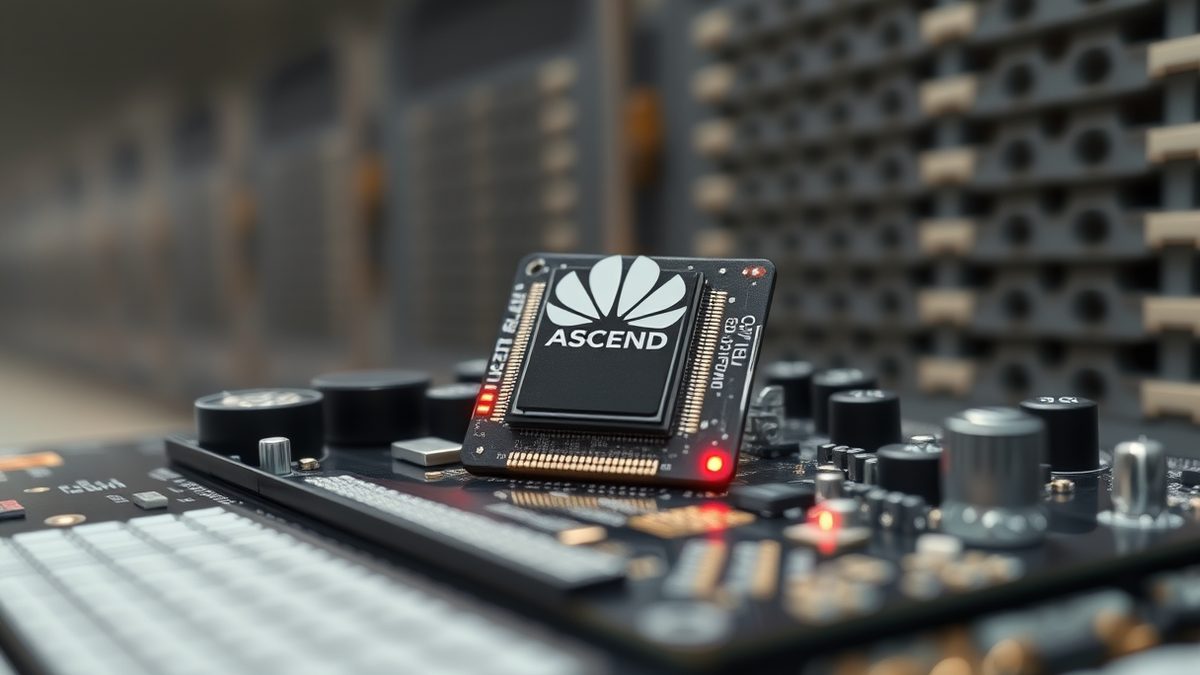
Two stories landed within days of each other, and they point the same way. On 28 September, Bloomberg reported that Chinese government agencies have started telling affected people that close relatives of certain AI and chip executives need Beijing's approval before going abroad, even for short trips. On 30 September, The Decoder reported that Deepseek had published open-source libraries and a programming language for Huawei's AI accelerators, with Huawei's backing and a supernode of 128 Ascend 950 chips optimised by the two companies.
One restricts the movement of people. The other tries to make Chinese hardware usable without American software underneath it.
Who is covered, and what is not clear
Business Standard, which carried the Bloomberg report, says the new requirement is not an outright ban. It applies to founders and heads of strategically important AI firms, and it broadens earlier curbs imposed since earlier this year on staff at private companies including Alibaba and DeepSeek. Bloomberg said it is unclear whether all those families fall under the new strictures. Two people told the outlet that government departments have already notified several individuals that family travel must be cleared. The Ministry of Industry and Information Technology did not respond to a faxed request for comment, the report says.
The same report notes separate rules effective 15 September for enforcing exit bans in criminal investigations and in cases involving industrial and technological security. Beijing plans to add names over time, according to the people cited.
Context matters here. Rest of World reported on 30 September that Beijing blocked Hugging Face in 2023 and tolerates VPN workarounds only because total isolation would starve its own developers of global models. The outlet cites Rebecca Arcesati of the Mercator Institute for China Studies. Her point: China worries that access to US-based platforms could be cut off at any moment, and from Beijing's perspective the ideal is an indigenised stack, from the libraries upward.
The software layer is the target
Deepseek's release reads like that idea written in code. The Decoder reports that TileLang, originally developed by Peking University researchers, is now Deepseek's main tool for its AGI work, having first been tested on Nvidia chips. Nvidia's hold on AI compute does not rest on silicon alone. It rests on an estimated four million CUDA developers, and that ecosystem is the moat rivals have failed to cross. Deepseek is arguing, in effect, that a universal language easier than CUDA is the precondition for any independent ecosystem.
There is a counter-argument worth keeping in view. The Decoder cites SemiAnalysis, which tested OpenAI's inference chip, Jalapeño, and called the CUDA moat "potentially dead" on performance per watt in most scenarios tested. But those scenarios were relatively easy to optimise, around 8,000 input tokens and 1,000 output tokens, and the firm had not yet run AgentX, the multistep agent benchmark where it found Nvidia well ahead in August. Huawei's chips were not part of that comparison.
Reuters, as cited by The Decoder, reported the Deepseek software release. Huawei's current rotating chairman, Eric Xu, said the company cannot accept a future that hinges on whether others are willing to sell chips to China. Huawei plans to sell fewer chips abroad while it cannot meet domestic demand.
What the export push looks like on the ground
A week in Beijing and Shanghai, described by investor David Cheng in Earned Intuition on 30 September, gives the policy a texture. Youth unemployment was 17.9% in July, retail sales rose 0.6% year on year against an expected 1.5%, and Cheng describes AI as the one sector the state has decided must work, subsidised with cheap electricity and fast-tracked listings. The phrase he kept hearing, 内卷 or involution, describes hundreds of labs undercutting each other on price while producing engineering and almost no profit. The line that stuck: if you don't go overseas, all that grinding was for nothing.
Read together, the travel curbs and the Huawei toolchain are the same reflex at different points. Keep the people who know how to build the stack at home, and make sure the stack does not depend on anyone else's software.
Sources
5- 01China broadens travel curbs to encompass family of top AI talentEN
- 02China's AI industry closes ranks as Deepseek ships open-source software for Huawei's Ascend chipsEN
- 03The open-source AI platforms vying to become China's Hugging FaceEN
- 04Involution Without Export Is Wasted EffortEN
- 05China's 2,250kW chargers are in service, US thinks about 750kW next yearEN
All figures and quotations in this text come from the sources listed below.
Content prepared by the editorial team with AI assistance.
Dr. Amara Patel
Comments
0- No comments yet — be the first.