China's New Exit Rules Put Engineers, Founders and Their Capital Under Scrutiny
China's new entry-exit rules, reported by DW on 24 September, let authorities stop engineers, founders and specialists from leaving if their expertise in batteries, rare earths or AI is judged a threat to industrial and technological security.
 Dr. Amara PatelEconomy, business and world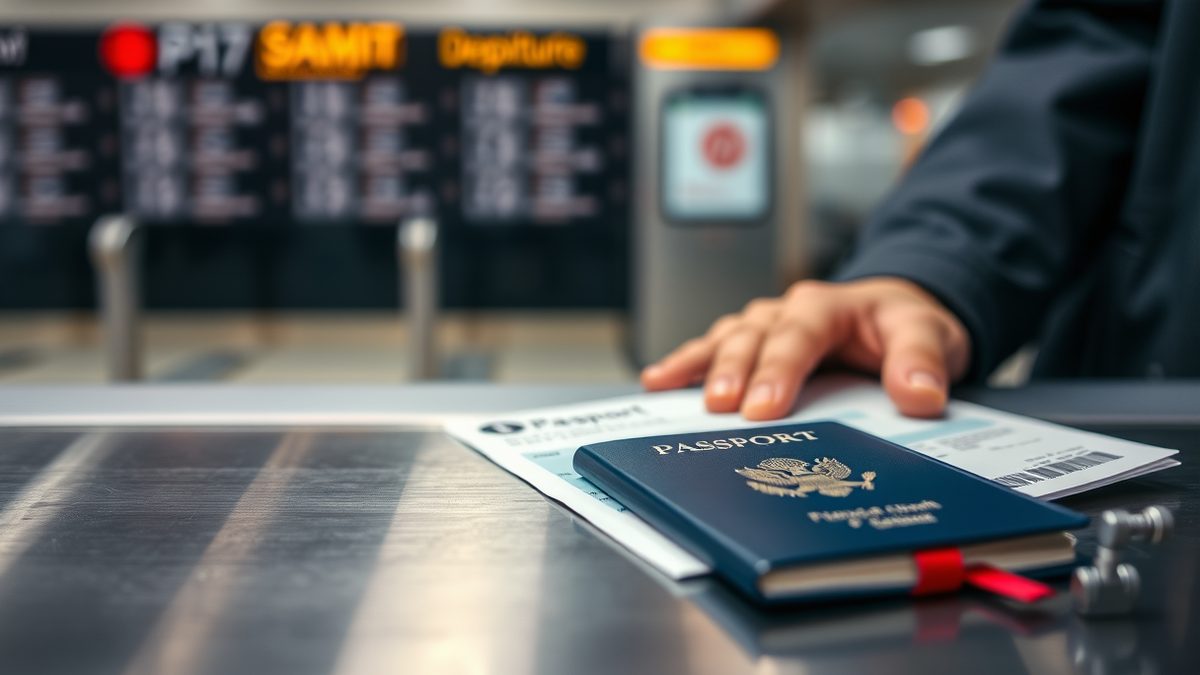
On 24 September, DW reported that new entry-exit rules had taken effect in China. They give authorities the power to block engineers, founders and other specialists from leaving the country when their expertise in batteries, rare earths or artificial intelligence is judged a threat to "industrial and technological security." The same report noted that Beijing has tightened outbound-investment rules, cracked down on Chinese nationals holding wealth offshore and restricted the posting of technical staff overseas.
That is the policy turn now shaping how China's technology sector deals with the outside world. The measures sit alongside export controls, visa scrutiny and capital rules, and they are arriving while the domestic economy is weak. DW reported that bank lending fell to a record low over the summer and that new car sales in August dropped nearly a quarter year on year. The article is the newest source in this dossier to treat talent and money leaving the country as a policy problem rather than an individual choice.
A blocked deal and a founder rumor
The most prominent example in DW's account is Manus, an AI startup created by two Chinese nationals in Beijing. The company moved its headquarters to Singapore last year, partly to avoid US investment curbs and expand into global markets. When Meta tried to acquire Manus last December for $2 billion, Beijing blocked the move and barred the firm's two founders from leaving the country, according to DW.
DW also reported that Chinese social media this month was awash with rumors that Huawei founder and CEO Ren Zhengfei and his daughter, CFO Meng Wanzhou, may have left the country, claims picked up by Taiwanese and Indian media. On Wednesday, Chinese-language media shared a photo of Ren in Shenzhen a day earlier, signing a cooperation deal with a Chinese automaker. DW did not confirm the rumors; it reported the photo as the apparent response to them.
The money side has its own numbers. DW cited Bloomberg Intelligence's estimate that some $1 trillion in Chinese wealth left the country last year, the largest outflow of "hot money" since records began in 2006. Beijing has not changed the annual $50,000 foreign-exchange quota that households may take out, according to DW, but Alicia Garcia-Herrero, chief economist for Asia-Pacific at Natixis, told the outlet that the unofficial routes around that cap are being squeezed: "They haven't changed the $50,000 quota. They are now squeezing the people and agents that money usually travels with."
Henry Gao, a law professor at Singapore Management University, told DW that the curbs taken together "offer a rare glimpse into the true state of China's economy" and suggest Beijing is deeply concerned about economic weakness and substantial capital outflows. Gao added that authorities are also determined to stop "entrepreneurs and skilled personnel from leaving the country."
The chip question behind the controls
Talent controls are only one front. On 28 September, Ars Technica reported that China is considering relaxing controls to let some of its biggest AI firms import perhaps millions more of Nvidia's banned chips over the next year. Sources familiar with the talks told The Information, which Ars Technica cited, that the Ministry of Industry and Information Technology asked Alibaba and ByteDance to share plans to buy Nvidia's RTX Pro 5500 chips, gaming parts that could be put into servers to power in-demand AI models.
The same Ars Technica piece described how Nvidia's position in Washington has changed. Huang has blamed US export controls for cutting Nvidia's share of China's advanced AI chip market from about 95 percent to zero, The Information reported. Trump initially tightened controls and banned H200 exports, then met Huang at Mar-a-Lago, lifted the H200 controls and has since appeared with him in public repeatedly, with regular phone calls, according to Stephen Witt, author of The Thinking Machine. Witt told NPR that Trump's recent claims about AI, including that warnings of human extinction are a "hoax," are "exactly Jensen's talking points."
Critics quoted by Ars Technica worry that what is good for Nvidia may not be good for the United States. The piece notes that export controls were not discussed at the recent Trump-Xi summit and that an already tenuous trade truce was extended for just two months, with looming US controls potentially triggering Chinese rare-earth retaliation, analysts expect.
On the same day as the DW report, The Diplomat's 30 September analysis argued that Washington's vocabulary has shifted away from "China Plus One." The piece said China-US trade fell by around 30 percent in 2025 alone, according to the McKinsey Global Institute's 2026 update on the geometry of global trade, and that China is now the only country making goods in all 41 industrial categories and 666 sub-categories in the UN classification. McKinsey called it the factory to the world's factories, the piece said, and the Wall Street Journal described the same shift.
Two other clocks: batteries and launches
Beijing is also formalizing where it wants its industrial base to be by 2030. CnEVPost reported on 28 September that the Ministry of Industry and Information Technology released a battery industry development plan for 2026 through 2030, dated 14 September and jointly issued by seven agencies including the National Development and Reform Commission and the Ministry of Transport. It targets initial large-scale use of all-solid-state batteries by 2030, long-life lithium batteries reaching 15,000 charge-discharge cycles, and leading manufacturers hitting parts-per-billion defect rates.
The same document backs sodium and flow batteries, supports corporate mergers and restructuring, calls for faster domestic exploration of lithium and cobalt, and proposes a digital identity system for EV power batteries, with battery passport arrangements and mutual recognition of carbon footprint data. It follows the 11 September release of the five-year plan for intelligent connected NEVs, which targets a 70 percent NEV share of domestic new passenger vehicle sales by 2030, according to CnEVPost.
SpaceNews reported on 1 October that China completed its ninth and tenth launches of September, with a Long March 8A lifting off on 23 September carrying the 26th group of Guowang satellites and a Long March 6A launching the fourth group of Yaogan-40 satellites on 24 September. The Guowang batch was tracked by the US Space Force in roughly circular 1,100-kilometer orbits inclined by 50 degrees; Guowang is run by state-owned China SatNet and is planned to comprise around 13,000 satellites. The launches took China to 70 orbital launch attempts for 2026, with at least 31 needed in Q4 to pass 100 for the first time.
The commercial side is moving too, though not uniformly. CnEVPost reported on 1 October that Geely Auto sold 292,168 vehicles in September, up 6.97 percent year on year, with exports of 106,685 units up 162 percent year on year but down 3.10 percent from August, ending eight consecutive months of record exports. Domestic sales fell 20.21 percent year on year to 185,483 vehicles, the smallest decline since February. China's NEV retail sales fell 20 percent year on year in the first 27 days of September, CnEVPost reported on 30 September, citing the China Passenger Car Association, with overall passenger car retail sales down 29 percent.
Foreign automakers are adapting. Hyundai launched its China-tailored Ioniq V electric sedan on 29 September from a limited-time 99,900 yuan ($14,820), with CATL batteries and Momenta driver assistance, CnEVPost reported. SAIC Volkswagen opened pre-sales for the ID. ERA 8X extended-range SUV, with an official launch set for 12 October, according to a 28 September CnEVPost report. Tesla, by contrast, is giving Chinese buyers a 16-inch screen and up to 2.2 kW of AC power export across the Model 3 and Model Y lineup, while the US Model 3 keeps a 15.4-inch display and no vehicle-to-load, Electrek reported on 30 September.
Omdia's 30 September outlook adds a wider frame: it expects 59 percent of organizations to raise AI budgets by 10 percent or more in 2027, more than 100 countries to pursue digital sovereignty initiatives, and global humanoid robot shipments to exceed 700,000 units by 2030, while noting hardware delays already affect 60 percent of PC channel partners. Two opinion pieces in Rest of World, published on 22 and 24 September, argue that the US is measuring the wrong race and that China's health tech rise should be watched closely, but their dates put them in background territory here.
What ties the newest items together is less a single policy than a direction: Beijing is tightening who may leave, loosening what chips may enter, and writing industrial targets that run to 2030. The DW report's sources describe the exit rules as a symptom of strain rather than confidence. Whether the chip talks and the five-year plans change that reading will not be clear for months.
Sources
15- 01China's new travel rules unsettle tech giants and talentEN
- 02Experts worry about Nvidia's AI chip sales in China and influence over TrumpEN
- 03Goodbye, 'China Plus One': The Real Change in US China PolicyEN
- 04China launches Guowang, Yaogan-40 satellites, sets up busy Q4 manifestEN
- 05Geely September sales rise 7% to 2026 high as record export streak endsEN
- 06China NEV retail sales fall 20% in first 27 days of September as decline deepensEN
- 07Hyundai launches China-tailored Ioniq V electric sedan from under $15,000EN
- 08VW ID. ERA 8X EREV SUV opens for pre-sales in China, launch set for October 12EN
- 09China unveils 5-year battery plan targeting large-scale all-solid-state use by 2030EN
- 10Tesla upgrades China Model 3 with 16-inch screen and V2L, US left outEN
- 11Four forces set to reshape technology in 2027 – OmdiaEN
- 12China is excelling in health tech. That's good news for the worldEN
- 13America is in the wrong AI race with ChinaEN
- 14China's Stake in the Russian Duma ElectionsEN
- 15GAC plans to buy 50% of FAW Toyota to coordinate operations at Toyota's 2 China joint venturesEN
All figures and quotations in this text come from the sources listed below.
Content prepared by the editorial team with AI assistance.
Dr. Amara Patel
Comments
0- No comments yet — be the first.