Humanoid robots head for the factory floor, from Stuttgart to Singapore
On 6 October, the University of Stuttgart's ICD said it is starting two robotics construction projects in November 2026, each funded with €4 million by the European Innovation Council. The same day, researchers in Singapore showed off a one-kilogram robot that lands on water and sails.
 Rachel NwosuAI, models and technology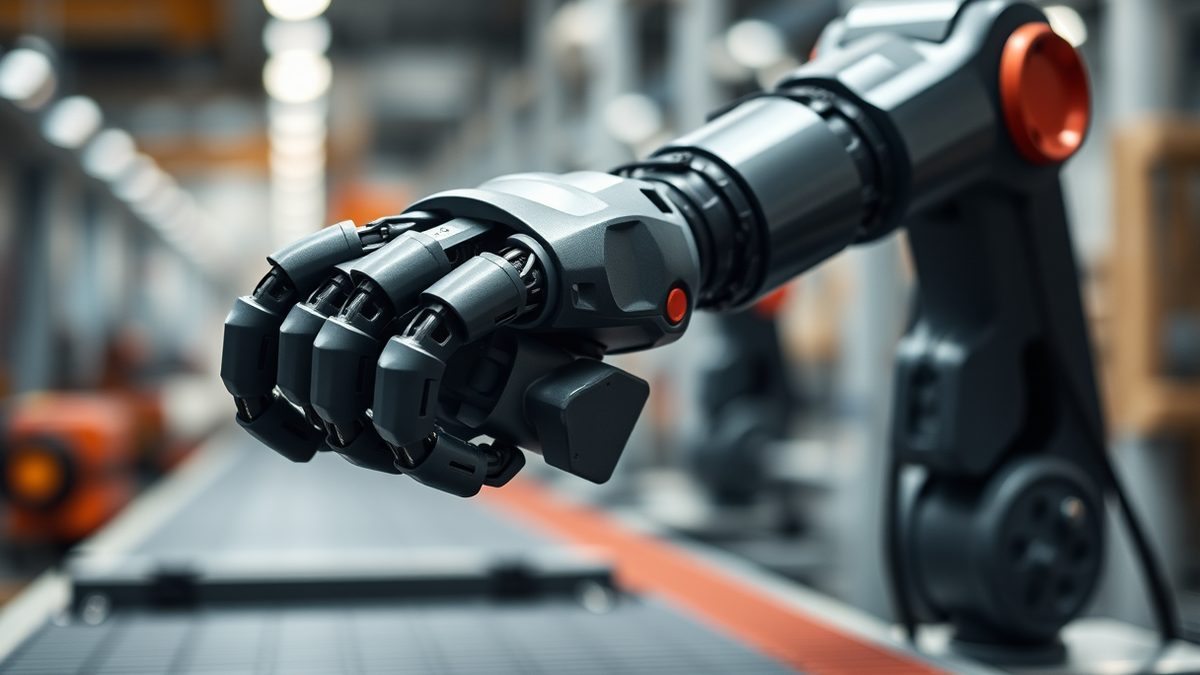
Two very different bets on where robots go next landed on 6 October. In Stuttgart, the Institute for Computational Design and Construction (ICD) at the University of Stuttgart said its Scalar and Cobras projects will begin in November 2026 and run for three years, each backed by €4 million from the European Innovation Council, according to heise online. In Singapore, researchers unveiled Albatross, a one-kilogram machine that combines flight and sailing to collect environmental data, reported t3n on the same day.
Neither is a humanoid. That is the point.
While the humanoid debate keeps circling manufacturing and warehouses, the money and the papers are also moving toward robots that do one narrow job well. The week of 6 October made that split unusually visible: two construction projects in Germany, a sailing sensor platform in Singapore, a new hand in Massachusetts, an open-weight model from Runway AI, a regulatory squeeze in Washington and a strategic investment from Teradyne. Each item answers a different question about what a robot is for. None of them settles the humanoid argument, but together they show where the engineering effort and the capital are actually going.
Stuttgart: robots that build with wood and steel
The ICD projects are about construction, not humanoid labour. Scalar aims to develop a new timber construction system where components are prefabricated in a factory and only assembled on site, with a fleet of autonomous construction machines handling the on-site assembly. Nils Opgenorth, a research group leader at the ICD, told heise that cranes would transport and roughly position components, while mobile robots and grippers do the fine work, coordinated by an on-site control system that also handles safety. The whole process is simulated virtually first.
Cobras takes a different route: small robots that assemble space frames, coordinating decentrally through swarm intelligence. Samuel Leder, also a research group leader at the ICD, said the goal is to fundamentally change a process that is currently complex and labour-intensive. According to heise, the ICD's director Achim Menges argues that robotics cannot be viewed in isolation, and that design, planning, materials, component production, the construction site and robotics have to be treated as one integrated system.
"Um das Bauwesen zukunftsfähig aufzustellen, denken wir Entwurf, Planung, Materialien, Bauteilfertigung, Baustelle und Robotik als Teil eines integrativen Gesamtkonzepts."
The funding is notable for its size in a European context. As heise reported, the competition for European Innovation Council money is intense, and the university called the two awards an honour. Both projects start in November 2026.
Singapore: a one-kilogram sensor platform
Albatross, short for Airborne Lander with Buoyant AuToROtating Sailing Sensor, is a multimodal system developed by a team at the Singapore University of Technology and Design led by Shane Kyi Hla Win. According to t3n, the peer-reviewed study appeared in Science Robotics. The robot can be dropped from an aircraft or a drone over open water. It uses autorotation, the same principle as a maple seed, to slow its fall without a parachute or rotors. Once in the water, its low centre of gravity rights it automatically, and its rigid wings become sails.
The hardware count is the interesting part: one kilogram, three actuators, three sensors. The researchers see environmental disasters such as oil spills or algal blooms as possible uses, where the system could collect data quickly. That is a very different pitch from the general-purpose humanoid, and it is cheaper to build.
The factory question
The humanoid industry, meanwhile, is still trying to prove it belongs on a production line. The most concrete recent data point comes from China. According to IDC figures cited by TechNode on 29 September, China shipped more than 19,000 humanoid robots in the first half of 2026, accounting for 77.9% of global shipments. Global shipments reached nearly 25,000 units, up 432.1% year over year. IDC also raised its forecast for global humanoid shipments in 2030 to more than 750,000 units.
Those numbers describe shipments, not utilisation. A robot that ships is not necessarily a robot that works a full shift. The gap between the two is where most of the current argument sits.
Boston Dynamics offered one answer on 1 October, when it unveiled a new hand for its Atlas humanoid: four fingers, 13 degrees of freedom, directly actuated, and designed for mass manufacturing, according to The Robot Report. The previous version had seven degrees of freedom and was built to grasp a wide variety of objects. The new one is built to manipulate them. Dylan Thrush, a mechanical engineer on the Atlas team, said there is no pinky because the team decided the extra dexterity was not worth three additional degrees of freedom, the size and the power consumption. The company also ran a test in which staff taped their pinky and ring finger together for a day to see what they could not do.
That is a manufacturing decision as much as an engineering one. The hand is similar in size to a large human hand, which drives actuator size, and Boston Dynamics says it kept similar strength to the previous version. A week earlier, the company opened its Robotics Metaplant Application Center at Hyundai Motor Group Metaplant America in Georgia, a training centre for integrating Atlas into Hyundai's automotive operations.
Software and the data problem
Runway AI introduced Praxis-1, an open-weight world action model for robots, The Robot Report wrote on 2 October. Kamil Sindi, Runway's chief technology officer, said most robot policies are bottlenecked by robot data, which is scarce and expensive to collect, and that Praxis-1 learns mostly from third-person video. Runway said simulating robot policies inside its world model predicts real-world results with 0.95 correlation. Early partners include Noble Machines, Standard Bots and Ultra, running Praxis-1 on their own hardware.
If that correlation holds up outside Runway's tests, it changes the economics of training. Robot demonstrations are expensive; YouTube videos are not. Runway's claim is that a single model can adapt across bimanual arms and humanoids with light fine-tuning, which is exactly the kind of claim that needs third-party replication before anyone builds a factory around it.
The other software front is inference. Microsoft Research published work on 23 September arguing that running physical AI inference exclusively on onboard GPUs can limit robot performance, battery life and scalability, and that offloading to edge or cloud GPUs can improve task success rates and enable larger models. That sits awkwardly next to the regulatory pressure coming from Washington.
In July, the FCC added foreign-produced advanced robotic devices to a list of technologies it deems to pose unacceptable national security or safety risks, The Robot Report noted on 5 October. The designation prevents new devices from receiving the FCC authorisation generally required to be imported, marketed or sold in the US. The restrictions apply broadly to advanced mobile robots, including humanoids and quadrupeds, that can collect detailed information about their surroundings. Officials have warned that foreign-made robots could enable surveillance or remote interference.
The Robot Report's analysis argues this could push more inference on-device, since companies that want control over who can access a robot and its data have an incentive to keep processing local. That is a direct tension with Microsoft's offloading argument: the security logic and the performance logic point in opposite directions.
Where the money is going
Teradyne announced a strategic investment in Bright Machines on 5 October, alongside a collaboration to integrate Teradyne robotics and test technologies with Bright Machines' manufacturing platform, according to The Robot Report. Shantnu Sharma, Teradyne's chief development officer, said designs change quickly and every unit has to be verified, and that the loop Bright Machines closes, design into a manufacturing cell, robots assembling, test verifying, data feeding back, is what drew the investment. Fiaz Mohamed, Bright Machines' chief growth officer, said the partners have already begun adding Universal Robots to their lines.
Teradyne's most recent earnings statement marked its fifth consecutive quarter of growth, with AI credited as a main driver. That is a useful reminder that the companies making money from the robotics buildout are often not the ones building the robots.
Physical security is another buyer. The Robot Report reported on 4 October that more than $23 billion has been invested in 2026 in organisations focused on improving how robotics and AI work together, with much of the focus on protecting people and property. That figure covers a broad category, not humanoids specifically.
On the human-robot interaction side, Eli Lilly and Purdue University will present field study findings at RoboBusiness 2026 on 20 and 21 October in Santa Clara, The Robot Report wrote on 2 October. Faraz Yousuf, a senior principal robotics application engineer at Eli Lilly, and Dr Anastasia Kouvaras Ostrowski of Purdue ran studies with manufacturing and warehouse operators around live automated guided vehicles. The session is at 11:45 a.m. PT on the first day. Their findings on how workers actually perceive robots on a factory floor may matter more than any hand design.
One counterpoint worth keeping in mind comes from a robotics veteran. Charlie Kemp, cofounder and chief technology officer of Hello Robot, told Robots Guide in an interview published on 28 September that sometimes autonomy is not the answer, because the individual wants more control. His focus is assistive robots for older adults and people with disabilities, not factories, but the observation travels. A robot that does one task reliably, like Albatross, may prove more useful than a generalist that needs a human standing by.
Sources
13- 01Roboter aus Stuttgart sollen das Bauen beschleunigenDE
- 02Albatross: Dieser Roboter segelt nach dem Flug auf dem WasserDE
- 03China accounts for 77.9% of global humanoid robot shipments in H1, IDC saysEN
- 04Boston Dynamics drops pinkie on new humanoid handEN
- 05Runway introduces Praxis-1 world action model for roboticsEN
- 06Offloaded inference for real-world physical AI roboticsEN
- 07FCC robot restrictions could accelerate shift to local AIEN
- 08Teradyne invests in Bright Machines to bring robotics to AI infrastructure manufacturingEN
- 09How robotics and physical AI can responsibly tackle key physical security challengesEN
- 10Eli Lilly, Purdue to share field learnings on human robot interaction at RoboBusinessEN
- 11A Day in the Life of a Roboticist: Charlie KempEN
- 12Delivery Hero alumni have built 150 startups worth €7.5B, making it Europe's biggest founder factoryEN
- 13Productive, Durable, Fungible: How NVIDIA AI Factories Maximize Return on InvestmentEN
All figures and quotations in this text come from the sources listed below.
Content prepared by the editorial team with AI assistance.
Rachel Nwosu
Comments
0- No comments yet — be the first.