Japan's $140bn AI Data Centre Push Follows a Week of Chip Investment Deals
JERA, Dell and UK developer RHAELM signed a non-binding agreement on Thursday to build AI data centres in Japan, a programme the Financial Times values at as much as $140bn.
 Dr. Amara PatelEconomy, business and world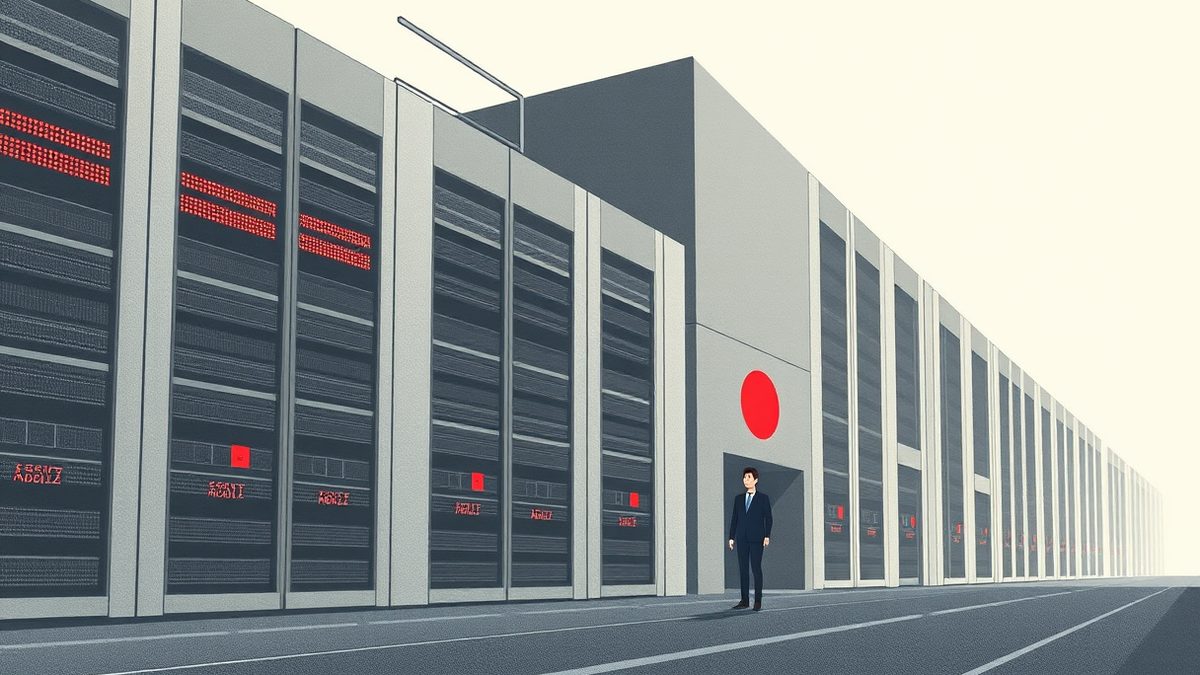
The agreement, confirmed by JERA and reported by the Financial Times, covers a first project beside the company's gas-fired power station in Chiba, east of Tokyo. That single site will draw about 400 megawatts and cost more than $15bn across all phases, with operations due to start around 2028.
JERA generates about a third of Japan's electricity, according to the company. It brings land and power to the partnership; Dell supplies ready-built racks of servers; RHAELM runs the construction. Private equity firm Apollo is funding the work as RHAELM's financing partner.
The selling point is speed, because the site takes power directly from the adjacent plant rather than waiting for a grid connection. "We can deliver a 400MW facility years ahead of a conventional grid-connected timeline," RHAELM chief executive Bradd Lewis said, in comments carried by The Next Web. JERA global chief executive Yukio Kani said the company is "uniquely positioned to power Japan's AI ambitions".
The partners want to copy the model at other JERA sites, aiming for several gigawatts of AI capacity across Japan in the 2030s. JERA has not put its own number on that wider rollout; the $140bn estimate comes from the FT's reporting.
A week of chip and materials money
The data centre plan lands in the middle of a run of semiconductor investment announcements in Japan, most of them tied to materials and memory rather than logic.
Nikkei Asia reported on Thursday that Toshiba plans to double hard disk drive supply to fill an AI-driven memory gap. The same outlet reported on Wednesday that the Bank of Japan's Tankan survey showed a sixth straight rise in manufacturer sentiment, and on Thursday that Infineon opened a plant near Bangkok as Thailand pushes its own chip ambitions.
Air Liquide said it would invest more than 170 million euros to supply ultra high purity gases to a semiconductor manufacturer expanding in Japan, a figure repeated by gasworld and Indian Chemical News. None of those reports named the customer.
Memory capacity is moving too. SanDisk and Kioxia plan a $31bn Japan memory expansion through 2032, according to scanx.trade, and SK hynix is weighing a Japan memory plant with an investment in the tens of trillions of won, the same outlet reported on Wednesday. Shinko Electric's acquisition of Japan Display's Mobara plant, reported by finance.biggo.com and Tech Times, converts the site into an AI semiconductor packaging base.
The listed headlines above come from aggregator summaries rather than the companies' own disclosures, and FLASH24 has not independently verified the investment totals.
Japan's market reaction was visible. The Nikkei hit a six-week high on Thursday as chip stocks rallied on AI optimism, according to The Economic Times, after Micron's earnings revived the trade. finance.biggo.com put the index above 68,000 at one point, while bbntimes.com recorded a fall to 65,481.27 on ex-dividend adjustments and rate worries. Those two figures are not reconcilable from the summaries alone.
The supply chain argument
At an event in Budapest, the European Space Agency's Kate Underhill made the case that advanced manufacturing concentration is a strategic risk rather than a procurement detail. She told EE Times that space systems typically run at least ten years behind consumer electronics, and that ESA once tried to order 20 laser diodes from a German supplier that required a minimum order of 10,000 units. "If there is any U.S. component on your satellite, then you have to comply with U.S. regulations," she said, referring to ITAR.
China is running the same argument from the other direction. Huawei rotating chairman Eric Xu claimed this week that the company's Ascend neural processing units have surpassed Nvidia in Chinese market share. "It's pretty hard to collect data about the market share of Nvidia in China, but based on the data we have collected, Ascend has surpassed Nvidia," The Register quoted him saying. Xu also said Huawei lacks capacity to meet Chinese demand and has no plans to expand internationally in a fully fledged way.
Ars Technica reported separately that China's Ministry of Industry and Information Technology has asked Alibaba and ByteDance to share plans to buy Nvidia's RTX Pro 5500 chips, citing sources familiar with the talks. That report, published on 28 September, sits alongside Nvidia's own disclosure on its Q2 earnings call that H200 shipments to China amounted to less than 1 percent of data centre revenue.
Where the tools are going
Chip design itself is the next target. OpenAI and Synopsys signed a multi-year partnership to build GPT-Synopsys, a model intended to reason about chip design and verification and operate Synopsys' EDA tools directly, The Decoder reported on 30 September. Synopsys chief executive Sassine Ghazi said AI could significantly speed up design; OpenAI co-founder Greg Brockman framed the deal as a path to better chips and better AI. Both companies said customer data will not be used for training and will be stored encrypted.
Emergence AI is pitching a narrower version of the same idea at fabless chipmakers. Executive chairman Satya Nitta told EE Times at SEMICON India that demand exceeds supply and every fab is at capacity, so the only lever left is yield. "You cannot make chips any faster, but what you can do is definitely get more chips per wafer yielding with AI," he said. The company pairs large language models with symbolic AI so that, in his description, algorithms propose and symbolic AI verifies.
None of this settles whether Japan's data centre buildout will be financed on the timeline its backers describe. The JERA agreement is non-binding, the first site is not due to operate until around 2028, and the $140bn headline is an FT estimate rather than a committed figure. Blackstone said in June it planned $30bn for Japanese AI data centres over the next few years, and Japan's digital minister has warned the country could become an "AI colony" if it falls behind.
Sources
11- 01Japan eyes $140bn AI data centre push with Dell and JERA, FT reportsEN
- 02Huawei boss claims homegrown AI chip sales top Nvidia in ChinaEN
- 03Experts worry about Nvidia's AI chip sales in China and influence over TrumpEN
- 04OpenAI and Synopsys team up to build an AI model that designs chips like a seasoned engineerEN
- 05Europe's Space Industry Seeks Greater Supply Chain ControlEN
- 06Emergence AI Targets Fabless Chipmakers With Neuroformal AIEN
- 07MaxLinear claims new 'Puma 9' DOCSIS chip is a big cost-cutterEN
- 08Qualcomm Unveils Snapdragon 8 Elite Gen 6 and Elite Extreme Gen 6: Next Gen Flagship Mobile ChipsEN
- 09Steam Deck 2: Is AMD Gainsborough the chip Valve's been waiting for?EN
- 10MaxLinear intros 'AI-ready' Puma 9 DOCSIS chipsetEN
- 11Meet the solar industry's new Republican evangelistEN
All figures and quotations in this text come from the sources listed below.
Content prepared by the editorial team with AI assistance.
Dr. Amara Patel
Comments
0- No comments yet — be the first.