Fusion's Reality Check: Helical's 2027 Test, Grid Rules and a Talent Flip
Japan's Helical Fusion says it will start preliminary power-on tests at its Helix HARUKA pilot reactor in 2027, the company said on Tuesday, as reported by The Asahi Shimbun on 30 September. That is a first-stage milestone, not a power plant: commercial operation, CEO Takaya Taguchi told reporters, is targeted for the 2040s at the earliest.
 Sofia MarchettiScience and health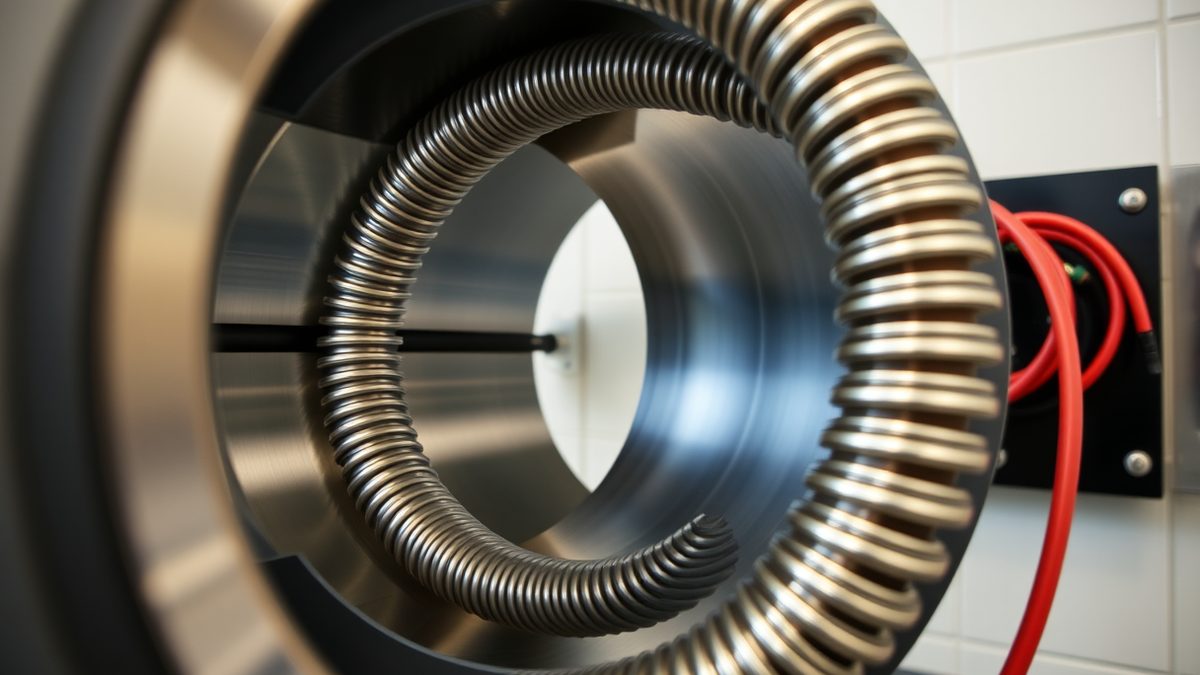
Construction of the first spiral coil at the National Institute for Fusion Science site in Toki, Gifu Prefecture, started early this year. It is now largely complete. That is why Helical Fusion opened the facility to media on 29 September. The company says it completed a performance test of a high-temperature superconducting coil in 2025. It replicated the magnetic environment inside a fusion device and achieved stable current flow under superconducting conditions, a claim it describes as a world first.
Read the timetable carefully. If the first-stage tests work, Helical plans to install a second coil and major components including a liquid-metal wall blanket. Then it would run power-on tests of the completed integrated facility around 2030. A follow-on reactor, HELIX KANATA, is designed for a net output of 50 MW. Full-scale investment in that project is pencilled in for the 2030s.
Taguchi, the CEO, was blunt about what stands between HARUKA and a commercial plant: technical hurdles, but also cost, safety and construction speed. Asahi also notes the political tailwind. Prime Minister Sanae Takaichi supports the sector. The government has designated fusion as one of 17 strategic sectors, with 3.1 trillion yen ($19.7 billion) of public and private funding planned through the 2040 financial year.
Money moves faster than megawatts
While Helical drills and winds coils, the grid around it is being re-regulated. On 26 August 2026, President Trump signed an executive order declaring a national emergency to restrict high-risk foreign-produced equipment in the US electric grid, according to a SemiEngineering analysis. It covers gear at 69 kilovolts and above: large transformers, grid-tied inverters, circuit breakers, battery storage, SCADA and industrial control systems. No vendor is named yet. The Department of Energy's implementing rules are due 24 December 2026.
The order reaches into firmware, signing keys, cloud connections and update paths, not just where a box was assembled. That matters for anyone banking on a fast buildout of storage and inverters to back intermittent generation. The International Energy Agency puts China at roughly 80% of world manufacturing in the relevant categories, per the same analysis.
Transmission is the other bottleneck. The Senate permitting bill unveiled on Wednesday would order regional grid operators and utilities to streamline planning and permitting, require advanced transmission technologies and force coordination on buildouts, Canary Media reported. Analysis commissioned by the Center for Climate and Energy Solutions found the reforms could cut the cost of delivering electricity by roughly $7 billion by 2035, after $1.9 billion in new transmission investment, and cut residential bills by about $1.1 billion. Greenline Insights, which ran the modelling, estimated almost 100 GW more wind, solar and battery storage plus nearly 40 GW of interregional capacity. Rob Gramlich of Grid Strategies called the provisions the changes that could "expand and de-congest" the grid. That is a projection, not a result.
Research results that do not need a reactor
Elsewhere in the dossier, the measurable news is smaller and cleaner. Caltech physicists reported in Nature that they used laser-trapped atoms as a quantum simulator to make the first direct measurements of energy levels predicted by the Ising and tricritical Ising conformal field theories, ratios theorists had calculated for about 40 years, ScienceDaily reported on 30 September. Separately, CIC energiGUNE in Spain completed 10,000 charge-discharge cycles on an iron-lead redox flow battery using a single electrolyte loop and a fluorine-free membrane, tested at 25 C to 30 C, with kilowatt-scale modules as the next step, according to pv magazine on 1 October. Both are component-level results. Neither ships this decade.
The people part is shifting too. China employed 41% of the world's leading AI researchers tracked by a Carnegie China study last year, ahead of the US at 34%, a reversal from 2022 when the US led 46% to 27%, the South China Morning Post reported.
Back on the balance sheet, US clean energy employment fell to 3.52 million in 2025, down 36,949 jobs, the first annual decline since the pandemic, Electrek reported on 28 September, citing E2's analysis of Department of Energy data. California lost nearly 21,000; Florida gained about 3,800. E2's tracker recorded 142 clean energy projects cancelled or downsized in 2025.
The pattern across all of it: fusion is a 2040s promise with a 2027 test date, grid reform is a 2035 projection with a December 2026 rulemaking, and the verified results are lab-scale. That is not a reason to stop reading. It is a reason to date every claim.
Sources
15- 01Japan's fusion energy startup to begin power-on tests at pilot reactor in 2027EN
- 02US Executive Order On Energy Grid Supply Chain SecurityEN
- 03Senate permitting bill could greatly expand power lines and clean energyEN
- 04Caltech physicists finally measure a quantum energy ladder predicted 40 years agoEN
- 05Spanish researchers validate 10,000 cycles for iron-lead flow batteryEN
- 06China overtakes US as top workplace for elite AI researchers, study findsEN
- 07US clean energy jobs fell for the first time since the pandemicEN
- 08The Download: OpenAI's chief research officer explains its hacking responseEN
- 09Why mathematicians are hiding research results in zero-knowledge proofsEN
- 10Duke Energy wants to build a new gas plant. Regulators said not so fast.EN
- 11The Iran war pushed countries toward clean energy - and coalEN
- 12Mazama Energy raises $135M for superhot geothermal at Oregon volcanoEN
- 135 Companies Using NVIDIA AI for Clean EnergyEN
- 14How Open Science Can Help Researchers Prepare for the Next PandemicEN
- 15Introducing Quine: An AI research system designed for the complexity of biologyEN
All figures and quotations in this text come from the sources listed below.
Content prepared by the editorial team with AI assistance.
Sofia Marchetti
Comments
0- No comments yet — be the first.