Iron-lead flow battery passes 10,000 cycles as AI biology models scale up
Spanish research centre CIC energiGUNE has completed 10,000 charge-discharge cycles on an iron-lead redox flow battery, according to pv magazine, testing a design built from abundant materials for multi-hour grid storage.
 Sofia MarchettiScience and health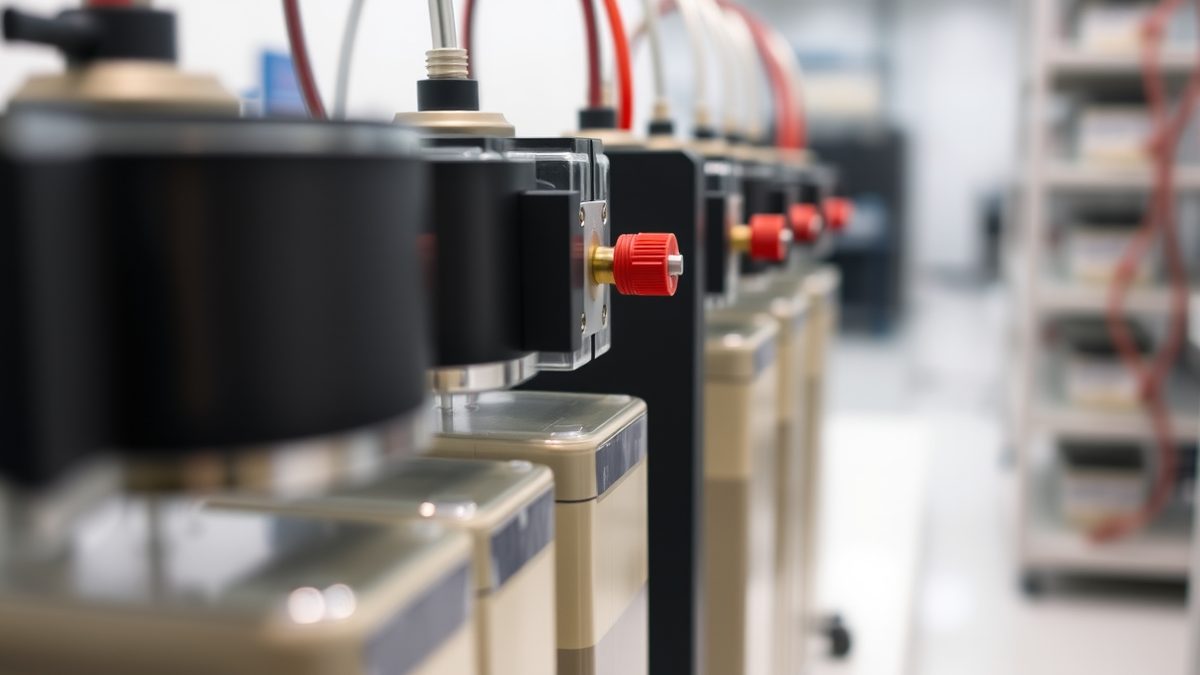
The validation, published on 1 October, puts the cell through 10,000 cycles at temperatures between 25C and 30C. CIC energiGUNE says the battery uses iron and lead as active materials and a single electrolyte loop instead of the two circuits found in conventional flow batteries. A fluorine-free membrane is designed to cut internal resistance and limit unwanted transport of chemical species between the two sides of the cell.
Flow batteries store energy in external tanks. More electrolyte means more energy capacity, while power output depends on the size and number of cells and stacks. That separation lets a system be sized for several hours of storage without scaling both parameters together. CIC energiGUNE says the combination of high cycling capability and safety suits solar and wind integration, grid-scale storage, microgrids and industrial energy management.
The same week brought a very different kind of scaling claim, this one from Microsoft Research. On 29 September the company introduced Quine, described as a multimodal world model of biology and an interactive harness connecting models, scientific tools, literature and researchers. Working with the Broad Institute of Harvard and MIT, Microsoft says the system prioritised compounds predicted to drive therapeutic tumour-state shifts and validated several top-ranked candidates across multiple wet-lab assays.
Microsoft is careful about the limits. Quine is experimental research technology, intended only for research and not for clinical or medical use, and its outputs may be incomplete or inaccurate and require review by qualified researchers and experimental validation. A Quine Fellows programme will give a cohort of scientists access and a chance to feed back into the system.
Protein structures and the pandemic gap
On 24 September NVIDIA said it had joined Google DeepMind and the European Molecular Biology Laboratory's European Bioinformatics Institute to release predicted 3D structures for the protein complexes of more than 2,800 viruses through the AlphaFold Database. The structures were inferred with AlphaFold2 and optimised with NVIDIA's BioNeMo Inference Runtime, which the company says allowed the team to scale inference to thousands of viral proteomes. About 30 per cent of the protein interactions added to the database are new to science, showing shapes never documented in the Protein Data Bank.
"When the next pandemic happens, there may be something that comes out of the blue, and we'll be lacking the knowledge we had for COVID," Joe Grove, professor of molecular virology at the MRC-University of Glasgow Centre for Virus Research, said in the NVIDIA post. "What we're trying to do is stockpile some of that knowledge ahead of time." The piece cites a Center for Global Development analysis estimating a roughly 50 per cent chance of a pandemic as severe as COVID-19 by 2050. Traditional structure determination can take years and cost thousands of dollars per structure, NVIDIA says.
Automation of the research process itself is also being pushed. A paper submitted to arXiv on 29 September describes AIM, an Agentic Idea Manager for what the authors call idea-driven automated research. The framework uses an Agentic Surrogate and an Agentic Acquisition mechanism to organise and select research directions, a Solution Auditor to keep ideas and implementations aligned, and a Resource Planner to allocate experimental budget across parallel branches. On 10 AutoLab benchmark tasks the authors report gains of 1.6 percentage points on System Optimization and 4.9 points on long-horizon Model Development and CUDA tasks, reaching the best baseline performance up to 3.1 times faster in wall-clock time.
Microsoft Research Asia's Singapore lab, which opened on 24 July 2025 as the company's first research lab in Southeast Asia, marked its first year on 28 September. The lab's stated pillars include next-generation models and agentic systems, domain-specific AI, AI-native research practices and talent development.
Not every dataset points in the same direction. A study published on 24 September in JAMA Psychiatry, led by the Barcelona Institute for Global Health and Aarhus University, analysed more than 2.1 million children and adolescents in Denmark and compared more than 71,000 diagnosed with ADHD or autism between 2012 and 2022 with more than 713,000 who were not. Children born with low birth weight were 54 per cent more likely to later receive either diagnosis at the start of the period; by the end the difference had fallen to 17 per cent. "The key message is not that these risk factors are no longer important," first author Magnus Elias Tarp said. "What we found is that people diagnosed in recent years resemble the general population more closely than those who received the same diagnoses a decade ago."
Sources
15- 01Spanish researchers validate 10,000 cycles for iron-lead flow batteryEN
- 02Introducing Quine: An AI research system designed for the complexity of biologyEN
- 03How Open Science Can Help Researchers Prepare for the Next PandemicEN
- 04AIM: Agentic Idea Management for Automated ResearchEN
- 05One year in: How Microsoft Research Asia - Singapore is advancing research, partnership and talent for real-world impactEN
- 06ADHD and autism diagnoses have surged. A massive study may help explain whyEN
- 07OpenAI cuts ties with 3 safety researchers, WSJ reportsEN
- 08The Download: OpenAI's chief research officer explains its hacking responseEN
- 09China overtakes US as top workplace for elite AI researchers, study findsEN
- 10China leads drone patent volume but US matches quality as start-ups drive innovation: studyEN
- 11Carbonato Botnet Compromises Docker Hosts to Deploy Telegram-Controlled Hermes AI AgentEN
- 12Creatine may help build muscle even without exercise, researchers findEN
- 13Launching Vespper DOCX MCP: 3x faster, 2x cheaper, more accurateEN
- 14Kelvin Wave In Pacific Ocean Heads Toward CaliforniaEN
- 15How personality traits predict life satisfaction: Insights from new psychology researchEN
All figures and quotations in this text come from the sources listed below.
Content prepared by the editorial team with AI assistance.
Sofia Marchetti
Comments
0- No comments yet — be the first.