Google Puts TPUs in Orbit as Earth-Bound Data Centre Power Fights Intensify
Google has launched a fridge-sized prototype satellite carrying four of its Tensor Processing Units. The launch is the first step in Project Suncatcher, a plan to run AI compute in orbit on solar power. The company announced the mission on 1 October.
 Grace OkonkwoAI, models and technology
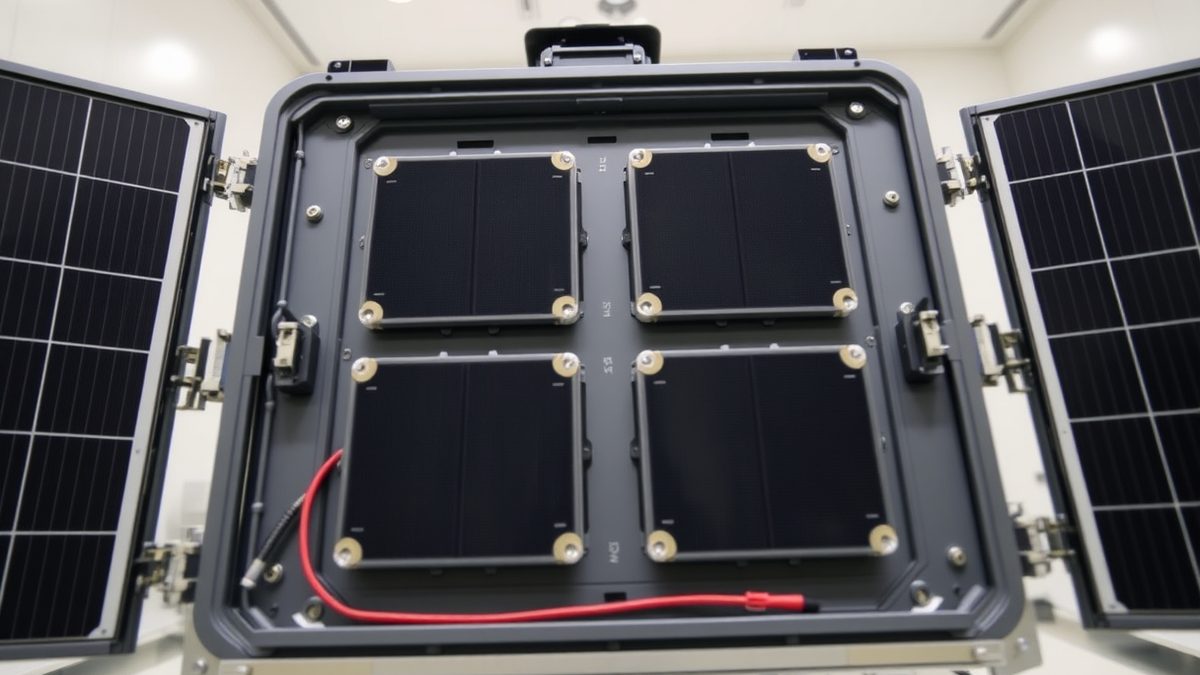
Google put a refrigerator-sized satellite into orbit carrying four of its Tensor Processing Units. These are the chips Google designed for machine learning and already runs in data centres on Earth. NPR reported the launch on 1 October. The craft will run a version of Google's Gemma AI model for 15 minutes at a time, limited by heat management, to answer simple queries.
The point is not the queries. It is the power bill. Google's chief executive, Sundar Pichai, told the company's developer summit in May that demand for AI services exceeds supply. He said he expects capital expenditures of $180 billion to $190 billion this year, more than six times the 2022 figure, according to NPR. Project Suncatcher is an attempt to move part of that load somewhere with no grid connection, no water permit and no planning committee. For anyone buying AI capacity, the question that follows is whether the compute behind a product is contracted, owned or experimental. Google has not said what an orbital data centre would cost per unit of compute or when any of it would serve paying customers.
"The sun puts out almost all of the power in our solar system," Travis Beals, senior director and lead of Project Suncatcher, said in comments carried by NPR. "All of the other power sources that humanity has tapped into are just a tiny fraction of a percent."
Why the electricity contract is the hard part
On the ground, the constraint is contracts and local consent. Amazon said on 2 October that it will spend more than $1 billion over five years on education, job training, local infrastructure and sustainability programmes in communities that host its data centres, according to The Register. The company's blog post argued that more than 100 data centre moratoriums are being considered across the United States.
Amazon also pushed back on water claims. It said its facilities use about 13,000 gallons a day, the equivalent of 42 US households, against claims that a typical data centre consumes five million gallons a day. The Register noted that the comparison leaves out the water consumed by power generation itself. Neither figure settles what a new facility does to a local utility's supply margin, which is the question regulators actually vote on.
Google's orbital test is small next to that fight. Beals called the satellite "a very minimal test" to check the chips survive launch, radiation and thermal extremes. Google plans two more satellites next year to test laser links between them. SpaceX has said it expects to start deploying orbital AI compute satellites as early as 2028, and the startup Starcloud flew an Nvidia H100 in space last November. None of this replaces a power purchase agreement in the near term.
The other end of the wire: breaches and exposure
Every contract signed for compute assumes the data sitting on it stays put. That assumption is under strain. Ars Technica reported that the Pentagon is notifying more than 2 million current and former military members that personnel records were stolen. The theft came in a compromise of a Defense Manpower Data Center system that began last October. The department says the breach covered records of 2.8 million living individuals, including Social Security numbers, names, addresses, race and occupational specialty.
The same report links it to a second incident. The ransomware group ShinyHunters claimed it hacked FBI systems and stole records of thousands of current or former employees. Reuters said the job titles included work on China and Russia. Ars Technica compared the pair to the 2015 breach of the US Office of Personnel Management, in which China-state hackers obtained 22.1 million records.
The Defense Manpower Data Center says it handles more than 60 million department person records. The department has not said how attackers got in, whether it has had contact with them, or whether ransom demands were made.
Commercial platforms are leaking too, often by configuration rather than intrusion. TechCrunch reported on 25 September that UpGuard found around 16,000 databases hosted on Supabase where some degree of personal data was exposed, including names, addresses, phone numbers and some passwords and authentication tokens. Supabase's chief information security officer, Bil Harmer, told TechCrunch the company had not seen the research. He said its projects are "secure by default" and described security as shared with customers. The company reached a $10 billion valuation this year.
What users and buyers should watch
Its two-satellite test next year is a connectivity trial, not a capacity announcement. The Earth-bound buildout, by contrast, is already running into local votes.
Regulators are moving on a different front. New Mexico asked a judge on Thursday to order Meta to pay between $35 billion and $40 billion in penalties. A jury found the company misled consumers about the privacy of their Facebook data, Reuters reported via Yahoo Finance. The jury returned its verdict on 25 September and found 26 of 29 statements misleading, with more than 43 million violations of state consumer protection law. Meta argued in filings for a cap of $3.45 billion. Judge Francis Mathew will set the figure.
The state's lawyer, Randi McGinn, told the court the penalty should speak to Meta "in the only language it understands, which is money, and the value of its stock price". Meta's lawyer, Matt Nicholson, called the request an "astronomical penalty that would obviously violate a host of constitutional provisions". Those numbers are a request, not a ruling.
Elsewhere in the power queue
Europe is bracing for a winter of high fuel costs. France 24 reported that the average diesel price across the EU is well above €2 a litre, against around €1.50 in October of last year. It reported that member states have been asked to prepare gas and electricity savings. The programme did not name the mechanism or the body making the request.
In cars, Ford's chief executive, Jim Farley, told the Automotive News Congress in Detroit that Europe is effectively lost to Chinese electric vehicles. "I watch what's happening in Europe right now, where that was not the case and it's really something that they have to deal with now, and it's too late," Gizmodo quoted him saying, citing CNBC. One in every seven battery EVs sold in Western European markets in the first five months of 2026 was a Chinese brand, according to Schmidt Automotive Research. Ford has a joint venture with Geely to develop EVs in Spain and a battery partnership with CATL. US Transportation Secretary Sean Duffy wrote last month that the CATL tie-up "challenges the spirit of American national and economic security and supply-chain independence policies".
None of that changes the arithmetic Google is testing. A satellite drawing on the sun sidesteps a utility contract, a water permit and a county board. It does not sidestep physics: 15 minutes of model runtime per pass, four chips, and a laser link that has not flown yet. The company has not said how much the programme costs or what fraction of its compute it could ever carry.
The Electronic Frontier Foundation, meanwhile, opened its Opt Out October campaign on 2 October with guides on telling AI tools not to train on personal data. The group said it does not endorse specific products. It is a reminder that the electricity contract and the data contract are signed by the same customer, and that neither is visible from orbit.
Sources
8- 01Google launches Project Suncatcher, a step towards AI data centers in spaceEN
- 02Shut up and take our money: Amazon plows $1B+ into quashing datacenter dissentEN
- 03Hacks of 2 federal agencies in a month have spilled a bonanza of sensitive dataEN
- 04Some Supabase customers are publicly exposing reams of people's data to the webEN
- 05New Mexico wants Meta to pay up to $40 billion in penalties after data privacy trialEN
- 06A grim winter ahead? EU states asked to prepare gas and electricity savingsEN
- 07Ford CEO Says Europe Is Lost to Chinese Electric VehiclesEN
- 08Welcome to Opt Out October. Let's Take Control of Our Data and Our DevicesEN
All figures and quotations in this text come from the sources listed below.
Content prepared by the editorial team with AI assistance.
Grace Okonkwo
Comments
0- No comments yet — be the first.