Humanoid Robots Enter Mass Production as Factories Become the New AI Frontier
A smart factory in China began producing 10,000 industrial humanoid robots at a scale of one unit every ten minutes, marking a shift from laboratory demos to mass manufacturing.
 Rachel NwosuAI, models and technology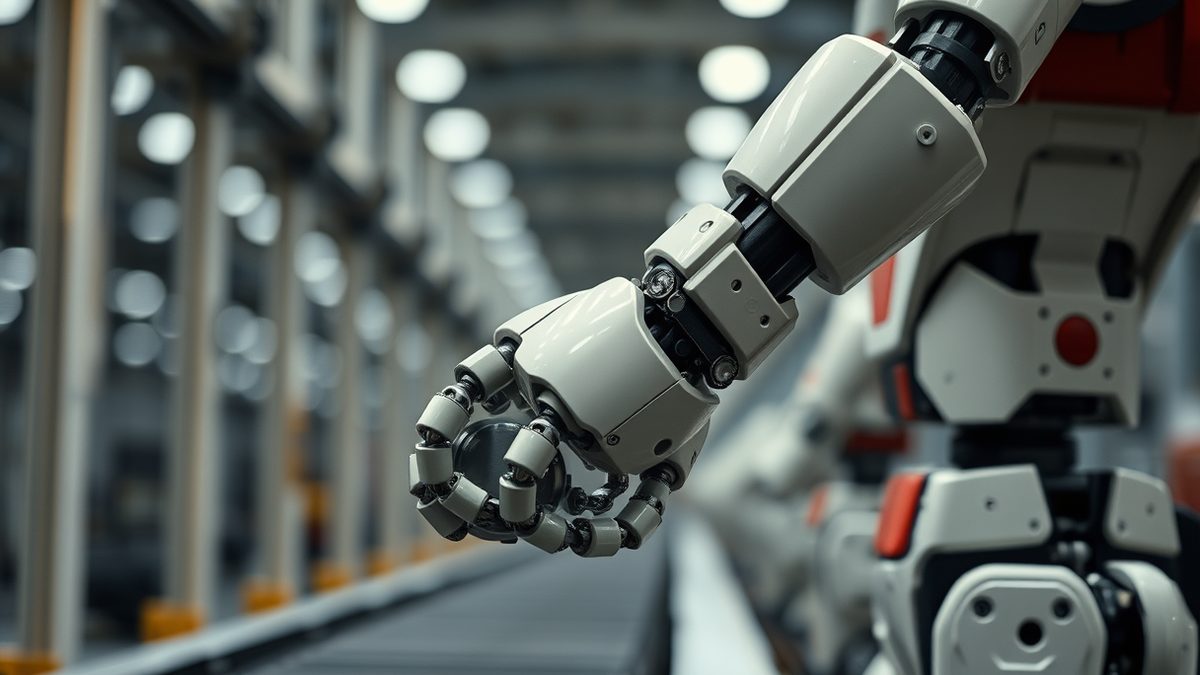
The shift from prototype to production line is accelerating faster than most analysts predicted. The clearest sign is a new facility in China. It is now churning out humanoid units at a rate of one robot every ten minutes.
Construction Physics describes the site as the world's first 10,000-unit-scale industrial humanoid robot smart factory. That label signals a move beyond small-batch testing into genuine mass production. The pace of deployment is changing how investors view the sector. They are pouring capital into physical AI, treating it as the next major revenue stream after generative language models.
The Economics of Embodied AI
Startups are raising record sums. According to Construction Physics, NEURA Robotics and Figure AI have raised $1.4 billion and $1 billion, respectively. Apptronik secured $520 million. China's Unitree went public, raising roughly $900 million. Agility Robotics plans to follow suit via a SPAC later this year. The volume of capital suggests the industry has moved past the proof-of-concept phase.
Brian Potter, writing for Construction Physics, argues that progress is driven less by hardware and more by advances in robot AI. He says the lion's share of recent capability gains comes from specially developed AI models that control the robots. These models, often called policies, map sensor data and instructions to specific robot actions. The goal is to create adaptive agents that can handle unstructured environments. This is a key requirement for factory floors where human workers and machines operate in close proximity.
The VLA Paradigm
The technical architecture powering these robots is standardizing around the vision-language-action model, or VLA. Potter explains that a VLA takes text, images, and robot state information as input. It outputs a series of robot actions. This architecture relies on attention mechanisms and transformer structures, the same components that made large language models successful.
Companies such as Figure, Unitree, Physical Intelligence, and Nvidia are all employing variations of this VLA approach. Physical Intelligence's open-weight pi0.5 VLA, released in 2025, has become widely used in the sector. It is not their most advanced model, but it is a common baseline.
It is not amazingly obvious if VLA's will remain the primary robotic AI paradigm, but as of now they are a very common method for controlling robots.
These models allow for a level of autonomy that was previously unattainable. Robots can now perceive their environment and adjust actions in real time. This adaptability is essential for manufacturing tasks that require precision and flexibility. Sorting packages or assembling complex components demands this kind of responsiveness. The ability to learn from a few examples, as shown by Generalist AI's GEN-1.5 model, suggests the gap between initial training and operational capability is narrowing rapidly.
From Demo to Deployment
Demos have become more impressive over the last year. Experts caution that these must be evaluated with a large grain of salt. Figure showed its robots sorting packages for hours and autonomously unloading a dishwasher. Physical Intelligence demonstrated a robot making coffee and folding boxes in a chocolate factory. While visually striking, these demos serve as evidence of capability rather than proof of industrial viability.
The real test is consistency and reliability over long periods of operation. Toyota is one of the major players pushing for large-scale deployment. CarBuzz reports that Toyota is deploying enough robots to potentially outpace Tesla's Optimus program. The company aims to deploy 400,000 humanoid robots in factories worldwide. The stated goal includes training new human employees as well.
This strategy highlights a dual purpose for the technology. It increases production efficiency and serves as a training tool for the next generation of factory workers. Kawasaki Heavy Industries has set a similar timeline. Nikkei Asia reports the Japanese firm aims for a fully autonomous humanoid AI robot by 2030. This focus on full autonomy suggests a long-term vision that extends beyond immediate factory applications.
The Humanoid Race
The competition is global and intense. In China, the second annual World Humanoid Robot Games showcased robots performing impressive physical feats. These included sprinting and boxing. Startup Fortune reported that a Chinese robot ran 100 meters faster than Usain Bolt ever did. That headline captures the public's fascination with the physical capabilities of these machines.
However, Nation.Cymru points out that the real test is not sprinting or boxing. It is doing mundane tasks like laundry or repetitive factory work. The ability to perform these tasks reliably and safely will determine their commercial success. Hyundai Motor Group is also making significant moves. Evrim Ağacı notes the company unveiled the Atlas robot hand and invested in a surge of talent.
Hyundai is redefining the factory floor with robots and AI in its Singapore hub. The Singapore Economic Development Board has also launched an automation center for logistics. This indicates that the government is actively supporting the integration of these technologies into the local economy. Despite the optimism, challenges remain. The technology is still in its early stages. The transition from laboratory to factory floor is fraught with difficulties.
Safety concerns, regulatory hurdles, and the need for reliable supply chains all present obstacles. The cost of these robots remains high, limiting their adoption to large manufacturers with significant capital resources. The question of whether the economics will work out for smaller firms is still open.
The Future of Work
The rise of humanoid robots is not just a technological story. It is an economic and social one. As these machines take on more tasks, the nature of work in manufacturing will change. Some jobs will be displaced, while others will be created. The training aspect, as seen in Toyota's strategy, suggests these robots may serve as a bridge to new types of human-robot collaboration.
For now, the focus is on scaling production and proving reliability. The 10,000-unit factory in China is a significant milestone, but it is just the beginning. As more companies enter the space and the technology matures, we can expect to see a rapid expansion of humanoid robots in industrial settings. The next few years will be critical in determining whether this technology lives up to its promise or remains a niche curiosity. The investment levels suggest that the industry is betting heavily on the former.
Sources
5- 01Understanding the AI That Drives RobotsEN
- 02Someone ‘Torturing’ LLMs in a Robot Prison Has Triggered the Dumbest Debate in AI YetEN
- 03Against the Personal Agents Theory of EverythingEN
- 04Musk explains why Tesla Robotaxi isn't running at night, and Lidar is the answerEN
- 05How robotics and physical AI can responsibly tackle key physical security challengesEN
All figures and quotations in this text come from the sources listed below.
Content prepared by the editorial team with AI assistance.
Rachel Nwosu
Comments
0- No comments yet — be the first.