IPP to spend €6m on stronger Wendelstein 7-X microwave heating
The Max Planck Institute for Plasma Physics said on 27 July it will spend €6 million from Germany's federal research ministry to replace Wendelstein 7-X's microwave heating with a stronger system, as the Greifswald stellarator works toward power-plant conditions.
 Sofia MarchettiScience and health
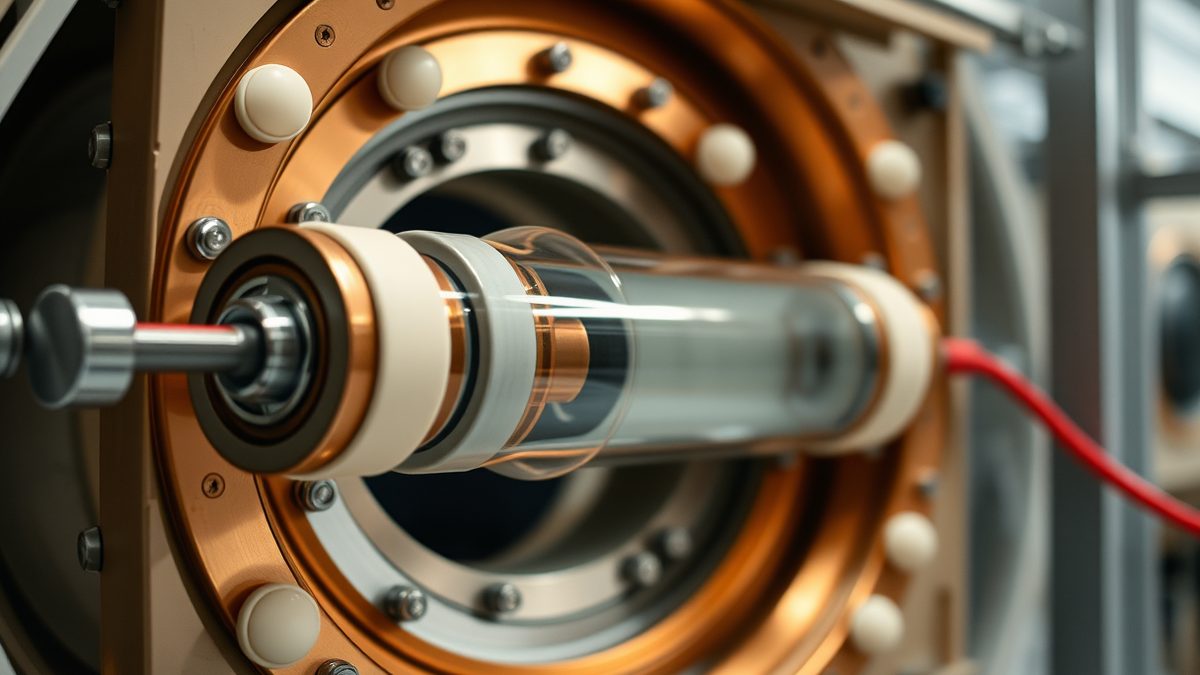
The Max Planck Institute for Plasma Physics will spend €6 million to replace the microwave heating on Wendelstein 7-X with a stronger system, the institute said on 27 July. The money comes from Germany's federal research ministry. The Greifswald machine is halfway through a maintenance shutdown and will not restart until September.
Why the heating needs replacing
Wendelstein 7-X is heated mainly by microwaves through devices called gyrotrons. It has 11 installed, with power ranging from about 0.6 megawatts for the oldest prototypes from 1999 to 1.3 megawatts for the current record holder, Autonocion reported. IPP estimates that reaching the 4 to 5 percent beta that a power plant will likely require would need up to 30 megawatts of heating power, most of it from microwaves. Beta is the plasma pressure relative to the magnetic pressure.
The building limits the fix. Wendelstein 7-X has exactly 12 gyrotron positions. Adding a 13th would cost around €10 million regardless of how powerful the tube is, because it would require a new building, new transmission tunnels and a much bigger high-voltage supply, Autonocion reported. The €6 million replacement avoids that outlay.
The machine and its record
Wendelstein 7-X is the largest stellarator, in Greifswald on Germany's Baltic coast. It runs on 50 superconducting coils, each roughly 3.5 metres tall and chilled to about minus 270 degrees Celsius. According to IPP, working out their shapes took supercomputers.
On 22 May 2025, the last day of its OP 2.3 campaign, the machine held a high-performance plasma for 43 seconds and hit a peak value of the triple product, World Nuclear News reported. The team injected about 90 frozen hydrogen pellets, each about a millimetre across, over those 43 seconds while microwaves heated the plasma. Plasma temperature passed 20 million degrees Celsius and peaked near 30 million. Energy turnover reached 1.8 gigajoules over six minutes, against 1.3 gigajoules in February 2023.
Four weeks later, IPP revised the claim. After researchers at the JET tokamak in Britain shared unpublished results, IPP said its official milestones page now describes the May 2025 result as "on a par with tokamak records" rather than ahead of them, Autonocion reported. JET had three times the plasma volume of Wendelstein 7-X.
The triple product multiplies plasma density, temperature and energy confinement time. All three must be high at once, which is why long pulses matter: they test how well heating, fueling and walls hold up together under stress, according to Earth.com.
Stellarators twist the magnetic cage in three dimensions and aim for continuous operation without a current driven through the plasma. That avoids the disruptions that have challenged tokamaks, Earth.com reported. A tokamak needs a large electrical current through the plasma to help confine it, which makes it a pulsed device by nature, according to Autonocion. Wendelstein 7-X will not produce electricity. It is meant to show whether stellarators can run continuously, while tokamaks operate in pulses, World Nuclear News reported.
In its 2018 campaign, Wendelstein 7-X reached discharges of up to 100 seconds and plasma densities of 2 x 10^20 particles per cubic metre, IPP said. The stronger heating targets the shortfall IPP describes: reaching 4 to 5 percent beta would need up to 30 megawatts, most of it from microwaves.
Sources
20- 01A German fusion machine runs on 50 superconducting coils chilled to 270 degrees below zeroEN
- 02World's most powerful nuclear fusion experiment sets a new recordEN
- 03Wendelstein 7-X sets new fusion performance recordsEN
- 04Successful second round of experiments with Wendelstein 7-XEN
- 05Transatlantic fusion energy research just got easierEN
- 06Transatlantic Fusion Energy Research Just Got EasierEN
- 07Thea Energy und MIT testen planare HTS-Magnete für mögliches FusionskraftwerkEN
- 08AMD's record quarter: Data center business doubles, while gaming cratersEN
- 09Germany’s EV share hits record 37% as BEVs beat gas and diesel combinedEN
- 10STATION F startups raise record €2B as campus unveils 2026 Future 40EN
- 11Text-Only Domain Adaptation for Low-Resource Medical ASR: Shallow Fusion and Density Ratio Rescoring for HausaEN
- 12Short-Term Forecasting of Heterogeneous Wind Power Fleets: Global Temporal Fusion Transformer Leveraging Static CovariatesEN
- 13Kia racks up another record month as its new $30K electric SUV hits dealersEN
- 14North Korea denies being behind record $6.3bn Binance hackEN
- 15AMD Q3 2026 Earnings Data Center Growth Drives Record QuarterEN
- 16Xpeng to report Q3 results on November 16 after record quarterly deliveriesEN
- 17Geely nears monthly sales record as exports remain strongEN
- 18Record Demand Catches (Some) OEMs with Their Pants Down — Europe September 2026EN
- 19Scientists confirm global warming is accelerating faster than ever recordedEN
- 20Is There Anything Left in the Dream of Cold Fusion?EN
All figures and quotations in this text come from the sources listed below.
Content prepared by the editorial team with AI assistance.
Sofia Marchetti
Comments
0- No comments yet — be the first.