ITER coil #17 completes cold test at 34 kA, half operating current
ITER's toroidal field coil #17 completed a cold test at 34 kA, half its 68 kA operating current, and left the Cadarache test stand on 30 October for storage before installation.
 Sofia MarchettiScience and health
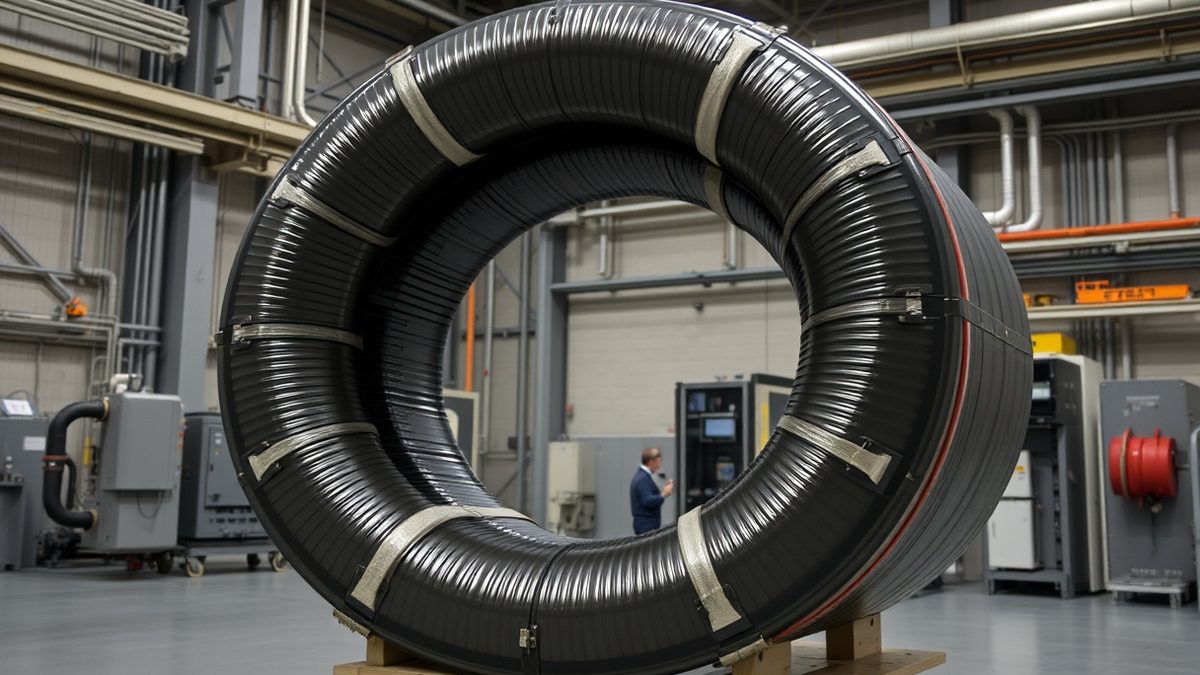
ITER's toroidal field coil #17 completed a cold test at 34 kA, half its 68 kA operating current, and left the magnet cold test facility at Cadarache, France, on 30 October. The 330-tonne D-shaped magnet will go into temporary storage before integration into the final sector module of the plasma chamber.
Why the result matters
ITER is a 35-nation tokamak under construction in southern France to prove fusion's feasibility; it will generate no electricity. Its magnets must hold plasma at 150 million Celsius, about ten times the core of the Sun, away from the machine's walls. The design calls for 500 MW of fusion power from 50 MW of heating, a gain of Q=10, and targets deuterium-tritium operation in 2039.
The coil test
The magnet cold test facility cooled coil #17 to 4 Kelvin, or minus 269 Celsius, and energised it to 34 kA. Superconductors carry current without resistance only below a critical temperature, and the cooldown put the conductor into that state. The 34 kA test was more than three times the 10 kA used in the facility's first campaign, which began in May 2026 with coil #7. Testing of coil #17 began in August 2026.
The Cadarache stand tests cryogenics, vacuum systems, power supplies, electrical feeders and control systems before magnets go into the tokamak. Each test campaign takes four to six months per coil, ITER said.
What the test proves
Engineers measured how the coil deformed under electromagnetic loads and compared that with structural models. “It is an important step to reach 34 kA and to confirm the coil is behaving as predicted by the models,” said Adrien Deydier, ITER's lead mechanical engineer involved in the testing. The campaign also gave teams operating experience ahead of integrated commissioning of the magnet system, he added.
The magnet cold test programme aims to validate high-voltage ground insulation at different temperatures, demonstrate quench detection and verify coil performance at nominal current, ITER said.
What happens next
ITER said engineers will cool coil #19, a spare, to 4 K in April 2027 and test it at 34 kA. That run will be the first to use Paschen-tight connections between the in-cryostat feeder and the coil, replicating the tokamak configuration and letting engineers test high-voltage ground insulation.
The facility will then be opened to install a reinforcement structure designed to prevent coil deformation at the full 68 kA. Engineers will also heat sections of the coil deliberately to trigger a loss of superconductivity as part of temperature-margin testing. After coil #19, the facility will be reconfigured for poloidal field coil #1. ITER's magnet system will use 18 D-shaped toroidal field coils, six poloidal field coils and a central solenoid.
Sources
23- 01World's largest fusion reactor tests 330-tonne magnet built to control superhot plasmaEN
- 02ITER's giant superconducting coil passes key testsEN
- 03ITER magnet test facility begins operationEN
- 04What is the International Thermonuclear Experimental Reactor (ITER)?EN
- 05ITER Fusion Experimental Reactor: Major Core Components Gather, Not Complete, Yet a Major Step ForwardJA
- 06A company outside Boston craned the second 48-ton half of a steel donut into Tokamak HallEN
- 07Europe is building a gigantic fusion reactor to harness solar energy on Earth - Earth.comEN
- 08Swiss expertise to power up ITEREN
- 09S. Korea aims to lead fusion energy race with homegrown reactor by 2035EN
- 10First: Volvo CE Electric equipment does the work, without disturbing the wildlifeEN
- 11Text-Only Domain Adaptation for Low-Resource Medical ASR: Shallow Fusion and Density Ratio Rescoring for HausaEN
- 12Short-Term Forecasting of Heterogeneous Wind Power Fleets: Global Temporal Fusion Transformer Leveraging Static CovariatesEN
- 13STAT+: Who will get the first psychedelic approved?EN
- 14 China deploys 'world's first' 800-volt DC power system for massive AI data center EN
- 15Toyota’s Corolla Cross EV spotted for the first time [Images]EN
- 16Is There Anything Left in the Dream of Cold Fusion?EN
- 17Westward Ho! First Trip Cross Country with Our New 2026 Tesla Model Y & Full Self Driving V14EN
- 18Bluetti 288Wh Elite 30 Mini power station exclusive pre-order deals, Aventon Abound SR + LR cargo e-bikes first savings, moreEN
- 19GAC's battery unit Inpow starts production at Thailand plant, its first overseas pack facilityEN
- 20NVIDIA Updates Rubin GPU Specs as First Production Hardware ArrivesEN
- 21T-Mobile: We'll be first with 6G, and no to SpaceX MVNOEN
- 22Price hikes aren’t all that’s at stake in FirstEnergy Ohio’s rate caseEN
- 23In a global first, Hong Kong opens secondary trading for tokenised public fundsEN
All figures and quotations in this text come from the sources listed below.
Content prepared by the editorial team with AI assistance.
Sofia Marchetti
Comments
0- No comments yet — be the first.