NASA Scrapped a $30M Rescue for Swift. Goddard's Empty Labs Explain Why
NASA and Katalyst Space Technologies called off the Link rescue of the Neil Gehrels Swift Observatory on August 19, 2026, after attitude control failures left the spacecraft spinning at about 9 degrees per second. The $30 million mission had nine months to build a satellite that usually takes years.
 Sofia MarchettiScience and health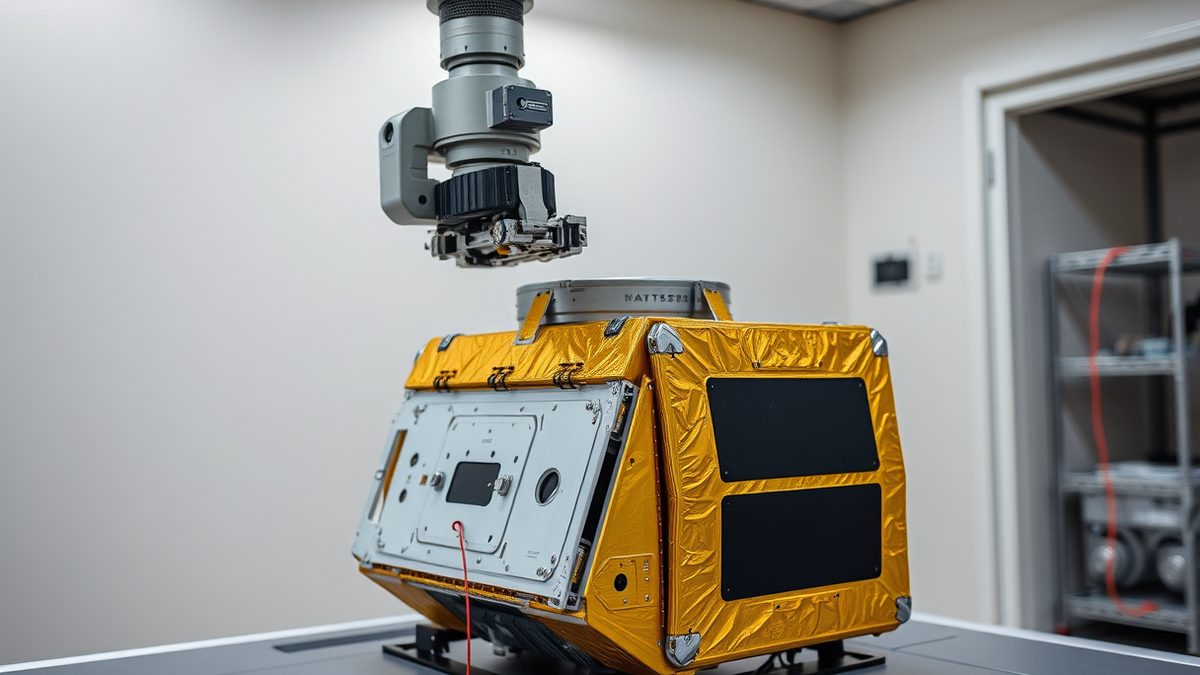
The Swift observatory will burn up in Earth's atmosphere later this year. It has no thrusters to raise its own orbit, so the only way to keep the roughly $500 million mission alive was to send something up to grab it. NASA tried that. It did not work, and the failure is the least interesting part of the story.
NASA awarded Katalyst a $30 million contract in 2025 to build Link, a spacecraft about the size of a refrigerator. Ars Technica reported that Link carried two solar arrays and three xenon-fueled electric thrusters, plus three robotic arms meant to capture Swift and lift it into a higher orbit over several months. The usual timeline for a first-of-its-kind satellite is several years. Katalyst got nine months, because NASA had calculated that Swift's orbit was decaying faster than expected and that any rescue had to launch by summer 2026.
Link launched July 3 on Northrop Grumman's Pegasus XL rocket. Mission managers established communications. Less than two weeks in, teams began reporting problems with the probe's orientation, according to NBC News. A July 15 NASA blog post said Katalyst engineers had "addressed early communications and attitude control issues." Software patches appear to have failed. On July 28, NASA said Link's attitude control systems had malfunctioned, "causing the spacecraft to spin and resulting in sporadic communications."
LINK was rotating at about 9 degrees per second, according to NASA.
Ars Technica reported that two of the satellite's three reaction wheels stopped working, and that cold gas thrusters used for fine pointing also had issues. That left the plasma thrusters as the only way to regain control. Mission managers managed to slow the spin this month. It was not enough. Katalyst said Wednesday that "ongoing attitude control issues" would prevent the capture and boost, and NASA agreed to abandon the rescue.
What Swift was doing, and what stops
Swift launched in 2004 with instruments built to catch gamma-ray bursts, the most powerful explosions in the known universe. Those bursts come from events like the births of black holes and collisions between ultra-dense stars at the end of their lives. Swift's value was not just detection but speed and range: its combination of multi-wavelength instruments and agile pointing let it locate a burst quickly enough for other observatories to follow up. It outlived its original two-year design by two decades.
The observatory had already paused operations ahead of the rescue attempt, Scientific American noted. So the science stopped before the rescue failed. Swift is now expected to reenter and break apart later this year, leaving what Scientific American called a gaping hole in astronomers' observations of the high-energy cosmos that is unlikely to be patched anytime soon. No replacement with the same combination of burst-hunting instruments and rapid pointing is in orbit.
Both NASA and Katalyst are framing the outcome as a loss of the boost, not of the mission. Katalyst said it will still try to approach and rendezvous with Link to run technology demonstrations. The spacecraft is still alive and may get close enough to Swift to test its close-in navigation system. NASA administrator Jared Isaacman said the outcome "does not change why this mission was worth attempting," and that the agency would learn from Link's rendezvous attempt. Shawn Domagal-Goldman, director of NASA's astrophysics division, called it "a first-of-its kind attempt, developed on an unprecedented timeline driven by the Sun's activity."
Katalyst CEO Ghonhee Lee, in a statement, said the company "took on this high-risk, high-reward challenge" and is "proud of the milestones we reached along the way," adding that the goal now is "building a repeatable playbook to inform future rendezvous and proximity operations and satellite servicing."
The part that is harder to write off
Here is where the Swift failure stops being a story about one satellite. The reason the timeline was nine months instead of several years is that Swift's orbit decayed faster than expected, and the reason for that is the Sun. All satellites in low Earth orbit lose altitude to atmospheric drag, but when solar activity ramps up, the atmosphere heats and expands, and drag increases sharply. NBC News traced the observatory's problems to 2024, during a period of intense solar activity.
NASA knew this was coming. It still had to compress a first-of-its-kind servicing mission into a schedule that Ars Technica described as forcing hard trade-offs, with the schedule driving engineers to tolerate technical risks they might not otherwise accept. That is a decision about risk appetite, and it was made under a deadline the Sun set.
Then there is Goddard Space Flight Center, where NASA builds spacecraft. On September 15, NPR reported that seven current and former Goddard scientists and engineers said relocations over the past 10 months had cost them specialized workspaces, employees and expensive machines needed to build the Roman Space Telescope and other spacecraft. Engineers told NPR that propulsion teams had to test Roman's fuel with less sensitive gear because more precise tools were lost in a move months earlier. A radio communications lab lost almost all its equipment, including what an engineer described to NPR as a $6 million antenna chamber, and could not test an antenna for Roman before launch.
The same pattern hit a satellite that is already in orbit. One engineer told NPR they had to launch a satellite called GRITSS in July before it was ready, without testing its ability to radio communications back to Earth. "We are half-blind in terms of trying to troubleshoot it," a scientist who worked on the satellite told NPR. Work on a Venus spacecraft called DAVINCI was delayed in August for lack of a lab.
NASA's management told NPR through internal documents that the moves were aimed at reducing costs and eliminating "waste and redundancies," and that they aligned with a previously published master plan and would avoid tens of millions of dollars in deferred maintenance.
Jack Kiraly, chief of advocacy at the Planetary Society, told NPR that the relocations "only add a whole lot of risk to an already risky endeavor" and that "these are potentially billions of dollars' worth of taxpayer investment."
Put the two stories side by side. A telescope NASA cannot save because it has no thrusters and its orbit is decaying. A rescue mission built in nine months that fails on attitude control. And a spacecraft-building center where engineers say they are losing the labs and tools that make satellites work. The Swift rescue was designed to demonstrate that NASA could move fast with private partners. It moved fast. The hardware did not cooperate, and the deadline was not negotiable.
Sources
4- 01NASA calls off rescue mission for its falling Swift space telescopeEN
- 02NASA mission to save its sinking space telescope failsEN
- 03NASA calls off mission to rescue Swift gamma-ray observatoryEN
- 04NASA scientists say relocations put space missions at riskEN
All figures and quotations in this text come from the sources listed below.
Content prepared by the editorial team with AI assistance.
Sofia Marchetti
Comments
0- No comments yet — be the first.