VivoSim and Chemveda put human tissue at the centre of AI drug discovery
VivoSim Labs and Chemveda Life Sciences said on 3 November that they will test AI-designed drug candidates in human tissue models, with VivoSim claiming its screens can evaluate more than 20 compounds in two weeks.
 Grace OkonkwoAI, models and technology
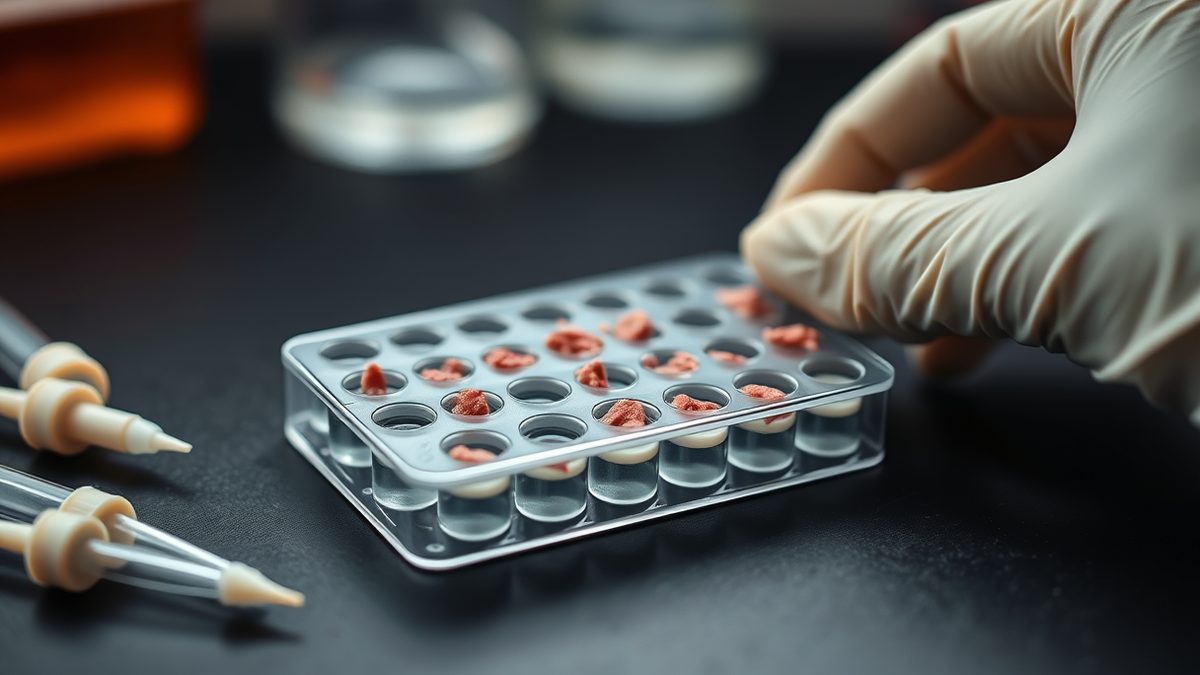
Generative models now propose molecules far faster than anyone can test them. Safety is where the queue forms.
If human-tissue screens work as advertised, biotech clients could drop bad compounds earlier and cut animal testing. Nobody has shown yet that better lab predictions lift clinical success rates.
The deal: human tissue as the test bench
Under the collaboration, Chemveda will design, synthesize and optimize AI-derived compounds for pharmaceutical and biotechnology clients. VivoSim will run selected molecules through its NAMkind Liver and NAMkind Intestine models, which are built from primary human cells. Why put human tissue in the loop at all? Because the chemist needs the toxicity signal while the molecule can still be changed. VivoSim calls this a rapid design-make-test cycle, with tissue data feeding back into synthesis rather than arriving after a candidate is locked. Keith Murphy, VivoSim's executive chairman, put the problem in blunt terms in the announcement. AI has handed the industry "a firehose producing new molecules", he said, but not a way to know which will work and which may harm patients.
Why safety testing is the bottleneck
The pitch rests on a familiar failure mode. Liver and gastrointestinal toxicity remain among the most common reasons promising drugs fail in the clinic, often after years of work and hundreds of millions of dollars. Generative models can now propose thousands of novel molecules in the time it once took to design a handful. VivoSim's evidence is a clinical dataset of 92 small-molecule compounds. On that set its NAMkind Liver model predicted drug-induced liver injury with 91% accuracy, 90% sensitivity and 95% specificity, the company says. It also claims more than 90% sensitivity where animal models and traditional methods detect only 50% to 65% of true liver toxicants.
These are company figures. They were published in a company announcement and have not been independently replicated.
The regulatory tailwind is real, though. The US Food and Drug Administration actively encourages human-relevant new approach methodologies in place of animal testing, according to the same announcement. That matters commercially: a screen regulators accept is worth more than one that only convinces a chemist.
Other groups are building the same validation layer
VivoSim is not alone in selling validation rather than generation. QurieGen and Rayca Precision said on 3 November that they will link target discovery, AI-powered molecular design and cellular validation in one iterative workflow. QurieGen measures gene expression, surface and intracellular proteins and phosphoproteins in individual cells over time. Rayca combines AI with physics-based simulations to model how proteins move and to find binding sites, including temporarily accessible ones. A pilot between them starts with one biological question, a disease area and agreed constraints. When results differ from expectations, the data is meant to separate a bad target from a bad molecule. The partners say the loop is designed to cut uncertainty before critical R&D decisions.
Money is moving into the same layer. Vitroscope raised $7 million, a $5 million seed round plus $2 million in non-dilutive funding from the Research Council of Norway, and has raised $8.8 million to date.
Its vitro.alive benchtop platform runs six independent, parallel experiments, and Vitroscope and Instant Bio kept vascularised human brain organoids under perfusion for seven days. A 96-experiment version, vitro.scale, is in development. Data is the other route. Parse Biosciences and Nomic Bio are building Cascade, a baseline dataset of 100 million cells that pairs single-cell RNA sequencing with more than 11,000 secretory protein profiles across more than 150,000 cytokine and drug conditions. GSK, Pfizer, Sanofi, Graph Therapeutics and Turbine have signed on as partners, according to the companies.
What would count as proof
What would proof look like? VivoSim says its partners will know in weeks, not years, which molecules deserve to move forward.
That is a claim about speed. The harder claim, that human-relevant screens raise the share of candidates surviving trials, will take years to test. Big pharma's own deals show the timeline. AstraZeneca signed a strategic drug discovery partnership with Insitro covering metabolic liver disease and heart muscle conditions, structured as milestone-based payments. Kalkine Media noted that any commercial benefit from that alliance would lie many years ahead. Vitroscope's new money is earmarked for commercial rollout of vitro.alive and for higher-throughput work with vitro.scale. Parse and Nomic call Cascade the largest resource of its kind ready for AI applications to model the immune system. Murphy said the aim is to replace guesswork with human-relevant results. None of these groups has published a clinical success rate. That number, when it arrives, will settle the argument.
Sources
28- 01VivoSim Labs and Chemveda Life Sciences Join Forces to Put AI-Designed Drug Candidates to the Human TestEN
- 02QurieGen and Rayca Precision redefine drug discovery by connecting novel target discovery with AI-powered drug designEN
- 03Vitroscope raises $7M to turn living human tissue into a new source of drug discovery dataEN
- 04Parse Biosciences and Nomic Bio Launch 100-Million-Cell Immune Dataset to Advance AI Drug DiscoveryEN
- 05Can AstraZeneca (LSE:AZN) turn its new Insitro tie-up into faster drug discovery this week?EN
- 06Scientists discover new Alzheimer’s drug that repairs DNA damage and reduces brain inflammationEN
- 07Ex-Phoenix Court partner launches $17M debut solo fund to discover next LovableEN
- 08STAT+: Servier’s $1.55 billion muscular dystrophy drug fails first major testEN
- 09The Claude effect: In AI drug discovery, commoditisation leads to collaboration - pharmaphorumEN
- 10All 5 genetic “letters” of DNA and RNA discovered in a 4.5-billion-year-old asteroidEN
- 11DOE Announces $8.5M for Fusion Energy Public-Private PartnershipsEN
- 12Servier's $1.5B bet on Edgewise drug fails five months inEN
- 13Three biotech platforms, one mission: Flagship Pioneering’s bet on AI drug discoveryEN
- 14Scientists discover that some “unhealthy” diets can boost cancer immunotherapy in miceEN
- 15CATL expands eVTOL partnerships with Blue Vector dealEN
- 16NASA's Hubble and Webb discover ancient worlds that remember their pastEN
- 17 Anycubic and Thingiverse announce exclusive 3D printing partnership EN
- 1828 Zero-Day Findings in Less Than Two Days: What AI-Speed Discovery Means for RoboticsEN
- 19Scientists discover the hidden “muscles” trees use to straighten themselvesEN
- 20WuXi Biologics, Fresenius partner ahead of biosimilar boomEN
- 21Scientists discover metals that defy the deep freeze at -424°FEN
- 22Scientists discover a bacterial defense so strange they thought it was brokenEN
- 23A surprising vitamin A discovery is changing what scientists know about visionEN
- 24Podcast: Rivian earnings, Waymo partners with Toyota, Ford bets on V2H for Fathom, and moreEN
- 25Scientists discover mysterious seahorse lookalikes that no one has ever seen aliveEN
- 26Scientists discover why chronic back pain feels so personalEN
- 27NASA discovers Jupiter’s invisible shield is more complex than Earth’sEN
- 28Scientists discover a hidden oxygen reservoir deep inside EarthEN
All figures and quotations in this text come from the sources listed below.
Content prepared by the editorial team with AI assistance.
Grace Okonkwo
Comments
0- No comments yet — be the first.