EUV: the 350 million euro machine nobody can replicate
The latest lithography machine weighs 200 tons, arrives in pieces on three Boeing 747s and costs between 200 and 350 million euros. One company in the world builds it: ASML of the Netherlands.
 Rachel NwosuAI, models and technology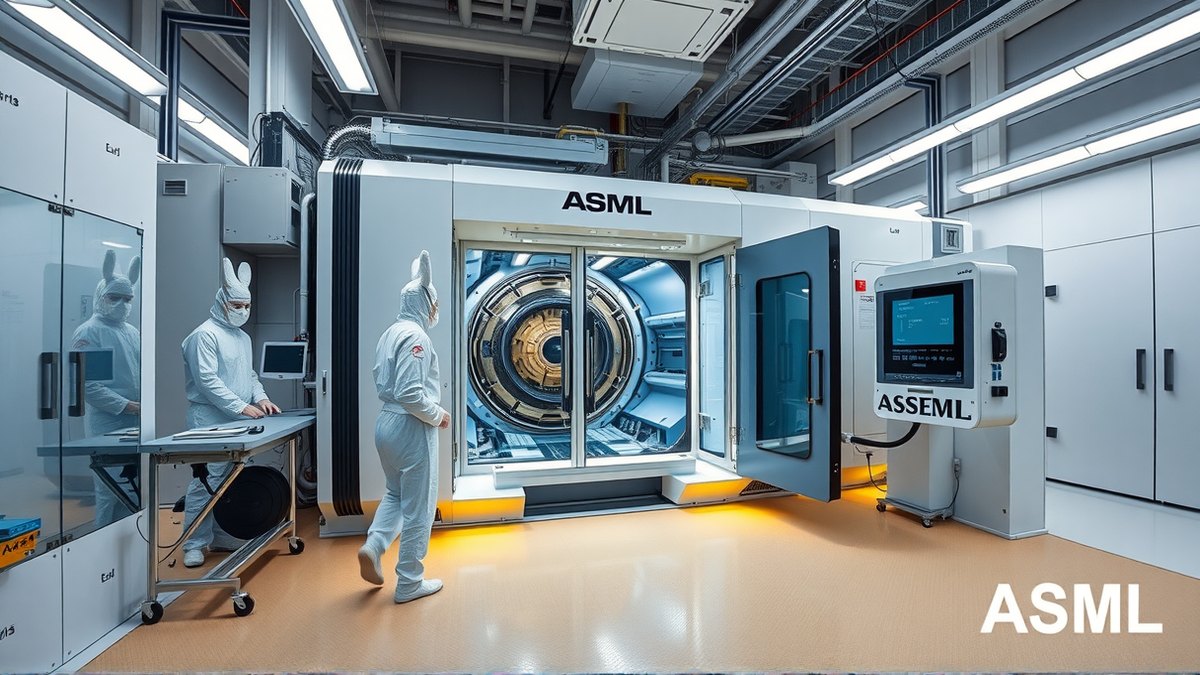
No modern AI processor exists without a single machine. heise online, writing about TSMC, and t3n.de, writing about EUV lithography, explain why it is the bottleneck of the whole industry.
Start with scale. Process names such as "3 nanometres" and "2 nanometres" say nothing about the actual dimensions of the structures. They are generation labels. Real features measure around 20 nanometres. A coronavirus is about 100 nanometres across, and a human hair is 80 000 nanometres thick. One current Apple chip packs roughly 20 000 000 000 transistors into an area smaller than a fingernail.
How is it done? Lithography is photography in reverse. A light-sensitive lacquer goes onto a silicon wafer 30 centimetres across, a pattern is projected onto it with light, and the lacquer is developed and etched. Then comes the next layer, and the next, 80 or 100 of them stacked on top of one another. The catch: you cannot expose structures much smaller than the wavelength of the light. For decades the industry used ultraviolet light with a wavelength of 193 nanometres and squeezed it with tricks, multiple exposures and a layer of water. When that stopped being enough, it reached for EUV, extreme ultraviolet light with a wavelength of 13.5 nanometres.
How the light is made
Only one company in the world builds machines that can produce such light: ASML of the Netherlands. A single unit starts at 200 000 000 euros, and the latest generation costs rather around 350 000 000. The device weighs 200 tons, and it takes three Boeing 747 transport aircraft and several trucks to deliver it.
Making the light sounds like the experiment it is. A droplet of molten tin flies through a vacuum and a laser hits it twice. The first pulse flattens the droplet, the second vaporises it into a plasma, which briefly glows in the EUV range. The machine does this 50 000 times per second. The light is so energetic that ordinary lenses would simply absorb it, so mirrors take their place. They have to be so smooth, and the figure comes straight from Zeiss, which makes them, that if you scaled one up to the size of Germany, its largest bump would measure one tenth of a millimetre.
Why nobody will repeat it
The scale of the investment explains why no single country can recreate the whole chain. heise notes that for Taiwan, TSMC works as a "silicon shield", and estimates cited in the piece say that halting production there would cut global gross domestic product by around 10 percent. Politics circles in the background too: t3n mentions accusations by the US administration that one advanced EUV machine reached China, which by itself shows how strategic this equipment is.
For a reader in Europe this is more than a technical curiosity. The Dutch monopoly on lithography and the German mirrors are the only links in the global semiconductor chain where Europe still holds a position that cannot be bypassed. The rest, design, manufacturing and packaging, has spread across Taiwan, Korea, the USA and China. That is at once the strongest argument in Europe's debate about technological sovereignty and its weakest point: a single conflict around the Taiwan Strait would be enough to stop the whole chain.
Sources
2- 01heise: Warum diese Chipfirma niemand nachbauen kannDE
- 02t3n: EUV-Lithographie – die komplizierteste MaschineDE
All figures and quotations in this text come from the sources listed below.
Content prepared by the editorial team with AI assistance.
Rachel Nwosu
Comments
0- No comments yet — be the first.