Foxconn targets quantum manufacturing as Quint raises €9.1M for error correction
Foxconn aims to be the world's largest quantum computer manufacturer, chairman Young Liu told CNBC in an interview reported on 3 November. Commercial viability is at least two years away; Quint Computing reported raising €9.1 million for hardware error correction.
 Grace OkonkwoAI, models and technology
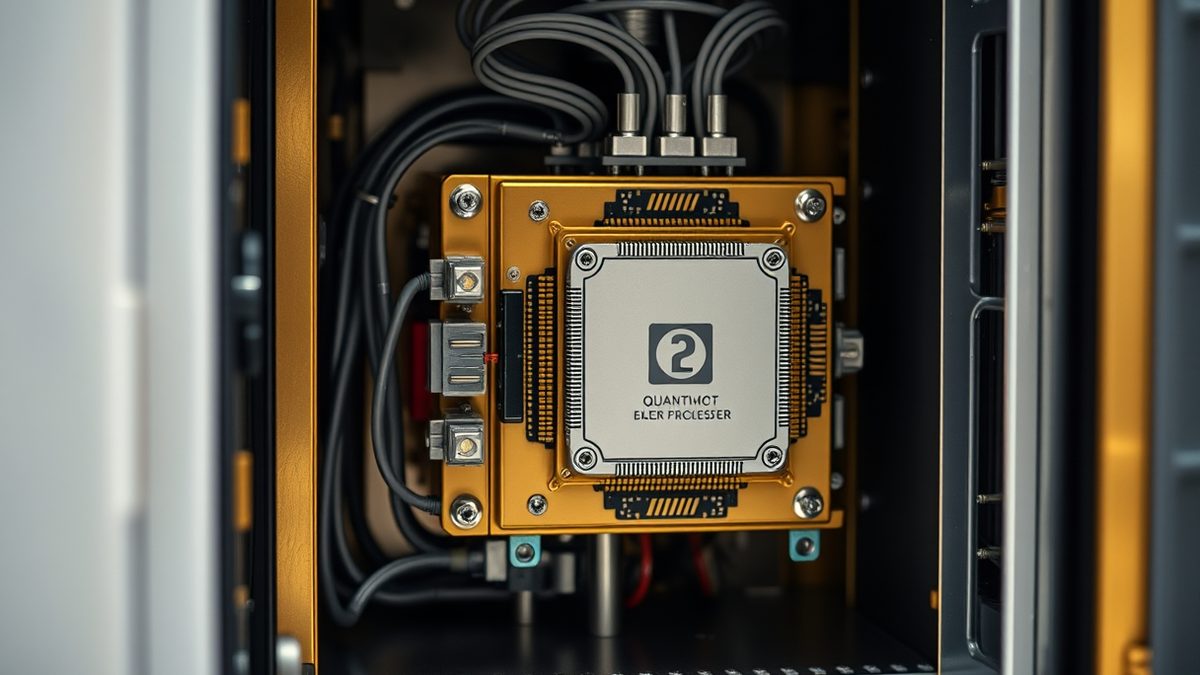
Liu said Foxconn had found a role building machines for quantum hardware companies. It would not sell quantum computers under its own brand. "We focus on manufacturing," he told CNBC, according to a Data Center Dynamics report on 3 November. "We hope we can become the largest quantum computer manufacturer in the world without owning that technology." He also played down the idea that quantum machines will displace existing chips. He described them as an addition to CPUs and GPUs for problems that classical computers handle slowly.
The distinction matters for anyone buying quantum capacity. Foxconn is betting on assembly and scale, not on qubit design. Liu applied his two-year timeline to the whole industry, not just his own company.
The same day brought money for the other end of the problem. German startup Quint Computing said it raised €9.1 million in an initial round led by Vsquared. Quantonation, Nucleus Capital, Faber, Vanagon Ventures and ZOHO.VC participated, alongside Prof. Mikko Möttönen, founder of IQM and QMill. The European Innovation Council separately awarded a €2.2 million Pathfinder grant, Tech.eu and HPCwire reported on 3 November.
Physicists Michael Hartmann and Christopher Eichler and economist Jona Stinner founded Quint in October 2025. It grew out of research at Friedrich-Alexander-Universität Erlangen-Nürnberg. It is part of the Munich Quantum Valley ecosystem.
The company's bet is on hardware-level error correction. Its superconducting chip architecture aims to stop a large share of errors inside individual circuit elements. It would not correct them afterwards with software and extra qubits. Once fully implemented, HPCwire reported, the approach is expected to cut complexity, hardware overhead and energy consumption by a factor of 100. It would keep clock speed high.
"The race to build commercially viable quantum computers is gaining momentum," Eichler said in the funding announcement. "Quint has a clear roadmap to accelerate the development of the required technology." He is the chief executive.
Hardware milestones are arriving in parallel. IBM Research published a paper describing four long-distance couplers, or L-couplers. They operate between two 120-qubit Nighthawk R1 superconducting processors at meter scale. The work is a step toward stitching processor modules into larger machines. SemiEngineering flagged the paper, arXiv 2610.29986, on 2 November.
Public money is moving too. Canada's Quantum Champions Program, which Canada announced in December 2025, provides up to C$92 million, about $64.5 million, in milestone-based contributions. The program splits the money between Anyon Systems, Nord Quantique, Photonic and Xanadu, EE Times reported on 2 November. Three of those companies are also taking part in DARPA's Quantum Benchmarking Initiative. It assesses roadmaps and costs rather than qubit counts. It asks whether a system can deliver value that exceeds its cost by 2033.
Julien Camirand Lemyre, chief executive of Sherbrooke-based Nord Quantique, told EE Times that defence procurement could support earlier-stage technology. Canada, he said, must be prepared "not only to buy quantum computers but also to use this technology."
Larger vendors are repositioning around the same assumptions. Intel said on 26 October it had agreed to acquire Israeli quantum software company Classiq. It aims to build a full-stack platform around its silicon spin-qubit work. SoftBank and five Japanese partners started a NEDO-funded materials development project. The partners are AGC, Toppan Holdings, Aisin, Asahi Kasei and DIC. The project runs from fiscal 2026 to fiscal 2028, Light Reading reported on 28 October.
Networking suppliers see a supporting role. Lumen said on 29 October it would fund research at Ohio State University into quantum connectivity over fibre. It is preparing quantum-resistant security inside a Fortinet-based secure access service edge product.
Further out, UK engineering firm Craft Prospect is building a quantum key distribution space network emulator. It is working on payloads for the €20 million OPS-SAT VOLT mission, SpaceNews reported on 21 October. None of these projects ships a fault-tolerant machine today. Liu's two-year horizon and the startups' roadmaps describe the same gap from opposite sides.
Sources
9- 01Foxconn details quantum ambitions, wants to become world's "largest quantum computer manufacturer"EN
- 02Quint Computing raises €9.1M to scale quantum computing technologyEN
- 03Quint Computing Raises €9.1M to Advance Fault-Tolerant Quantum ComputingEN
- 04Quantum Interconnects Link Two 120-Qubit Processors (IBM Research)EN
- 05Canada's Quantum Sector Sets Sights on CommercializationEN
- 06Intel to Acquire Classiq to Create a Full-stack Quantum Computing PlatformEN
- 07SoftBank teams up with five Japanese firms to build quantum-based platformEN
- 08Lumen redefining networking for AI and quantum eras with three new initiativesEN
- 09Summer of Quantum: Building momentum for space-based QKDEN
All figures and quotations in this text come from the sources listed below.
Content prepared by the editorial team with AI assistance.
Grace Okonkwo
Comments
0- No comments yet — be the first.