Google and IBM raced to quantum milestones while rivals argued over the scoreboard
In April 2017, John Martinis of Google gave his team until the end of that year to build a chip that could perform a calculation beyond any conventional computer. IBM announced a 50-qubit processor prototype that November.
 Rachel NwosuAI, models and technology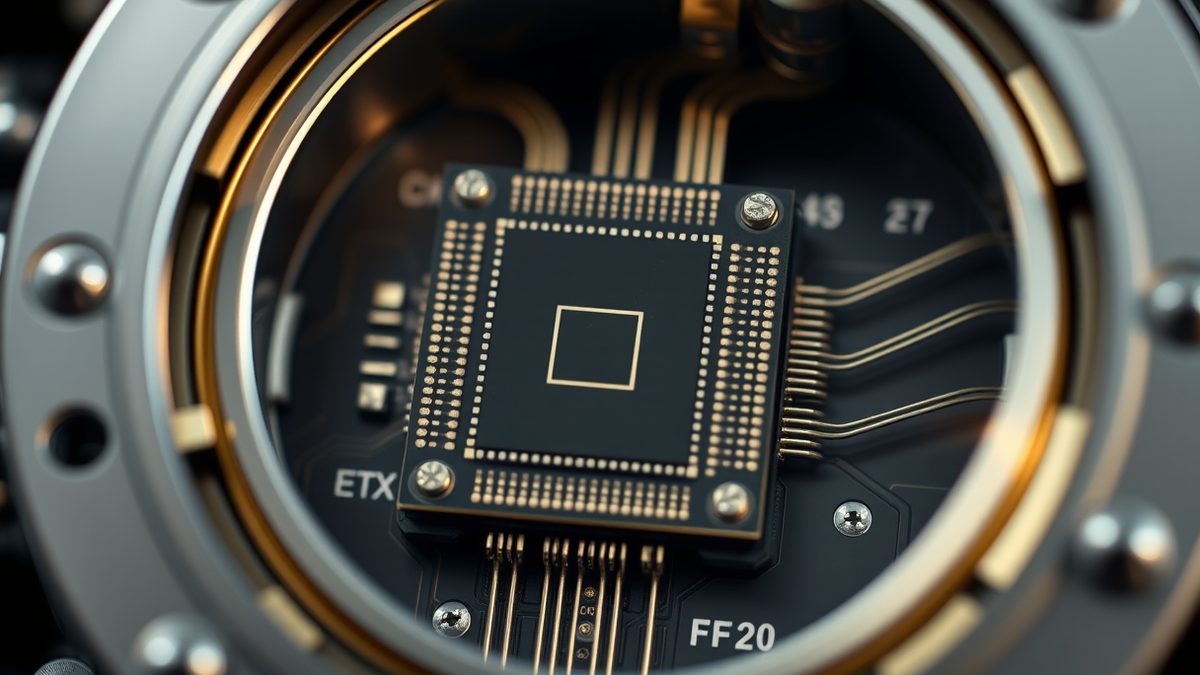
In April 2017, John Martinis of Google gave his team until the end of that year to build a chip that could perform a calculation beyond any conventional computer. IBM announced a 50-qubit processor prototype that November.
Martinis joined Google in late 2014 from the University of California, Santa Barbara. He told MIT Technology Review that his group of roughly 25 people would reach "quantum supremacy" by the end of 2017. The experiment would pit Google's chip against one of the world's largest supercomputers. Designs for devices with 30 to 50 qubits were already in progress, he said.
Google's published chip at the time carried nine qubits arranged in a line. The newest device MIT Technology Review reported on had only six qubits, but they sat in a two-by-three grid. Martinis said that showed the technology still worked when qubits sat side by side. The six-qubit chip also tested a manufacturing method: qubits and their control wiring are made on separate chips and later bump bonded together.
"That process is all working," Martinis said. "Now we're ready to kind of move fast."
Simon Gustavsson, a principal investigator in a quantum computing group at MIT, told MIT Technology Review that Google was one of the leaders and that the field was "pretty comparable between Google and IBM." Chris Monroe, a University of Maryland professor and cofounder of the startup IonQ, called the supremacy experiment "an academic milestone." The harder work, he said, would be making such machines scalable and programmable.
IBM claims the 50-qubit mark first
On 10 November 2017, IBM said its scientists had built and measured a processor prototype with 50 qubits. Dario Gil, who led IBM's quantum computing and artificial intelligence research division, said it was the first time any company had built a quantum computer at that scale, according to the Associated Press. Seth Lloyd, an MIT mechanical engineering professor not involved in the research, told the AP that IBM likely still had glitches to work out. Even so, he said, the announcement was a sign of significant progress.
A month later, at the Q2B conference at NASA Ames, Martinis pushed back on how such milestones get counted. "Press releases always talk about quantum space race in number of qubits," he said, according to Gizmodo. "It's more than just quantity, it's qubit quality."
Gizmodo reported that Google was then fabricating a 49 or 50 qubit device and planned to begin testing within two weeks. Martinis said the chosen problem had to be hard, require many high-quality qubits and be generalizable to any quantum computer. The team would entangle its qubits, let the system evolve, then measure outcomes whose probabilities are so complex that a classical machine might need weeks to simulate what the quantum device does in minutes.
The conference also heard from CalTech theorist John Preskill, who described the emerging NISQ era, for Noisy, Intermediate-Scale quantum computers. Fault tolerance, he said, had to keep advancing.
The scoreboard moves again
By March 2019, IBM had shifted the argument to a different metric entirely. At the American Physical Society March Meeting, the company said its Q System One, with a 20-qubit processor, reached a Quantum Volume of 16, double the Quantum Volume of 8 for its existing IBM Q system, ZDNET reported.
IBM said Quantum Volume accounts for qubit count, connectivity, coherence time, gate and measurement errors, device cross talk and compiler efficiency. The company said the metric would need to double every year to reach Quantum Advantage within the next decade, and that it had doubled the power of its quantum computers annually since 2017.
Sources
4- 01Google's New Chip Is a Stepping Stone to Quantum Computing SupremacyEN
- 02IBM says it's reached milestone in quantum computingEN
- 03Why Google Is Poised to Hit the Next Critical Milestone in Quantum ComputingEN
- 04IBM hits quantum computing milestone, may see 'Quantum Advantage' in 2020sEN
All figures and quotations in this text come from the sources listed below.
Content prepared by the editorial team with AI assistance.
Rachel Nwosu
Comments
0- No comments yet — be the first.