Humanoid Robots on the Factory Floor: Strikes, Training Camps and a Long Road Ahead
Thousands of Hyundai workers walked off the job in July 2026 after 15 rounds of negotiations over humanoid robot deployment failed. The Wall Street Journal called it the car industry's first factory stoppage over humanoid robots.
 Rachel NwosuAI, models and technology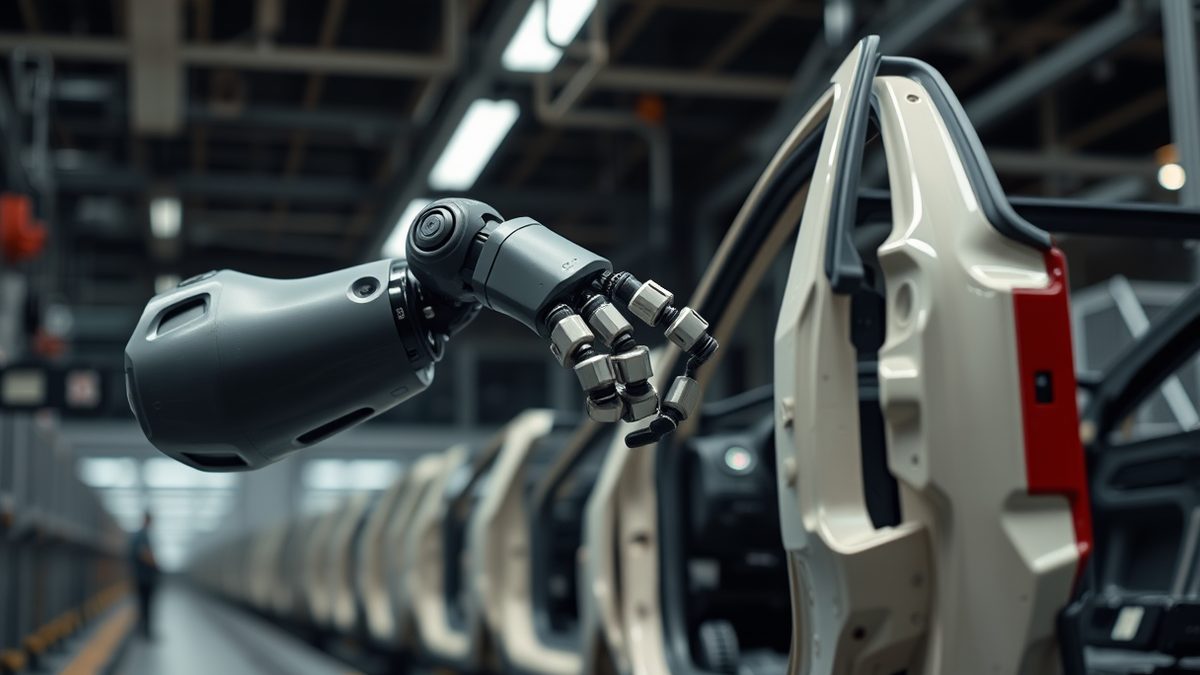
Thousands of unionized workers at Hyundai's Ulsan complex in South Korea began leaving their shifts two hours early from July 13 to July 15, 2026. They planned four-hour strikes from July 20 to 22. The Korea Times reported the action followed 15 failed rounds of negotiations over the automaker's plans to deploy humanoid robots. Ulsan is the world's largest automotive plant.
The union represents more than 39,000 South Korean workers. It wants hourly production pay converted to a fixed salary, so that any automation-driven cut in working hours does not hit take-home pay. It also wants the retirement age raised from 60 to 65, according to The Wall Street Journal. The union has pushed for bigger bonuses as well.
The trigger was Atlas, the two-legged humanoid made by Boston Dynamics. It stands more than 6 feet tall and can lift over 100 pounds. Hyundai Motor Group showed the latest version at the start of this year. Hyundai aims to put more than 25,000 Atlas robots across Hyundai and Kia plants, The Korea Herald reported, starting with US factories in 2028. No timeline has been disclosed for other markets.
The economics that worry the union
Each Atlas unit costs an estimated $130,000 but may pay for itself in about two years of operation, according to Samsung Securities analyst Esther Yim, speaking to Bloomberg. James Hong of Macquarie Securities Korea suggested that if the unit cost eventually falls to $100,000, running costs could drop below the US federal minimum wage of $7.25 an hour. That would undercut a typical auto worker's salary by a wide margin.
That math is not unique to Hyundai. Tesla has been developing its Optimus robot for its own EV factories. BMW has run pilot tests with humanoid robots from Figure AI at its plant in Spartanburg, South Carolina. Chinese automakers including BYD are trying humanoids too, and in some cases building their own. The automation push sits on decades of industrial robotics: more than 1 million robots were already installed in automotive factories worldwide by 2021, about one-third of all industrial robots, according to the International Federation of Robotics. The United States had deployed 38,000 industrial robots as of 2025, with 13,500 of them in automotive.
What is different now is the pitch. Traditional industrial arms do one task. Humanoid robots running modern AI models are marketed as general-purpose machines that can eventually handle many jobs while fitting into workplaces built for people. That promise, not the current capability, is what unions are bargaining against.
Georgia, where the first US deployment lands
Hyundai plans to put Atlas to work first at Metaplant America, its EV factory outside Savannah, Georgia, starting in 2028. The plant is already the most heavily automated automotive factory in the United States, with more than 850 robots unloading parts, stamping steel, assembling frames and fitting doors, according to IEEE Spectrum. It also runs 300 automated guided vehicles that move parts to work stations while avoiding people. Boston Dynamics' four-legged Spot robot performs exterior quality inspection in the weld shop. An Atlanta Journal-Constitution reporter visiting in July 2026 described the robotic dogs probing sensor-embedded noses to sniff out defects.
Atlas would start with sorting and organizing parts. Jerald Roach, a general assembly executive at Metaplant, told the AJC that humanoid robots will not threaten the human workforce. Human hands and their sense of touch are needed for soft parts such as hoses, wires, carpets and trim panels, he argued.
Hyundai has committed to 8,100 full-time human workers at Metaplant by 2031 under its economic development deal with Georgia, which came with an incentive package worth an estimated $2.1 billion. The AJC found the site already employed more than 3,800 workers by the end of 2025. US workers there are not unionized, though the United Auto Workers, which represents about 400,000 autoworkers across the US, Canada and Puerto Rico, has been trying to organize the Georgia facility.
Pressure is building elsewhere in the US. The UAW recently criticized General Motors for installing about 50 new robot arms at its flagship EV plant in Detroit after laying off more than 1,300 workers as a supposedly temporary measure. At the UAW Constitutional Convention in Detroit in June 2026, president Shawn Fain warned against the direction of travel, according to Ars Technica's account.
China's data factories
The training problem is harder than the hardware problem, and China is attacking it with state money. Local governments have announced more than 40 state-owned robot data collection centers, with about two dozen already operating, according to the intelligence firm Interact Analysis. Rest of World reported on trainers who wear VR headsets and arm exoskeletons to repeat movements such as opening a microwave door, folding clothes or stacking blocks, hundreds of times a day, so humanoid robots can learn them.
One of the largest, in suburban Beijing's Shijingshan district, was launched with humanoid company Leju. It covers more than 10,000 square meters and offers 16 training scenarios, including a mock car assembly line, a smart home and an elder-care facility, according to a government statement. A project spokesperson quoted in that statement compared it to teaching children to walk through practice. In Hubei province, nearly 100 humanoids controlled by humans practise folding, ironing and wiping tables.
Interact Analysis analyst Marco Wang told Rest of World the infrastructure buildout risks overcapacity: "There are some potential bubbles," he said. Goldman Sachs estimates the worldwide humanoid robot market could be worth $38 billion by 2035, with some 250,000 shipments as early as 2030. Tesla has dozens of workers acting out motions to train Optimus, a much smaller effort than China's.
What the robots can actually do
The second World Humanoid Robot Games, hosted in Beijing from August 22 to 26, 2026, offered a useful reality check. Viral clips showed sprinting robots beating Usain Bolt's human 100-meter record, alongside robots crashing into barriers, falling because they could not stop, breaking at the waist in showers of sparks, or catching fire. Many competitors were still teleoperated by humans, and the event penalized scores for remote control rather than autonomous operation. In an outdoor firefighting scenario, only three of 12 teams finished the full task, according to the Global Times.
Dipam Patel, a Purdue University computer science PhD student and IEEE graduate student member, told Ars Technica that the record-breaking runs do demonstrate whole-body control, since every joint has to move to complete the task. But he noted the robots were engineered for one job. They sprinted in a straight line and could not slow down around the track after the finish. "You can simulate something like 100,000 scenarios for hammering a nail, but that's just one task from millions of tasks in the world," Patel said.
"If you cross the finish line, that's the goal. It doesn't matter if you stop and it doesn't matter if you fall into different pieces."
Patel suggested the games would mean more if robots had to run the same race 10 times, proving reliability rather than a single performance. The less flashy events, such as laundry, hotel housekeeping and library shelving, may prove better benchmarks.
The broader context is a race between capability and cost. Google DeepMind announced at CES in January 2026 that its Gemini Robotics model would run on Boston Dynamics robots including Atlas and Spot, with tests planned at Hyundai factories. Boston Dynamics CEO Robert Playter told WIRED that manufacturing environments like Hyundai's are a good place to deploy context-aware robots, while acknowledging that guaranteeing human safety is essential: "Even the little ones can be dangerous," he said.
Analysts and engineers agree the general-purpose factory humanoid is not here yet. The question unions are answering now is who bears the risk while the industry finds out how long the road is.
Sources
4- 01Fear of humanoid robots spurs human workers to strike at Hyundai auto factoryEN
- 02Google Gemini Is Taking Control of Humanoid Robots on Auto Factory FloorsEN
- 03In Chinese data factories, workers teach humanoid robots boring tasksEN
- 04World humanoid robot games show runners breaking records, bursting into flamesEN
All figures and quotations in this text come from the sources listed below.
Content prepared by the editorial team with AI assistance.
Rachel Nwosu
Comments
0- No comments yet — be the first.