Innodata opens motion-capture lab as humanoid hype meets factory reality
Innodata opened a motion-capture laboratory on Wednesday to generate training data for humanoid and industrial robots, a move aimed at the physical-world data gap that robotics teams keep hitting.
 Grace OkonkwoAI, models and technology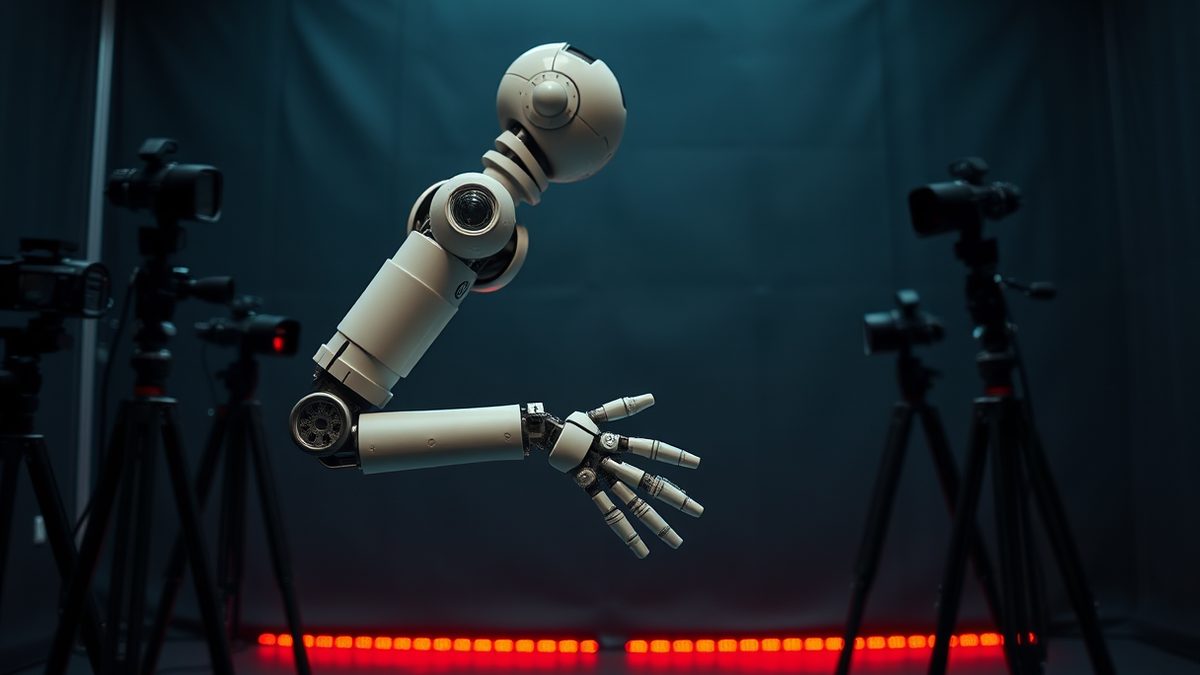
Innodata Inc. said on 30 September that it has opened a laboratory to capture motion data for training the next generation of human-like robots, and to independently validate the performance data those robots generate internally. The Ridgefield Park, New Jersey data engineering company, founded in 1988, frames the facility as a fix for a shortage that is now the defining constraint of the sector.
"Physical AI is growing faster than any other segment in AI, but every robotics team hits the same wall: There isn't enough real-world interaction data, and what exists is expensive and slow to produce," Rahul Singhal, Innodata's CEO, said in a statement carried by The Robot Report. Franklin Tanner, the company's vice president of robotics and physical AI, told the same publication that "physical AI has to earn its tokens one interaction at a time, and they have to be deliberate."
The pitch is narrow and technical. Other data providers infer 3D motion by analysing 2D video. Innodata says it captures 3D data directly from bodies, human or mechanical, and that its sensors register the movement of every joint. Tanner argued the accuracy matters because a humanoid can weigh almost 200 lb (90.7 kg), so readings "can't be in the ballpark."
The data problem is the deployment problem
Innodata's lab lands in a week thick with claims about how fast robots are moving into factories, and with scepticism about how much of that is real. The same day, The Robot Report's parent company Arrowfly launched AI for Engineers, a platform, conference and advisory board aimed at engineers applying AI in product design, manufacturing and robotics. Arrowfly says its engineering network reaches 2.1 million verified industry readers across more than 20 brands, and that 30,000 engineering professionals have already engaged with AI topics across its portfolio. The conference, scheduled for 20 to 22 September 2027 in Henderson, Nevada, expects 700 engineers across five tracks, including robotics and industrial operations. Amanda Buehner, senior vice president for sales and strategy at Arrowfly's engineering division, said the challenge engineering leaders describe is not whether to adopt AI but "how to move from experimentation to practical, repeatable applications that deliver results."
On the model side, a startup called MindOn published a technical post on 30 September claiming its new physical AI model, Mind-1, cuts robot inference latency from 82ms to 32ms. The company argues that speed, not just capability, determines whether robots enter real workflows. At an end-effector speed of 3 metres per second, it notes, 10ms of latency corresponds to roughly 3cm of movement, enough to affect precise grasping and insertion. MindOn also points at a training-data problem that rhymes with Innodata's. Much robot manipulation data comes from teleoperation, which is slower than natural human motion, and models learn the tempo of their demonstrations along with the task. Slow demonstrations, the company says, produce conservative policies.
Benchmarks hide a jagged picture
Independent evaluation work published on 30 September complicates any single-number story about progress. Researchers at Fig Inc. evaluated frontier models including Astra and Opus 5.5 across web automation and four physical domains: Bench2Drive, VLABench, IndEgo and Assembly101. Their finding, released alongside a dataset called RIDGE: in every model pair tested, the lower-scoring model solved at least one task the higher-scoring model failed.
Model updates reshaped those profiles without moving the averages. An update within a model family left the average almost unchanged while many individual tasks flipped, and an update that raised the average still lost tasks the older model had solved. The same jaggedness appeared in physical domains, where models that beat Gemini 3.5-Flash on every domain average still did worse on some task categories. That matters for factories because deployment decisions lean on benchmark scores. If success rates swing widely inside a single reported figure, then a robot that looks reliable on average can still fail on the specific task a line needs it to do.
Europe funds the vision layer
Funding continues to flow to companies attacking the perception and control gap rather than the humanoid form factor itself. Paris-based Inbolt raised €11 million, Tech.eu reported on 30 September, in a round led by Shift4Good with Bridges Climate Transition Partners and existing investors BNP Paribas Développement and Ora Global. Total funding now stands at €30 million. Inbolt, founded in 2019 by Rudy Cohen, Albane Dersy and Louis Dumas, combines 3D vision with a hardware-agnostic AI software layer that lets robots adjust their control loops in real time, on new or existing production lines. Tech.eu reports the system is deployed on more than 200 robots in over 100 factories across three continents, with customers including Bosch, Beko, Flex, Ford, Stellantis and Toyota.
The company is targeting a mundane failure mode: misaligned parts or tooling wear that stalls robots, generates errors or produces defective parts. That is downtime, not a demo problem.
Tesla's solar supply chain, and a Robotaxi order that isn't one
Not every robot-adjacent story this week is about robots. Tesla's planned solar factory in Texas has been dragged into a US patent lawsuit between two Chinese equipment makers, Electrek reported on 30 September. Linton Crystal Technologies, a Rochester, New York company wholly owned by China's Dalian Linton, sued Zhejiang Jingsheng in the Eastern District of Texas, Marshall Division, on 22 September, asserting two patents covering a seed lifting and rotating system used in Czochralski crystal pullers. Jingsheng, which trades in Shenzhen and disclosed the suit to investors on 24 September, says its products use "technical solutions entirely different" from the patents, that it has not been formally served and that it expects no material impact. Linton is seeking damages, treble damages for willful infringement and a permanent injunction. Chinese industry reports say Jingsheng won a Tesla order for crystal pullers worth roughly 3 billion yuan, about $420 million. Tesla is not a party to the suit, and neither Tesla nor Jingsheng has confirmed the order.
The ingot puller is the first step in Tesla's chain. In August, Electrek notes, Tesla filed for a $10.1 billion "Project Crystal Sun" factory in Fort Bend County covering ingot growth through finished modules, with production planned for early 2029. No pullers, the report says, means no wafers, no cells.
Separately, the Robotaxi trade produced a textbook example of how thin some automation announcements are. KIDZ AI, formerly the online coding school Classover Holdings, announced on 30 September that it had sent Tesla a "procurement inquiry" for 500 Robotaxis. Electrek points out what the release itself concedes: the inquiry "does not constitute a binding order," the plan is in a preliminary phase and the company "may determine not to proceed." KIDZ AI reported $8.88 million in cash and restricted cash at the end of June. Its Q2 2026 results showed service revenue down 34% year over year to $0.48 million and a $2.5 million quarterly loss. Electrek calculates that 500 Cybercabs, even at Elon Musk's stated "under $30,000" target, would cost about $15 million, roughly six times the company's market value. The stock fell about 6% after opening, having risen about 10% pre-market.
What 30,000 robot dogs say about shipping
The most grounded account of the week came not from a lab or a filing but from a maker. Rongzhong Li, who built the OpenCat prototype in his university dorm room ten years ago, wrote on Hackster that since the Nybble campaign in 2018 his company has shipped more than 30,000 quadrupeds, and that his third product, Quaddle, is on Kickstarter from $99.
Li's numbers are the least glamorous in this set and possibly the most useful. The first OpenCat prototype had 14 degrees of freedom, a bill of materials around $300, and a cost measured in time rather than parts. He notes that the most-delivered products in robotics in recent years have been videos, and that complaints that robots only dance or run fast miss the point: spectacle has long been part of the job. His open question, unresolved in a decade, is not about actuators or inference latency. It is about whether a maker can build a robot and make the work meaningful enough for others to sustain it. That question does not appear in any benchmark.
Sources
8- 01Innodata opens motion-capture lab to help humanoids move more like peopleEN
- 02The Robot Report parent Arrowfly launches AI for Engineers platform, events for engineers navigating AIEN
- 03Mind-1: Cutting robot inference latency from 82ms to 32msEN
- 04How Do Astra and Opus 5.5 Perform on Robotics and Web TasksEN
- 05Inbolt raises €11M to bring real-time vision and intelligence to industrial robotsEN
- 06Tesla's solar factory dragged into patent war between Chinese suppliersEN
- 07Tesla Robotaxi fleets are the new crypto treasury for zombie companiesEN
- 08What 30k robot dogs taught me about degrees of freedom, shipping a real productEN
All figures and quotations in this text come from the sources listed below.
Content prepared by the editorial team with AI assistance.
Grace Okonkwo
Comments
0- No comments yet — be the first.