Italy's measles reports climb 78.1% in first five months of 2026
Italy's national surveillance system logged 609 measles reports in the first five months of 2026, against 342 in the same months of 2025, up 78.1%, Il Mattino reported on 23 September 2026. Confirmed cases stand at 472, up from 322.
 Sofia MarchettiScience and health
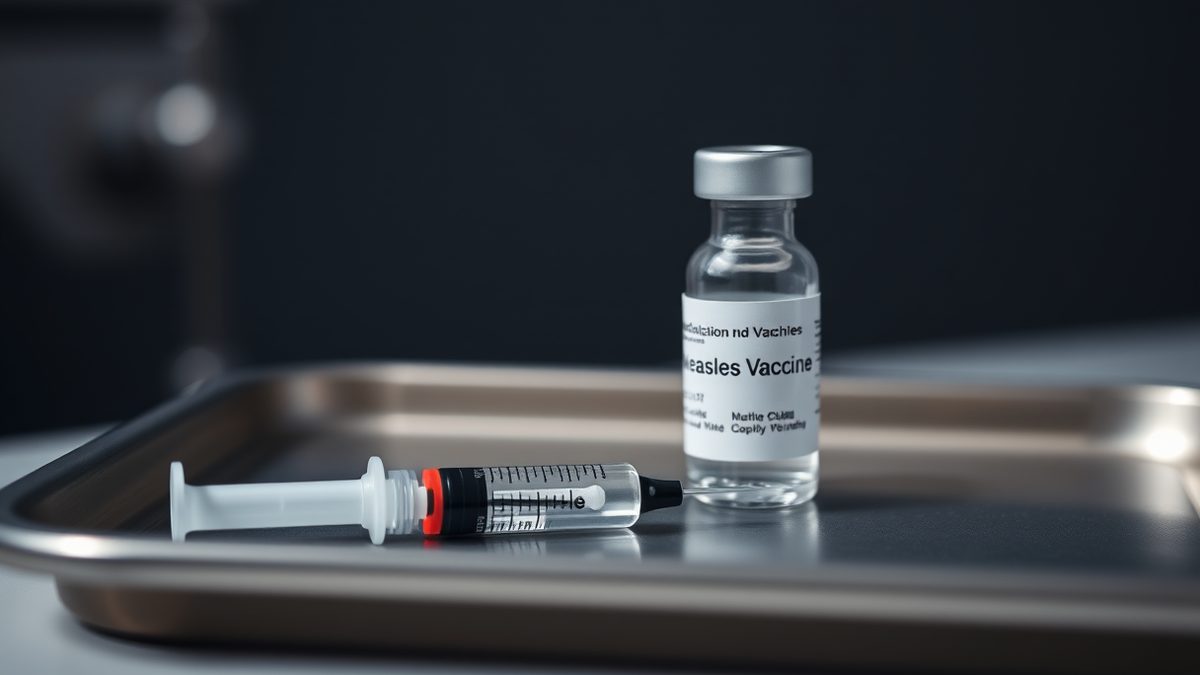
Italy's national surveillance system logged 609 measles reports in the first five months of 2026, against 342 in the same months of 2025, an increase of 78.1% [4]. Il Mattino reported the figures on 23 September 2026 [4].
Confirmed cases stand at 472, up from 322 a year earlier [4].
The jump is not a run of bad luck. Every Italian region sits below the 95% second-dose coverage needed to stop transmission, according to the World Health Organization. The virus is finding the people the schedule missed [4][2]. Those people are mostly adults. The first to pay are infants too young for vaccination and immunocompromised adults who cannot take a live vaccine [2][4]. Schools and hospitals absorb the rest of the bill [5]. Nobody can say yet whether Europe's 2025 decline survives the final tally. Nobody can say how far the Italian curve climbs before the February to April peak [1][4].
Italy's caseload turns up
Average age of the infected is 30 [4]. The 15 to 39 group accounts for 345 reports, adults aged 40 to 64 for 124, and children up to four for 98 [4].
Incidence still runs highest among the youngest children. The under-fours record 49.4 cases per million, against 22.3 per million in the 15 to 39 group [4]. Infants depend on the people around them being immune [4].
The geography is uneven. Calabria went from 17 reports in the first five months of 2025 to 265 in the same window of 2026 [4]. Campania rose from 18 to 100, Tuscany from 6 to 49, Lazio from 47 to 54 [4]. Genetic work points to separate chains: genotype B3 sits behind the Campania and Tuscany outbreaks, D8 behind Calabria's [4]. Strains already circulating in 2025 turned up again, which suggests endemic transmission never stopped [4].
Among young adults with a known vaccination status, 94.7% had received no vaccine [4].
Italy's Ministry of Health has issued a circular on the resurgence of viral circulation. It points to increased transmission in Europe and the Mediterranean basin as well as at home [4].
The gap is the second dose
Italy's national second-dose average is 84.45%, and no region clears 95% [4].
Campania shows the shape of the problem: 93.74% for the first dose, 71.89% for the second. That is a gap of almost 22 points between starting and finishing the course [4]. Sicily sits at 67.88%, Calabria at 76.80%, Lazio at 77.81% [4]. Umbria at 94.30% and Lombardy at 93.92% lead the country and still fall short of the threshold [4].
The target is about 95%, the herd immunity threshold the World Health Organization uses [2][6]. Across Europe, roughly 94% of children get a first dose and about 88% get two [6]. Low- and middle-income countries lag further behind [6].
That leaves generations who grew up during years of patchy coverage as the largest pool of susceptible people [4]. The regions with the deepest gaps are the ones now reporting the most cases. Campania, Calabria and Lazio all sit below the national second-dose average [4].
Europe's 2025 decline is not an all-clear
Fifty-three countries in the WHO European Region reported 33,998 measles cases in 2025, down nearly 75% from 127,412 in 2024. The figure comes from preliminary WHO data published in February 2026 [1].
Spain, Austria, the United Kingdom and Armenia have recently lost measles elimination status [1]. The count of countries with continuous virus circulation, or where endemic transmission is returning, rose from 12 to 19 [1]. Spain reported almost 400 confirmed cases in 2025, against 227 in 2024 [1]. Spain's second-dose coverage is below 94% [1].
The 2025 numbers are provisional. In 2024, the reporting system logged 127,412 cases and the final figure came in at 151,040 [1].
What an outbreak costs
20.6 million children worldwide missed a first dose in 2024, and 59 countries had large or disruptive outbreaks that year [5].
In one Texas school district, recorded absences ran roughly ten times higher than confirmed cases alone would explain. Suspected cases, quarantine and precaution kept healthy children at home [5]. A Birmingham outbreak produced dozens of hospital admissions, hundreds of lost bed days and thousands of contact tracing notifications at a single children's hospital [5]. Absences spread wider than infections [5].
Measles spreads easily. One infectious person can pass it to up to 18 others, and the virus can linger in an enclosed space for up to two hours [5]. It is contagious before the rash appears [5]. Early symptoms look like any other respiratory infection, which delays diagnosis [5].
For immunocompromised adults the calculation is harder. The measles vaccine is live, and doctors advise against it for patients taking conventional, targeted or biologic antirheumatic drugs [2]. Guidelines call for withholding methotrexate, leflunomide and systemic glucocorticoids for four weeks before immunisation, and for four weeks after [2]. Halting community transmission needs coverage near 95%, and below that these patients face higher exposure [2].
The next test is the spring
Measles is strongly seasonal, with more cases in February, March and April, and cases were already appearing at the start of 2026 [1].
Globally, around 11 million measles cases are likely in 2026 [6]. Europe's 2025 figures remain preliminary, and the 2024 revision suggests the final total could move again [1].
What would change the trajectory is coverage, and the Italian data show where it breaks: between the first dose and the second [4].
Sources
27- 01Measles Resurgence Among Italian Young AdultsEN
- 02Preliminary data show that measles cases in Europe declined in 2025, although they increased in countries such as SpainEN
- 03New research reveals huge impact of measles outbreaks on schools and hospitalsEN
- 0411 million measles cases expected worldwide in 2026EN
- 05Measles Outbreaks Threaten Vulnerable Rheumatic PatientsEN
- 06Resurgence of measles spreads deep concern among ophthalmologistsEN
- 07Little Ice Age cooling in Europe may have raised the risk of ricketsEN
- 08French blood banks hacked in latest cyber-attack on EuropeEN
- 09CATL, Octopus Energy and Ampace partner to explore European home energy storageEN
- 10 Dimorphos in sight: Europe's Hera probe gets its 1st look at battered space rock (photo) EN
- 11Tesla cuts FSD’s speed margin from 50% to 10% over the limit in EuropeEN
- 12Supermarket fridges hit with cyberattacks across Europe — here's what's happeningEN
- 13Mercedes-Benz Is Giving Up On Its EV Charging Network In EuropeEN
- 14Portuguese AI startup Granter bags €1.6M to expand across EuropeEN
- 15The ETS Investment Engine: Scaling Europe’s Strategic E-fuel Market for Shipping & AviationEN
- 16Mistral CEO: Europe faces ‘complete trap’ without frontier AIEN
- 17How Europe’s battery passport could have a big impact on US e-bikesEN
- 1830,000-year-old DNA reveals Ice Age Europeans were far more connected than we thoughtEN
- 19Synopsys to Offer EDA Software Through European Chips Design PlatformEN
- 20Novo won't launch CagriSema in Europe for 'a couple of years,' CFO saysEN
- 21Record Demand Catches (Some) OEMs with Their Pants Down — Europe September 2026EN
- 22Forget AI, Europe has a plan to win the next tech revolutionEN
- 23Hyundai IONIQ 3 Named European Car of the Year 2027 FinalistEN
- 24New Wave of Refrigeration Cyberattacks Hits Supermarkets Across Europe, Forcing Stores to Pull FoodEN
- 25Europe vs. Elon: 5 ways the EU is trying to squeeze out Musk’s StarlinkEN
- 26Flexell Space Establishes French Subsidiary to Strengthen European PresenceEN
- 27Europe can still shape the rules of AIEN
All figures and quotations in this text come from the sources listed below.
Content prepared by the editorial team with AI assistance.
Sofia Marchetti
Comments
0- No comments yet — be the first.