ITER completes multiyear repair campaign on tokamak components
ITER has completed this autumn a multiyear campaign to repair key tokamak components, construction head Sergio Orlandi said, closing a difficult chapter and changing how vacuum vessel sectors are fitted to their neighbours.
 Sofia MarchettiScience and health
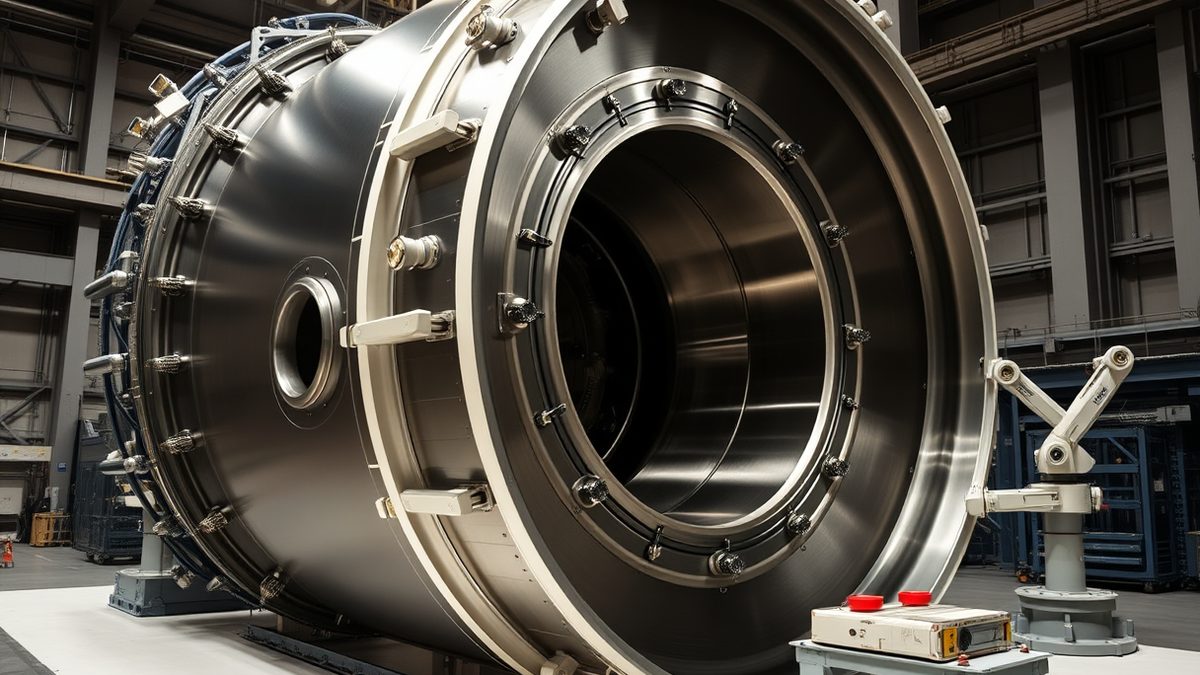
ITER has completed this autumn a multiyear campaign to repair key tokamak components, Construction Project head Sergio Orlandi said in an ITER interview. The work closes a difficult chapter in the project's construction history and has prompted changes in engineering, industrial partnerships and machine assembly, he said.
What went wrong
Orlandi dates the trouble to May 2022, when the first vacuum vessel sector module, #6, was lowered into the tokamak pit. The lift demonstrated technical capability, he said, but fundamental problems were already coming into focus.
ITER had found corrosion in some thermal shield cooling pipes, which raised concerns about other panels. The vacuum vessel sectors also had dimensional deviations in the bevel regions, where adjacent sectors would eventually be welded together.
Orlandi said a more fundamental issue was the integration of the nine sectors. Even a sector manufactured within its specified tolerances needs adjustment to fit precisely with its neighbours, he said. ITER had to bring assembly sequences under control in terms of duration and cost.
How ITER repaired the components
In July 2023, ITER removed sector #6 from the pit. Orlandi said the operation was more than an installation in reverse and required additional engineering and modifications to tooling. Once the sector was accessible to metrology, teams understood how much its bevel joints deviated from a configuration acceptable for integration with other sectors.
In parallel, ITER sought advice from specialist organisations. These included welding institutes in France and Italy and research institutes such as the French Alternative Energies and Atomic Energy Commission (CEA), and CERN for the thermal shield.
Over one year, ITER worked with industrial companies to develop mockups, test approaches for repairing both types of defects, and qualify welding, material build-up and machining procedures for bevel repair.
The conclusion was that the components could be repaired, Orlandi said, though uncertainties and differing technical opinions remained. The breakthrough came when teams stopped considering each sector in isolation and focused on how it could be adjusted to fit its neighbours. Depending on the location, material had to be added, removed through machining, or both.
Working with ITER specialists, external experts and industrial partners, the project established qualified procedures for repairing or refabricating all thermal shield sets and for repairing the sector bevel joints, with nuclear safety oversight. By autumn 2023, ITER had selected companies and contracts were in place.
Changes to assembly
Orlandi said the repairs forced ITER to rethink how it works. One lesson was that ITER needed greater ownership of engineering and planning for construction. The project now develops detailed engineering work packages before launching a competitive bid, so companies can prepare realistic proposals and ITER has a stronger basis for evaluating performance.
ITER also divides work into more clearly defined packages, each with its own engineering preparation and execution strategy, instead of relying on a single large contract to cover many activities.
Next stage
The tokamak is assembled from nine sectors. Westinghouse signed a $180 million contract with ITER in June 2025 to complete the vacuum vessel and, once all sectors are in place, weld the nine sectors simultaneously into a single ring-shaped chamber, or torus. Westinghouse had already built five of the sectors with partners Ansaldo Nucleare and Walter Tosto.
The vacuum vessel is a hermetically sealed, double-walled steel container that will house the fusion plasma. Larsen & Toubro agreed a memorandum of understanding with ITER to assemble ports and complex parts inside the vacuum vessel, after delivering the cryostat in 2020.
Sources
8- 01"The repair campaign obliged us to rethink the way we work"EN
- 02Practice makes precisionEN
- 03Assembly of 'Artificial Sun on Earth' ITER Fusion Reactor Halted; French Authorities Demand "Safety Issues Must Be Resolved"EN
- 04Westinghouse and ITER Sign a $180M Contract to Advance Nuclear FusionEN
- 05ITER contracts L&T for critical tasks linked to fusion reactor's vacuum vesselEN
- 06Assembly starts of SPARC, as ITER cryopumps completedEN
- 07Act-HiMotif: Hierarchical Daily Activity Schedule Generation via Learned Activity-Structure MotifsEN
- 08Launch Preview: Falcon 9 and GSLV rockets scheduled to launchEN
All figures and quotations in this text come from the sources listed below.
Content prepared by the editorial team with AI assistance.
Sofia Marchetti
Comments
0- No comments yet — be the first.