Sealed Roman child's sarcophagus opened in Constanța with toys inside
Archaeologists opened a sealed Roman child's sarcophagus in Constanța on 27 October and found a wooden coffin, two clay toys and two bullae inside, five days after the grave was discovered during a preventive excavation. VICE reported on 4 November that the museum has still not confirmed whether any of the child's remains survived.
 Sofia MarchettiScience and health
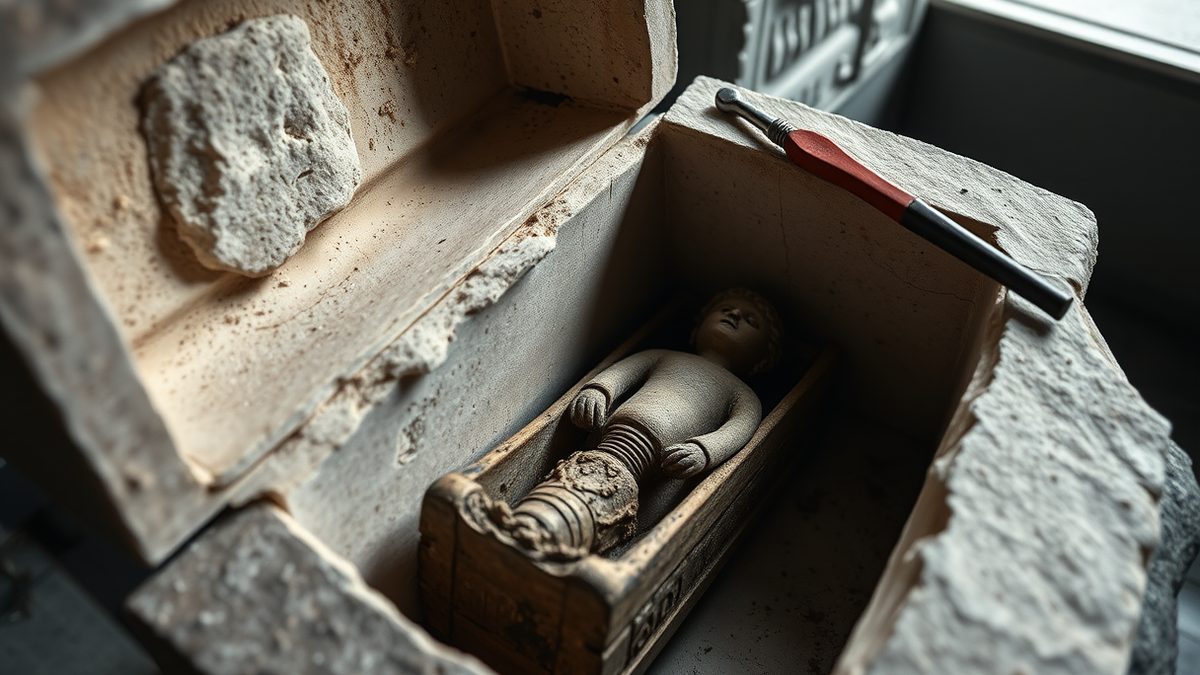
A sealed coffin opened in Constanța
The sarcophagus was discovered on 22 October 2026, during a preventive excavation in the Flămânda district of Constanța. Work like this happens before construction covers a site. Five days later, on 27 October, conservators, restorers and archaeologists opened it inside a museum building, because the stone box was too fragile to open where it was found.
Two lead clamps and a band of mortar had held the lid shut. That seal is why the contents survived roughly 18 centuries.
The grave goods included a coin, two clay toys, two bullae, bronze bracelets and other bronze items, and plant remains, including leaves folded into small bundles. The wooden coffin survived with dovetail joints and side panels still in place, along with part of a burial shroud. The toys are a small horse on wheels and a rooster-shaped rattle. Ana Hamat, an archaeologist on the team, said the pellets inside the rooster still rattled when the object was moved.
The survival of the wood matters as much as the toys. Wood is among the first materials to vanish from an archaeological site, so a coffin that lasted can show how carpenters of the period built and joined their pieces.
Why an intact child burial is rare
Constantin Băjenaru, who led the excavation with Cătălin Nopcea, called the discovery "exceptional and extremely rare" for Tomis. He said small sarcophagi used for children are extremely rare and that nothing like this had turned up at the site before.
The museum's own language is more careful than some of the coverage. Its statement says documentation is still at the beginning, and puts the value of the find on the intact sarcophagus and the untouched funerary inventory, which offers "precious information regarding Roman-era funerary practices in Tomis".
Toys are the clearest sign that this was a child's grave. They rarely appear in adult tombs, so their presence shows the burial was furnished for a child.
What the toys and amulets suggest
The two bullae are the most suggestive objects in the grave. They were protective amulets traditionally associated with freeborn Roman boys, which raises the possibility that the child was male. Boys wore them until the transition to adulthood, and the pendants could also be linked to Roman citizenship.
Researchers have not established the child's biological sex. The pendants are a clue, not a conclusion.
Age is just as open. The dimensions of the sarcophagus initially suggested a child of around four or five, but the toys may point to a younger age. Osteological examination will be needed to settle the question.
The plant remains are another open file. Laboratory work could identify the leaves and their role in the funeral.
Reports disagree on a basic point: whether any of the child's remains survived. Europe Says reported that the team found the skeletal remains of a young child inside the coffin, while Arkeonews described the sarcophagus as containing the remains of a child. VICE reported on 4 November that the museum had yet to confirm whether any remains survived the centuries, and Gizmodo said on 2 November that the museum's statement did not clarify the question.
What the grave goods do suggest is money. The artisan quality of the tomb and the objects inside point to a prominent or wealthy family. Băjenaru said the surrounding area very probably belonged to an important family, because another unusual grave, made of brick, was found nearby four or five years ago.
A grave on the road to Histria
The sarcophagus lay about 1.5 km from ancient Tomis, beside a road that linked the city with Histria, another coastal settlement to the north. Arkeonews reported that, according to Băjenaru, it marks the northernmost known extent of Tomis's Roman-period necropolis.
Roman cemeteries stood outside city walls and along the roads leading out of town. The position of this grave may help researchers work out how far the necropolis stretched and how burials were arranged along the route.
Tomis began as a Greek settlement founded in the sixth century BCE and came under Roman control by the late first century BCE. It became a trade hub on the Black Sea. The burial itself is dated to the second or third century CE, roughly 1,800 years ago.
What happens next
The museum has not published a final report on the burial. It says analysis of the remains, the grave goods and the construction of the coffin is still going on.
Hamat said the child "will be very, very carefully looked after" and will probably go on display once the analyses are completed.
Sources
28- 01Archaeologists Opened a Roman Sarcophagus—and Found Toys InsideEN
- 02Archaeologists Opened a 1,800-Year-Old Roman Coffin and Made a Heartbreaking DiscoveryEN
- 03Roman Child’s Sarcophagus With Toys Found In RomaniaEN
- 04Archaeologists Open a Sealed Roman Child’s Sarcophagus in Romania, and the Toys Were Still InsideEN
- 051,800-Year-Old Roman Child’s Sarcophagus Found Intact with Toys InsideEN
- 06Child’s Sarcophagus Discovered in RomaniaEN
- 07Rare intact Roman-era child's sarcophagus discovered in Romania's ConstantaEN
- 081,800-Year-Old Roman Child’s Tomb Found With Toys That Still Make SoundsEN
- 09AI helps Stanford scientists discover a “natural Ozempic” with a surprising advantageEN
- 10From Waste to Discovery: Recycling High-Scored Unexposed Candidates in Taobao Feed RecommendationEN
- 11Data-Efficient Scaling-Law Discovery for Recommendation Systems via Coupled Hyperparameter ScalingEN
- 12The Iron Age King Who Lured Rome Into Britain Was Actually a Woman, Archaeologists SayEN
- 13All 5 genetic “letters” of DNA and RNA discovered in a 4.5-billion-year-old asteroidEN
- 14Scientists discover new Alzheimer’s drug that repairs DNA damage and reduces brain inflammationEN
- 15Scientists discover that some “unhealthy” diets can boost cancer immunotherapy in miceEN
- 16Trace Gas Orbiter discovers potential evidence of volcanic activity on Mars via atmospheric observationsEN
- 17NASA's Hubble and Webb discover ancient worlds that remember their pastEN
- 1828 Zero-Day Findings in Less Than Two Days: What AI-Speed Discovery Means for RoboticsEN
- 19Scientists discover the hidden “muscles” trees use to straighten themselvesEN
- 20Scientists discover metals that defy the deep freeze at -424°FEN
- 21Scientists discover a bacterial defense so strange they thought it was brokenEN
- 22A surprising vitamin A discovery is changing what scientists know about visionEN
- 23Scientists discover mysterious seahorse lookalikes that no one has ever seen aliveEN
- 24Scientists discover why chronic back pain feels so personalEN
- 25NASA discovers Jupiter’s invisible shield is more complex than Earth’sEN
- 26Scientists discover a hidden oxygen reservoir deep inside EarthEN
- 27Scientists discover a secret glow in toxic fire salamandersEN
- 28How AI Is Changing the Pace of Discovery for Millions Living With DementiaEN
All figures and quotations in this text come from the sources listed below.
Content prepared by the editorial team with AI assistance.
Sofia Marchetti
Comments
0- No comments yet — be the first.