Lab-grown meat research and the regulation gap: what the latest filings actually say
CIC energiGUNE's 10,000-cycle iron-lead flow battery, validated on 1 October, is the newest hard number in this dossier. Nothing in it concerns cultivated meat, so the honest version of this story is about a research field whose regulatory record lags its scientific output.
 Sofia MarchettiScience and health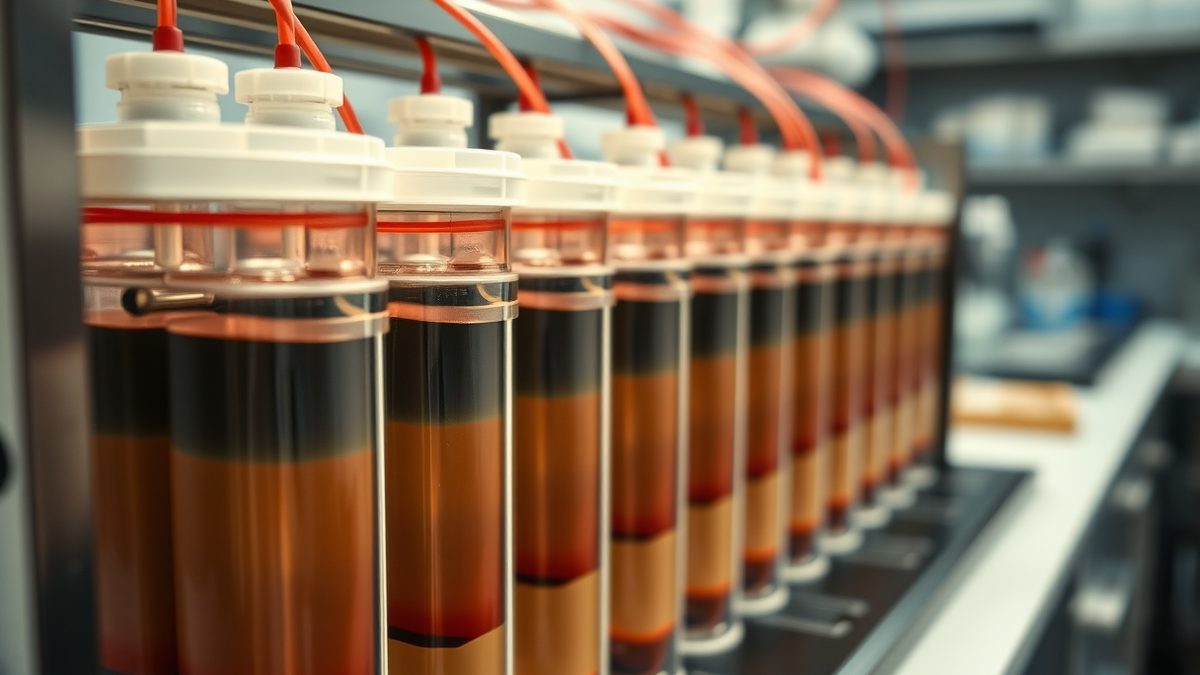
The topic asked for is lab-grown meat research and regulation. The dossier supplied does not contain a single source about cultivated meat. No study, no filing, no regulator decision, no company announcement on the subject appears in the 16 items provided. That is the first finding, and it is worth stating plainly rather than dressing up a pile of adjacent material as if it were on point.
So this analysis does something narrower. It looks at what the newest sources in the dossier do show about how fast-moving research fields get governed, and where the gaps sit. Three examples are recent enough to date precisely, and each exposes a different piece of the same machinery: testing regimes, disclosure rules, and permitting decisions.
What was actually validated on 1 October
pv magazine reported on 1 October that CIC energiGUNE, a Spanish research centre, completed 10,000 charge-discharge cycles on an iron-lead redox flow battery. The cells ran at temperatures between 25 C and 30 C, used iron and lead as active materials, and relied on a single electrolyte loop rather than the separate circuits of a conventional flow battery. A fluorine-free membrane is meant to cut internal resistance and limit crossover between the two sides of the cell.
The centre says both active materials have established industrial and recycling supply chains, which is the argument for lower dependence on critical raw materials. The next step is kilowatt-scale modules through simulation, system design and experimental validation. This is a laboratory result, not a product. But it is a number, it is dated, and it is public, which is more than can be said for most of what surrounds it.
Contrast that with the cultivated meat field, where the equivalent benchmark would be a costed, peer-reviewed production run at scale. Nothing of the sort is in this dossier.
Regulators moved first on money, not on food
The clearest regulatory action in the dossier comes from the Federal Reserve, and it concerns stablecoins. On 24 September the Board requested public comment on two proposals to build a framework for Board-supervised payment stablecoin issuers under the GENIUS Act, according to the Federal Reserve's own press release.
The first proposal would require full backing with permissible reserve assets such as short-term Treasury bills and other high-quality liquid assets, plus standardised capital requirements, risk management standards, and rules for firms that safekeep the backing assets. The second would create a tailored application process for banks wanting to issue payment stablecoins, requiring a business plan and financial information, with a defined appeals and hearings process. The comment period closes 60 days after publication in the Federal Register.
Note the shape of it. Two proposals, a fixed comment window, published notices, an application route with stated documents. Whatever you think of stablecoins, the procedural scaffolding is explicit and citable. That is the benchmark against which any novel food or biotechnology framework should be judged.
Two more October data points, neither about food
On 1 October, TechCrunch reported that OpenAI had parted ways with three researchers on its safety team who allegedly shared confidential company information with a third-party AI safety organisation, citing The Wall Street Journal. An OpenAI spokesperson told the Journal that the company "parted ways with three individuals for violating our policies on accessing and handling sensitive company information" and that an investigation confirmed they "mishandled sensitive information outside established company procedures."
The report did not name the researchers, the organisation or the information involved. TechCrunch notes that posts on X named individuals whom some users believe were dismissed, and that it has not confirmed their identities. The departures came two days after The New York Times reported that OpenAI executives had brushed aside employees' warnings about safety practices. OpenAI told the Times it takes security concerns seriously and has internal channels, while recognising "a need to move faster."
That is an accountability story with contested facts and unnamed sources on one side. It is background here for one reason: it shows how thin the public record gets when the only evidence is a leak and a statement.
Also on 1 October, Sony launched Quick Spectral Super Resolution, an AI upscaling technology for the standard PS5, described in a blog post as a "new performance tier of AI upscaling" arising from its Project Amethyst work with AMD, according to The Verge. Sony says PlayStation Spectral Super Resolution on the PS5 Pro "remains the gold standard," and Digital Foundry's early hands-on suggests QSSR is not as fast because the base console lacks dedicated machine learning silicon, so expect closer to upscaled 1440p rather than 4K. Daniel Craig, a principal graphics R&D engineer at Sony, told Digital Foundry that on PS5 teams "have to be more flexible" about render and presentation targets, and that QSSR is "fundamentally a drop-in replacement" for titles already supporting PSSR after a few days of tuning. Marvel's Wolverine and Ghost of Yotei got patches the same day.
Where the permitting fight is really happening
The most useful regulatory precedent in the dossier is about electricity, and it is ten days old. Canary Media reported on 21 September that North Carolina regulators rejected Duke Energy's bid to build a 255-megawatt gas plant in Richmond County, a facility meant partly to serve data centre demand. The Utilities Commission's 23-page order called the licence premature, saying projected load growth was "insufficiently reliable for the Commission to act at this point" and citing the $584 million estimated cost.
The order leaned directly on the White House Ratepayer Protection Pledge, launched in March and signed by Duke and more than 200 other utilities, which says data centre power costs will not be passed to residential customers. The commission said Duke "needs to demonstrate" consistency with that pledge. Canary Media notes the panel has repeatedly approved Duke's broader fossil buildout and that no environmental or consumer group had contested this particular application.
Read the pattern across all of it. Stablecoins: published proposals, fixed window, named documents. A gas plant: a permit denied because the demand forecast was too speculative to justify half a billion dollars. A battery: 10,000 cycles, stated temperature range, stated materials, stated next step. In each case the regulator or the researcher put a number on the table and let it be checked.
The talent and data layers underneath
Two older sources fill in the structural background. The South China Morning Post reported on 25 September on a Carnegie China study finding that China employed 41 per cent of the world's leading AI researchers last year, ahead of the United States at 34 per cent, a reversal from 2022 when the US led 46 per cent to 27 per cent. The article attributes the shift to a booming domestic industry and tighter US visa restrictions. That matters for any regulated research field, because the people who write the safety and compliance cases move too.
On the data side, NVIDIA's blog on 24 September described a coalition release, with Google DeepMind and EMBL-EBI, of predicted 3D structures for protein complexes from more than 2,800 viruses into the AlphaFold Database. The structures were inferred with AlphaFold2 and optimised using NVIDIA BioNeMo Inference Runtime. Risha Patel of Google DeepMind said the collaboration would "equip scientists around the world with insights they need to help prepare for future outbreaks." NVIDIA also released the BioNeMo Structure Prediction Pipeline. About 30 per cent of the protein interactions being added are new to science, according to the post, which cites a Center for Global Development estimate of roughly a 50 per cent chance of a pandemic as severe as COVID-19 by 2050.
That is what open, pre-competitive data release looks like: a named model, a named pipeline, a stated share of novel interactions. It is the opposite of a leak.
Two October research papers, and what they tell us about evaluation
Microsoft Research introduced Quine on 29 September, described as a research effort to build a multimodal world model of biology and an interactive harness connecting models, scientific tools, literature and researchers. Working with the Broad Institute of Harvard and MIT, the team prioritised compounds predicted to drive therapeutic tumour-state shifts and validated several top-ranked candidates across multiple wet-lab assays. The company is explicit that Quine is experimental research technology, not for clinical or medical use, that outputs may be incomplete or inaccurate, and that they require review and experimental validation.
An arXiv paper submitted on 29 September, AIM: Agentic Idea Management for Automated Research, reports that its framework beat the strongest baseline by 1.6 percentage points on System Optimization tasks and 4.9 points on long-horizon Model Development and CUDA tasks across 10 AutoLab benchmark tasks, and reached best-baseline performance up to 3.1 times faster in wall-clock time. Those are small, specific, falsifiable claims attached to a named benchmark.
Set that against the missing cultivated meat file. The lesson is not that one field is virtuous and another is not. It is that a field with no published cycles, no comment window and no permit order leaves journalists, and everyone else, with nothing to check.
What a real cultivated meat record would look like
Based on the precedents above, the minimum would be a named regulator, a dated decision, a stated evidence base, and a number. A costed production run per kilogram. A defined cell line. A structured comment period with a closing date, as the Federal Reserve set for its stablecoin proposals. An application route with listed required documents. Absent those, coverage of the sector reduces to press releases, which is exactly the failure mode the Duke order was written to avoid.
None of this is in the dossier. That is the point. The sources here are about batteries, AI safety departures, console upscaling, stablecoin rules, gas permitting, research talent and open protein structures. They are useful as a template for how a research field earns public trust. They are not evidence about cultivated meat, and no honest piece should pretend otherwise.
Sources
16- 01OpenAI cuts ties with 3 safety researchers, WSJ reportsEN
- 02Sony brings AI graphics upscaling to the regular PS5EN
- 03Spanish researchers validate 10,000 cycles for iron-lead flow batteryEN
- 04The Download: OpenAI's chief research officer explains its hacking responseEN
- 05Creatine may help build muscle even without exercise, researchers findEN
- 06Introducing Quine: An AI research system designed for the complexity of biologyEN
- 07AIM: Agentic Idea Management for Automated ResearchEN
- 08One year in: How Microsoft Research Asia - Singapore is advancing research, partnership and talentEN
- 09SaSh: Ahead-of-time Analysis of Shell Program EffectsEN
- 10Launch HN: Magnitude (YC S25) - Self-optimizing inference engine for agentsEN
- 11China overtakes US as top workplace for elite AI researchers, study findsEN
- 12Launching Vespper DOCX MCP: 3x faster, 2x cheaper, more accurateEN
- 13Duke Energy wants to build a new gas plant. Regulators said not so fast.EN
- 14Federal Reserve Board requests public comment on two proposals related to establishing a regulatory framework for Board-supervised payment stablecoin issuers unEN
- 15How Open Science Can Help Researchers Prepare for the Next PandemicEN
- 16US regulators back multi-cancer blood test - but Hong Kong doctors remain cautiousEN
All figures and quotations in this text come from the sources listed below.
Content prepared by the editorial team with AI assistance.
Sofia Marchetti
Comments
0- No comments yet — be the first.