LiberAI's Liber-0 joins a crowded race to train robot brains on human video
LiberAI launched Liber-0 on 4 November, a World Action Model pretrained on more than 2.2 million hours of human experience, according to Robotics & Automation News. It is the newest entry in a cluster of robot foundation model launches and fundings.
 Grace OkonkwoAI, models and technology
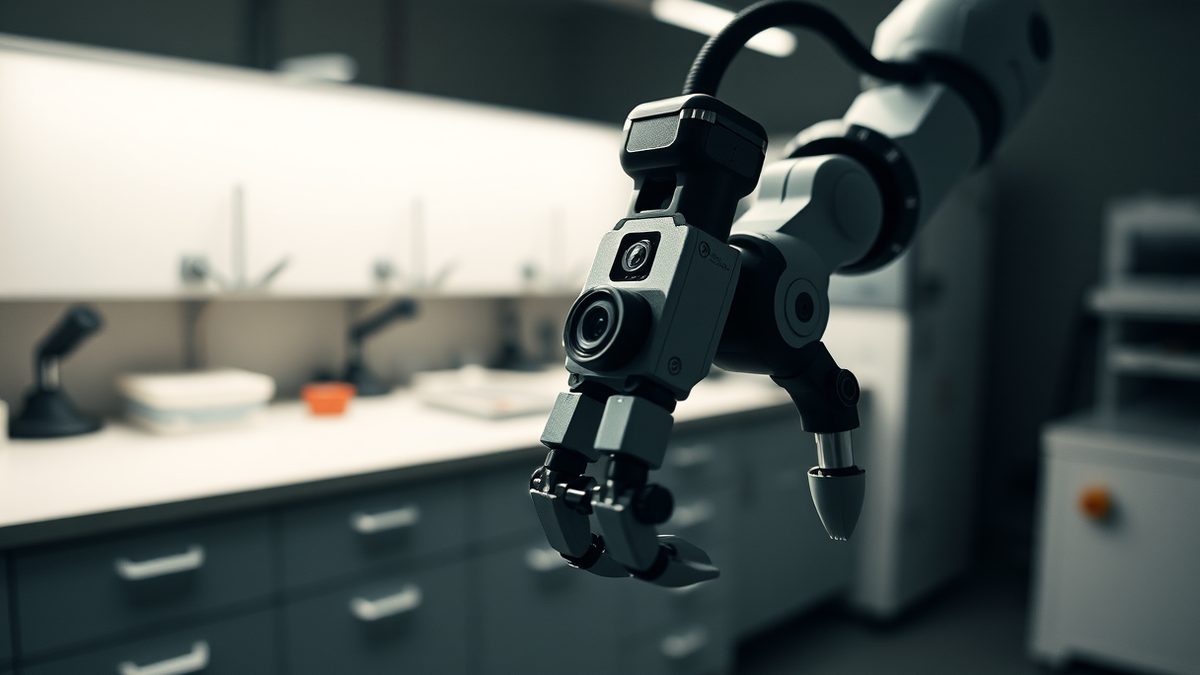
LiberAI bets on human video for robot control
LiberAI, founded in December 2025, calls Liber-0 a World Action Model. The company says it learns the relationships between visual observations, physical actions and what happens next.
For robot makers and buyers, the claim is general-purpose manipulation trained on human video and recorded hand motion instead of bespoke programming for every task. Two things remain unknown: whether vendor benchmarks reproduce outside controlled sites, and whether any of these systems runs reliably at customer scale. LiberAI has published training claims and no deployment figures.
The usual route is robot demonstrations. That data is valuable because it records actions the machine can actually execute, but collecting it needs robot hardware and repeated operator effort. Human experience, by contrast, exists at enormous scale, which is the whole argument for pretraining on it.
LiberAI says most of those hours are ordinary human activity video. That gives broad exposure to people, objects and environments, but says little about grip force or wrist rotation. More detailed data comes from instrumented gloves and from robots themselves, connecting what the model sees to the actions that produced it. The company does not break out how the 2.2 million hours split between video, glove recordings and robot demonstrations.
LiberAI names three gaps in the transfer. Cameras see the same activity from different viewpoints. Hand trajectories inferred from video are incomplete because of occlusion and depth errors. And human bodies move in ways a given robot cannot copy.
The data problem is the business model
Physical Intelligence shows what deployment data is worth. Its π0.6 model packed e-commerce orders through a full warehouse shift at 96.4% autonomy for partner Ultra in February 2026, according to AI Magazine.
Adding Weave's laundry-folding data to pre-training cut missed grasps by 42% and interventions by 50% in the same month, the magazine reported. Physical Intelligence was founded in March 2024 and had about 80 employees in March 2026.
Tutor Intelligence sells the same loop as a service. It puts robots into production environments with remote operators it calls tutors, and every completed task generates training data. The company announced a $75 million Series B led by Andreessen Horowitz on 2 November, bringing total capital to $117 million. Union Square Ventures and Neo, which led earlier rounds, also participated.
The approaches differ in where the data comes from. LiberAI leans on human video, Physical Intelligence on partner deployments, Tutor on its own deployed fleet and AGIBOT on a mix of first-person video and robot trajectories.
Valuations run ahead of published deployments
Physical Intelligence was valued at $5.6 billion in November 2025. Bloomberg reported in March 2026 that the company was in early talks to raise about $1 billion at more than $11 billion. Last week, Bloomberg reported talks at a $20 billion valuation, AI Magazine said.
That would be more than triple the November 2025 figure.
Benchmarks and open source will decide the next test
AGIBOT debuted GO-3 Preview, an embodied foundation model built on a World Reasoning Action Model framework, at its Innovation Day 2026 event in Shanghai on 29 October. The company presented results ranking first on RoboDojo and RoboColiseum and highest overall on RoboTwin. The results are vendor-reported.
Its training data combines first-person human video with robot trajectories, according to Interesting Engineering. AGIBOT also described Genie Evolver, a distributed post-training system that combines data from physical sources with physics simulation and world models. Genie Master is an agent layer for spotting and correcting mistakes mid-task. In one demonstration, a robot beat the average of tested humans at tabletop curling after four hours of online practice. Interesting Engineering reported that AGIBOT plans to open-source the full model by the end of 2026.
What to watch
Open weights would let outside groups test AGIBOT's continuous-improvement claims on their own manipulation tasks. Tutor CEO Josh Gruenstein says the company can hardly build robots fast enough. LiberAI has not said when Liber-0 will be available to customers, or how it will be priced. Whether Physical Intelligence closes the reported $20 billion round is the number to watch.
Sources
28- 01From human experience to robot action: LiberAI launches Liber-0 world-action modelEN
- 02Physical Intelligence: What are Robot Foundation Models?EN
- 03Tutor Intelligence Raises $75 Million Series B Led by Andreessen Horowitz to Scale Frontier Robotics Model Training, Manufacturing and DeploymentEN
- 04Tutor Intelligence raises Series B to scale model training, robot deploymentsEN
- 05AGIBOT Debuts GO-3 Preview Embodied Foundation Model in ShanghaiEN
- 06BYD teases new model for Guangzhou Auto Show, with next-gen Han expectedEN
- 07Anthropic is working on a system to prove AI models’ identityEN
- 08Nvidia is happy to take your money whether you're using open or closed models, says Jensen HuangEN
- 09Training Foundation Models with a Single AlgorithmEN
- 10I Checked Out Tesla’s New Model YL, Standard Y, Model 3 In Person — Here’s What Surprised MeEN
- 11 Google reveals new Gemini 4 Carbon AI model, narrowly beating Claude Opus 5.5 EN
- 12heise+ | Humanoide Roboter in Deutschland: Modelle, Preise und VerfügbarkeitEN
- 13Open models can do 90% of agentic work at a twentieth of the cost of a frontier LLM: GartnerEN
- 14Churchill Capital XI shareholders approve $2.5B Agility Robotics humanoid SPACEN
- 15Jülich Hosts EVE Language Model for Earth Observation and Earth ScienceEN
- 16Gentherm designs ThermAffyx to secure, heat patients during robotic surgeriesEN
- 17Top 10 robotics developments of October 2026EN
- 18Westward Ho! First Trip Cross Country with Our New 2026 Tesla Model Y & Full Self Driving V14EN
- 1928 Zero-Day Findings in Less Than Two Days: What AI-Speed Discovery Means for RoboticsEN
- 20Solving the Interconnect Challenge in Modern Robotics: How 3M Is Engineering for Motion, Density, and UptimeEN
- 21Google Launches LiteRT Tensor API for Building, Customizing, and Optimizing ML Models for On-DeviceEN
- 22Unusual robotic animals can prove their utilityEN
- 23Was I wrong about open models & cyber risks?EN
- 24An updated Model Spec for more capable and beneficial AIEN
- 25How we detect frontier model misalignmentEN
- 26VW considers bringing Xpeng co-developed architecture to European models, report saysEN
- 27Leading European Financial Services Organizations Embrace Open Models to Build Proprietary IntelligenceEN
- 28ByteDance accelerates robotics commercialisation with new recruitment driveEN
All figures and quotations in this text come from the sources listed below.
Content prepared by the editorial team with AI assistance.
Grace Okonkwo
Comments
0- No comments yet — be the first.