Memory makers, not AI, are rewriting the PC and phone market
Consumer memory and storage prices have risen by as much as 483% since last September, according to an analysis published by GamersNexus on 29 September, and the same diversion of DRAM and NAND capacity to data centres is now hitting smartphone and console prices.
 Dr. Amara PatelEconomy, business and world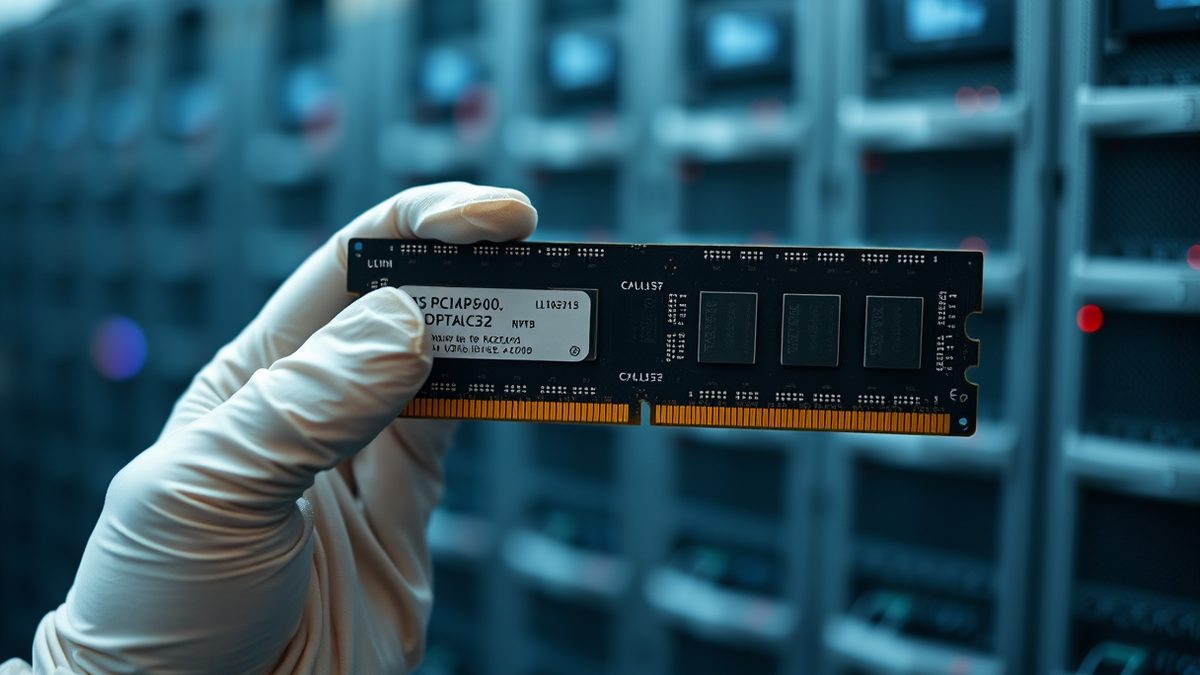
The memory market has stopped behaving like a memory market. In a piece published on 29 September, GamersNexus reported that average prices since last September have climbed 137% for 2 TB NVMe SSDs, 183% for 2 TB SATA SSDs, 363% for 32GB DDR5 kits and 294% for 32GB DDR4 kits. DDR5-6000 64GB kits, the outlet said, have gone from $240 to roughly $1,300 to $1,400, an increase of about 483%.
GamersNexus attributes the shift to Micron, Samsung and SK Hynix moving capacity away from consumer channels and into long-term agreements with fewer, larger customers. The article was originally published as a video on 21 September and adapted to text on 29 September, so its numbers describe the position at the end of September rather than a single day's trading.
The same consolidation shows up in how the companies talk. GamersNexus cites Amazon saying more users than ever will consider its cloud services because of the rising cost of on-premises hardware. Read the other way: the cloud provider benefits when the hardware it rents gets more expensive to own.
The bill reaches phones and consoles
Memory is not a PC enthusiast problem. GamersNexus quotes a forecast that worldwide smartphone shipments will fall 16.7% in 2026 while the average selling price reaches $581, up 27.6% in a single year. It also reports that Apple raised prices across its MacBook, iPad, HomePod, Apple TV and Vision Pro lines, and quotes Tim Apple on his final earnings call as CEO saying the company "reluctantly raised prices" because of what he called a "100-year flood on the memory pricing with exponential increases in memory prices."
Microsoft's console business followed. According to the GamersNexus account, Xbox said: "Effective August 1, 2026, we will be updating prices worldwide. The price of XBOX consoles will increase by US$100 for 512 GB models and US$150 for 1 TB models. We will also be sunsetting our 2 TB model."
That is a consumer electronics market being repriced from the component up. It also lands on the wider economy at an awkward moment, because the labour market is already being reshaped by the same data-centre build-out that is pulling memory away from consumers.
The other side of the data-centre boom
On 28 September, Electrek reported that the US lost 36,949 clean energy jobs in 2025, the first annual decline since the pandemic, according to findings from E2 based on US Department of Energy employment data. Clean energy employment fell to 3.52 million, erasing nearly 40% of the gains made in 2024. Losses reached 35 states; California shed nearly 21,000 jobs, the most of any state, while Florida gained about 3,800.
E2 connects the decline to the federal policy reversal under the Trump administration and the Republican-controlled Congress, which it says led companies to cancel or scale back projects. Its project tracker recorded 142 clean energy manufacturing, generation and storage projects cancelled or downsized in 2025. The employment figures show the size of the decline but do not establish how many jobs were lost because of any particular policy change, Electrek notes.
The broader US energy industry shed an estimated 86,000 jobs in 2025, according to the DOE data cited by E2, with clean energy accounting for roughly 43% of that fall. Clean energy still employs more than 3.5 million people. By comparison, oil and gas companies employ 958,000 workers, coal companies 125,000 and nuclear companies 70,000, per the same figures. These are E2's initial findings; its full Clean Jobs America 2026 report, with state, county and industry detail, is expected in October.
What the data pipeline says about where the money goes
While consumer hardware gets more expensive, the tooling that processes the resulting market data keeps getting faster. On 29 September, Polars published a case study by Thomas Jardine, head of data science for the Americas at BMLL, describing how the firm processes 1.5 TB of market data in under four minutes. BMLL provides harmonised Level 3, 2 and 1 historical market data across global equities, ETFs, futures and US equity options, normalised to nanosecond precision across more than 100 venues.
The numbers in that case study are a reminder of what the data-centre build-out is for. Loading one day of US equity trade data for all 11,000-plus Reg NMS securities takes close to 3.5 minutes in pandas, the incumbent tool, before any joins or aggregations. Polars does the same load in 4.3 seconds, roughly a 48-fold improvement, on the complete dataset with no sampling. The benchmark ran on a single 192-core, 1.5 TB RAM machine in BMLL Data Lab.
That is the same physical profile that is squeezing consumer supply: very large machines, very large memory footprints, and workloads that justify paying almost any price for capacity.
The jobs debate is running on thinner evidence
The political conversation about AI and employment is moving faster than the data. On 28 September the BBC reported that the UK needs a plan in case of "unprecedented" AI job losses, citing a minister, a line picked up the same day by City AM. The warning is hedged: it is about a scenario, not an observed outcome.
Other recent work points in different directions. Fed researchers say AI is changing the Texas workforce but is far from a job apocalypse, according to NBC 5 Dallas-Fort Worth on 28 September. A CFO Dive report on 28 September quotes White House economist Kevin Hassett arguing that AI creates jobs rather than kills them. A report covered by economy.ac on 29 September argues that AI may cut jobs quietly without triggering mass layoffs.
Where sources disagree, it is worth saying so plainly. The UK minister's "unprecedented" framing implies a discontinuity that may still be ahead; the Texas Fed research and Hassett's comments describe a labour market adjusting rather than breaking. Goldman Sachs has put 300 million jobs exposed to AI globally, a figure that measures exposure, not displacement, and the two are routinely conflated in headlines.
What is not in dispute is the direction of money. AI infrastructure spending is now large enough to show up in inflation data. Fed Governor Lisa Cook said on 29 September that AI infrastructure spending is pushing inflation up first, and that only a small fraction of a $2 trillion investment has been spent, according to finance.biggo.com. European Central Bank President Christine Lagarde warned on 28 September of an AI "bubble" and the risks to markets from corporate debt, Eunews reported.
Those two statements frame the next few quarters. If Cook is right that most of the $2 trillion has not been spent yet, then the pressure on memory, power and construction labour has barely started. And if Lagarde is right about the debt backing it, the correction, when it comes, will not be confined to the companies doing the building.
For consumers, the practical consequence is already visible on price tags. A 4 TB Samsung 990 Pro that GamersNexus bought for $390 in 2024 now sells for $1,100, a 254% increase. A 128GB DDR5-6400 ECC Registered kit bought for $1,060 in 2024 can be found from third-party sellers at $6,800 for a similar spec, the outlet says, while 512GB that used to cost $4,200 is listed at $23,811. GamersNexus calls the result a K-shaped economy: everyone pays more, but the people who need a high-end machine to start a business are the ones who may decide to rent instead.
That is the part of the AI boom that does not appear in the model release notes. The same capital expenditure that funds the data centres is bidding away the components that ordinary machines are made of, and the labour market effects being debated in Westminster and Washington are running on evidence that is, at best, preliminary.
Sources
3- 01Memory Companies Have Destroyed the Consumer MarketEN
- 02US clean energy jobs fell for the first time since the pandemicEN
- 03How BMLL Processes 1.5 TB of Market Data in Under 4 MinutesEN
All figures and quotations in this text come from the sources listed below.
Content prepared by the editorial team with AI assistance.
Dr. Amara Patel
Comments
0- No comments yet — be the first.