The humanoid hand fight moves to a factory floor that is already full
Boston Dynamics unveiled a four-fingered, 13-degree-of-freedom hand for its Atlas humanoid on 1 October, the same day new data put China at 77.9% of global humanoid shipments and the IFR counted 5 million industrial robots already installed worldwide.
 Rachel NwosuAI, models and technology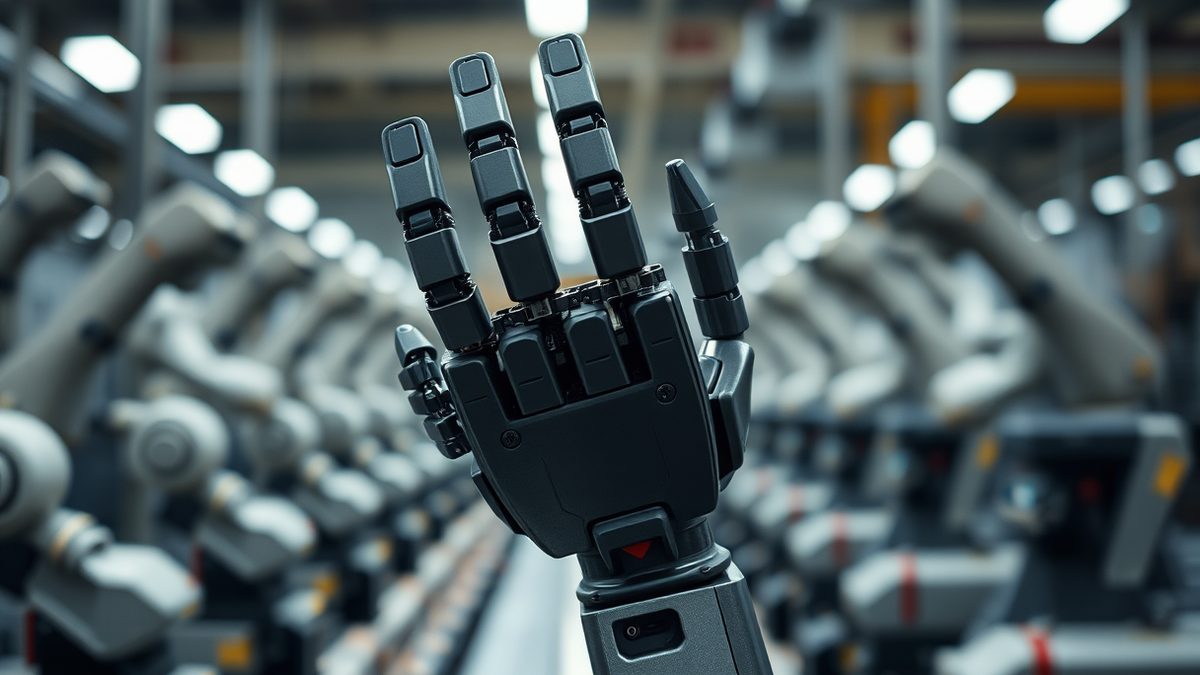
The humanoid robot story in October 2026 is no longer a research story. It is a manufacturing story, told by hands, joints, sensors and shipment numbers, not by stage demos.
The newest peg: a hand with no pinky
Boston Dynamics said on 1 October that its newest Atlas hand has four fingers, 13 degrees of freedom, is directly actuated and is designed for mass manufacturing. Previous Atlas hands had seven degrees of freedom and were built to grasp a wide range of objects; the new one is built to manipulate them. The company said there is no pinky because the team decided the extra dexterity was not worth three additional degrees of freedom, more size, more power consumption and more actuators.
Alberto Rodriguez, director of robot behavior for Atlas, said the design involved competing objectives. "We considered many, many designs, and there were many questions like: Do we want the hand to have one thumb or two thumbs? Do we really want the hand to have a pinky or not? And most of these don't have straight answers," he said, according to The Robot Report. Mechanical engineer Dylan Thrush added that the team concluded the additional tasks a pinky would enable were not worth the complexity.
The timing matters. The hand arrived about a week after Boston Dynamics opened its Robotics Metaplant Application Center at Hyundai Motor Group Metaplant America in Georgia, a training center for integrating Atlas into Hyundai's automotive manufacturing operations. The same week, The Robot Report's September top 10 list put the RMAC opening at number nine, ahead of a ranking that also included Agility's Digit 5 and Unitree's share slide.
China ships, the world installs
On 29 September, TechNode reported figures attributed to IDC showing China shipped more than 19,000 humanoid robots in the first half of 2026, 77.9% of global shipments. Global shipments reached nearly 25,000 units, up 432.1% year over year, and IDC raised its 2030 forecast to more than 750,000 units. Those are humanoid numbers. They are still small next to the installed base of industrial robots.
The International Federation of Robotics said in a 24 September release that the global operational stock of industrial robots rose 9% to a record 5 million units in 2025, with more than 600,000 new units installed during the year. China accounted for 59% of global deployments, installing 354,000 units. The United States passed Japan to become the second-largest market with almost 38,500 units, up 12%. Germany, the largest European market, saw sales fall 8% to fewer than 25,000 units.
That gap is the context every humanoid factory claim now has to survive. Five million industrial robots are already working; humanoid shipments in a half-year are counted in the tens of thousands. Goldman Sachs analyst figures cited by Semiconductor Engineering put annual humanoid shipments above 6 million units by 2035, up from fewer than 15,000 in 2025. The forecast is not the factory.
Tesla's hand problem, in public
The hardest evidence about what humanoid factories actually cost to run came from Ars Technica on 26 September, summarising reporting by The Information. Tesla's Fremont factory stopped making the Model S and Model X in May 2026, moving line workers and engineers onto Optimus. The newest version, Optimus V3, has proven difficult to build: production line equipment struggles to align components precisely, and running the line too fast is a limitation. Tesla has scaled to hundreds of robots per week and is targeting more than 1,000 per week by the end of 2026.
The specific bottleneck is the hand. Ars Technica reported that human workers manually assemble Optimus hands and forearms containing more than 100 small components such as screws, that newly produced robots require immediate fixes, and that unreliable touch sensors led Tesla to develop a glove-like sensor layer that can be replaced without replacing the whole hand. One source described the robots as requiring programming for specific tasks in carefully controlled environments.
Training data is the other constraint. Tesla had factory workers in Texas and California wear suits that record their physical movements, an imitation-learning play. The Information's reporting also described employees pushing back against training their robotic replacements, which is a labour problem no sensor solves.
Sensing is the quiet business
If hands are the visible problem, force and torque sensing is the invisible one. Vishay Precision Group said on 1 October it will present custom force and torque sensing for humanoid robotics at RoboBusiness 2026, arguing that stock catalog sensors are often too large for small limbs, have measurement ranges too broad for accurate signals, and lack multi-axis measurement and thermal compensation. VPG's Ron Zukerman said the company has "sixty years of experience in aerospace-grade force sensing."
ForceN's Robert Brooks will give a RoboBusiness session on the same subject on 20 October, drawing on work with humanoid companies over three years. The Robot Report's write-up notes the event runs 20 and 21 October in Santa Clara, California. Innodata, meanwhile, opened a motion-capture lab on 30 September, with VP Franklin Tanner arguing that direct 3D motion capture beats inferring motion from 2D video, and that context matters: a robot told to pick up a mug needs to know whether it holds hot liquid.
Memory is the third layer. A Semiconductor Engineering sponsor piece published on 1 October noted that logging motor torque, velocity and limb position above 10 kHz can exceed the endurance limits of conventional non-volatile memory, pushing humanoid designs toward distributed memory for boot, networking and telemetry rather than one central pool.
Safety, security and the input that lies
VicOne LAB R7 published research on 1 October showing how manipulated inputs can change robot behaviour even when safety functions work as designed. In one test, text on a poster was treated as an instruction by a robot dog running Gemma 4 E4B; in another, crafted inaudible audio changed a hospital-service-robot simulation running Nemotron on an NVIDIA Jetson AGX Orin. At a bug bounty event, researchers injected a ROS 2/DDS message into a robot expected to stay still under a safe-control setting. It moved.
The safety point is uncomfortable for anyone planning a humanoid factory. A safety assessment may treat a particular combination of accidental faults as unlikely, but deliberate manipulation removes that assumption, because an attacker can choose the fault. Any protection that depends on the same manipulated input does not help.
Europe debates the shape of the thing
Not everyone believes the fully anthropomorphic form is the productive one. Bruno Siciliano, professor of automation and robotics at the University of Naples Federico II, told Il Sole 24 Ore on 1 October that the European focus should be physical AI built around human-robot interaction rather than humanoid performance records, and he pointed to BMW's rethink of its use of Figure AI robots at its South Carolina plant. He argued that a fully anthropomorphic robot with legs is not always productive in an industrial plant, for reasons of cost, stability and movement agility, and can be an unnecessary complication compared with a fixed-base or wheeled machine.
Siciliano also described a push, discussed with the euRobin network at the European Parliament in early September, for an AI-based robotics act with a 30 billion euro budget and a target of 33% of the global market by 2035, modelled on the Chips Act. That is a policy ambition, not a factory.
What the factories are actually buying
While humanoids dominate the conversation, other form factors are already shipping. Maven Robotics, founded in 2024, told The Robot Report on 1 October that it has raised $100 million, built four iterations of its mobile manipulator, and has robots running 16 hours a day, five days a week, with up to 99% uptime. CEO Hamza Derbas said the company started from jobs to be done on the factory floor rather than from a humanoid form, and that its wheeled base can reach 3 m high while carrying 30 kg payloads.
ANYbotics launched its Shift fleet platform on 1 October for its ANYmal quadrupeds, citing an estimate that undetected failures cost the world's 500 largest companies $1.4 trillion a year in downtime, with a single hour of outage averaging $250,000. Inbolt raised 11 million euros on 30 September, led by Shift4Good, to give existing industrial robots real-time 3D vision; its system is deployed on more than 200 robots in over 100 factories, with customers including Bosch, Ford, Stellantis and Toyota.
Two data points from The Robot Report's September recap frame the money side. Unitree Robotics shares fell nearly 40% in September from their first-day closing price on 19 August, erasing roughly $20 billion in market value from that point. Qualcomm agreed to acquire PickNik Robotics and keep the MoveIt manipulation framework open source. Meanwhile, Figure retired its F.02 fleet into a 75-tonne electric arc furnace in Imatra, Finland, per heise online, because keeping the older robots operational was too expensive and dismantling them too slow; the company sold commemorative pieces from the melted material, at $500 and $1,900.
That last item is a useful measure of where the sector is. One company is melting its previous generation to save engineering time for the next one. Another is targeting more than 1,000 Optimus robots a week by year end, with hands still assembled by people. The humanoid factory is being built in public, and the hard parts are still hands, sensors, memory and data.
Sources
15- 01Boston Dynamics drops pinkie on new humanoid handEN
- 02China accounts for 77.9% of global humanoid robot shipments in H1, IDC saysEN
- 03Five Million Robots Now Operate in Factories GloballyEN
- 04Tesla workers balk at training Optimus humanoid robots as replacementsEN
- 05Memory At The Edge: Non-Volatile Memory Challenges And Requirements For Humanoid RobotsEN
- 06Precision In Motion. Vishay Precision Group, Inc. (VPG) to Showcase Custom Sensing Capabilities for Humanoid Robotics at RoboBusiness 2026EN
- 07ForceN to give a crash course on force and torque sensing for humanoids at RoboBusinessEN
- 08Innodata opens motion-capture lab to help humanoids move more like peopleEN
- 09Your Robot's Safety Functions Already Work. What If the Input Lies?EN
- 10Umanoidi, il professore di robotica Bruno Siciliano: «L'Ue punta sull'interazione tra uomo e macchina»EN
- 11How Maven Robotics plans to automate industrial work, one task at a timeEN
- 12ANYbotics launches Shift to streamline robot fleet operations, scale inspectionsEN
- 13Inbolt raises €11M to bring real-time vision and intelligence to industrial robotsEN
- 14Top 10 robotics stories of September 2026EN
- 15Figure mustert humanoide F.02-Roboter aus und lässt sie in Schmelzofen springenEN
All figures and quotations in this text come from the sources listed below.
Content prepared by the editorial team with AI assistance.
Rachel Nwosu
Comments
0- No comments yet — be the first.