RBA raises cash rate to 4.85%, highest since 2008
The Reserve Bank of Australia raised its cash rate by 25 basis points to 4.85% on Tuesday 3 November, the fifth increase of 2026 and the highest since late 2008.
 Dr. Amara PatelEconomy, business and world
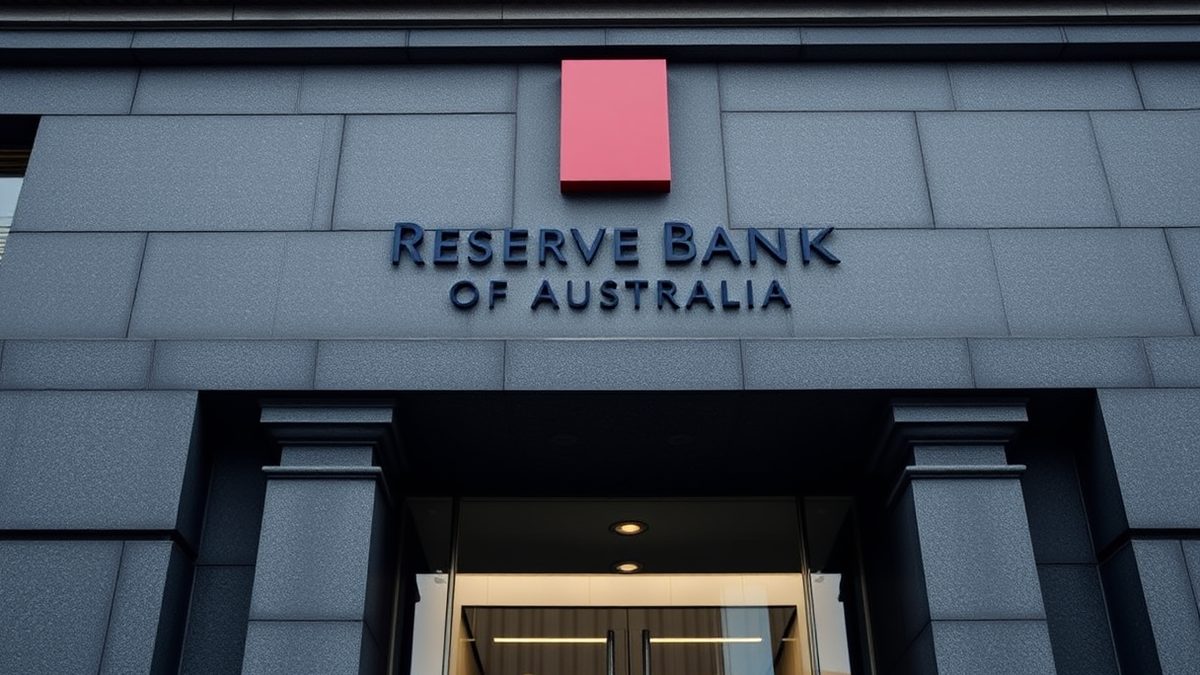
The Reserve Bank of Australia raised the cash rate target by 25 basis points to 4.85% on Tuesday 3 November. It is the fifth increase of 2026. The cash rate has not been this high since late 2008.
The increase adds about $119 a month to repayments on a $731,000 mortgage, the national average new owner-occupier loan, if lenders pass it on in full. Savers with high-interest accounts could earn more if banks lift deposit rates.
The decision
The Monetary Policy Board split 6-3. Three members voted to hold at 4.60%. Governor Michele Bullock said the rise was needed to get inflation down and would be difficult for Australians with mortgages.
The board left the door open to further tightening but did not explicitly signal another hike. The cash rate has now risen by 125 basis points since February, after increases of 25 basis points in February, March, May and September. All four major banks had forecast the move, and it was in line with market expectations. The Australian dollar fell 0.2% against the US dollar after the announcement.
What it means for borrowers
Canstar estimates the extra cost at about $77 a month on a $500,000 loan. It estimates about $153 on a $1 million loan.
Anja Pannek is chief executive of the Mortgage and Finance Association of Australia. She said every household will experience the decision differently. "A positive step borrowers can take today is to understand what it means for their repayments, their budget and their plans," she said.
Inflation forecasts pushed out
The RBA now expects inflation to remain elevated through much of 2027. It said inflation is not expected to reach the top of its 2% to 3% target range until late 2027, around three quarters later than previously forecast. It raised its end-2026 CPI forecast to 4.7% from 3.6%. It raised its end-2026 trimmed mean forecast to 3.6% from 3.3%.
September CPI rose 4.3% from 4.0% in August, the highest since March. Annual trimmed mean inflation rose to 3.6% from 3.5%. The RBA targets annual inflation of 2% to 3%. The board said inflation partly reflects higher fuel and other commodity prices affected by the conflict in the Middle East. It also said AI-related investment is driving rapid growth in prices for technology-related goods. The board judged domestic capacity pressures a little tighter than earlier thought, and said many firms were raising prices or planning to.
The board said "a further tightening in financial conditions is warranted". Deputy governor Andrew Hauser warned last month that an increasing share of businesses think 3% to 3.5% is the new normal. "That is the central banker's nightmare," he said.
The economy is already cooling
The RBA said the economy is slowing, housing prices have fallen significantly this year and the unemployment rate has risen. Unemployment is 4.7%. The bank raised its unemployment forecast to 4.7% from 4.5% by end-2026, and now expects it to average 5.1% in the December quarter of 2028, up from 4.8% in August. It also flagged uncertainties about the extent and economic effects of the housing downturn.
GDP rose 2.1% in the June quarter compared with a year earlier, down from 2.5% year-on-year in the March quarter. The RBA raised its 2026 GDP forecast to 1.6% from 1.4%.
Private forecasters are gloomier still. Belinda Allen, CBA's head of Australian economics, expects real GDP growth of 1% by the middle of next year, nearly half her previous 1.8% estimate. Gareth Spence, NAB's head of Australian economics, says unemployment may need to reach 5.4% by the end of next year to bring inflation down. Brent crude has risen from about $72 a barrel in early July to above $110 in recent days as the Middle East conflict broadens. Treasurer Jim Chalmers said the conflict is putting sustained upward pressure on inflation and its end cannot come soon enough.
What happens next
The RBA said the Monetary Policy Board will hold its final meeting of 2026 in early December. George Tharenou, chief economist at UBS Australia, said he expects the board to keep the rate on hold then.
Capital Economics analysts read the decision differently. They said it showed the RBA was more confident monetary policy was sufficiently tight. They said its next move would be a cut.
How much of the 25 basis points reaches mortgage rates is not yet known, and whether deposit rates follow is also unclear. A rate change takes 12 to 18 months to flow fully through the economy, so the full effect will not be clear until 2028.
Sources
15- 01Interest rates highest since 2008 as inflation forecast to stay highEN
- 02RBA hikes interest rates to 2008 levels, sharply raises inflation forecastsEN
- 03Australia hikes rates to 18-year high to fight inflationEN
- 04RBA lifts cash rate to 4.85%, highest since 2008EN
- 05RBA Raises Cash Rate to 4.85%, Highest Since 2008, in 6-3 VoteEN
- 06Australian central bank raises interest rates to 18-year highEN
- 07'Sharper, longer slowdown' predicted for Australian economy as fifth interest rate hike loomsEN
- 08Australia Hikes Interest Rate to 18-Year HighEN
- 09Australia raises key interest rate to 18-year highEN
- 10Live: RBA hikes cash rate to 4.85% – the highest since 2008 - Forbes AustraliaEN
- 11Australia raises interest rates to 4.85% as RBA Governor prepares to address media.EN
- 12‘Discontent and distrust’: annual social cohesion checkup shows exactly what’s making Australia angryEN
- 13How Some Media Shape Regional Australia’s Hostility to Renewable EnergyEN
- 14 Decisions taken by the Governing Council of the ECB (in addition to decisions setting interest rates)EN
- 15Electric Vehicle Council Celebrating 10 Years of EV Progress in AustraliaEN
All figures and quotations in this text come from the sources listed below.
Content prepared by the editorial team with AI assistance.
Dr. Amara Patel
Comments
0- No comments yet — be the first.