The Semiconductor Capacity Race Has a Quartz Bottleneck Nobody Fixed
Spruce Pine, North Carolina produces the world's only ultra-pure quartz at commercial scale. Two years after Hurricane Helene flooded the town, the supply chain feeding every silicon ingot still runs through one road.
 Grace OkonkwoAI, models and technology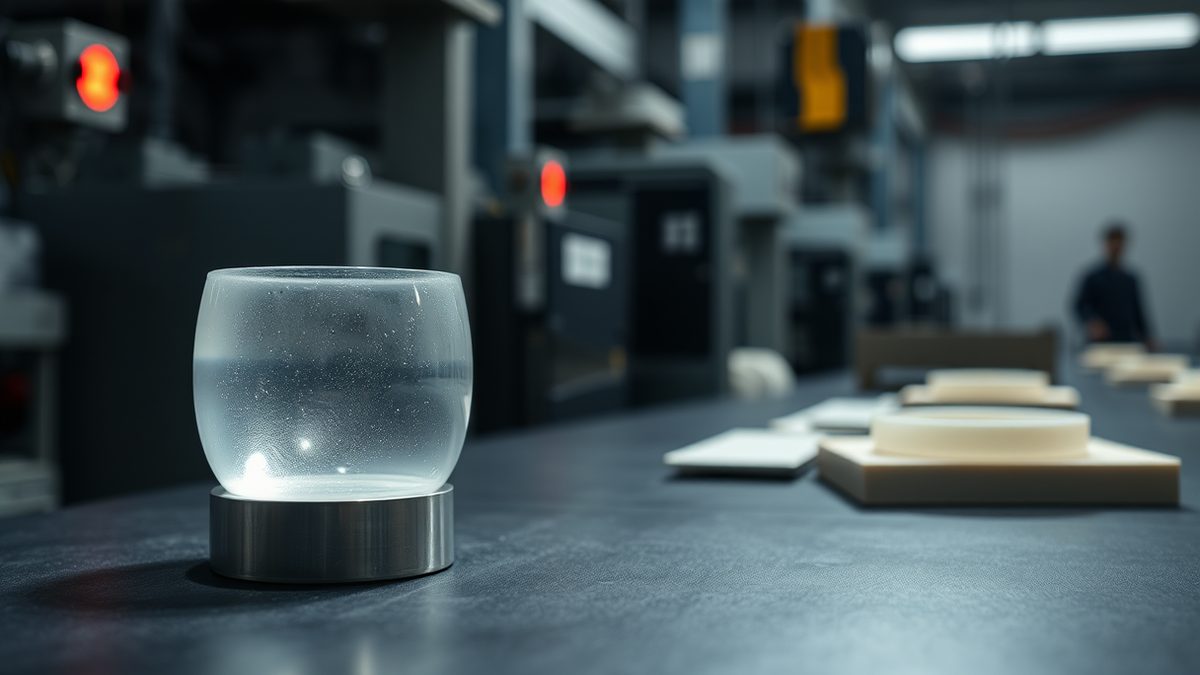
Every silicon wafer starts inside a crucible. That crucible is made from quartz pure enough not to contaminate molten silicon heated above 1,400 degrees Celsius. Almost all of the world's ultra-pure quartz comes from a small town in the Blue Ridge Mountains.
Hurricane Helene hit Spruce Pine, North Carolina in late September 2024. It dropped more than two feet of rain, cut off road access and left residents without power. Two companies mine ultra-pure quartz there: Sibelco North America and The Quartz Corp. Tom's Hardware reported on 1 October 2024 that Sibelco had confirmed a suspension of operations. The Quartz Corp told The Verge it was too early to determine whether its high-purity quartz production facility was affected.
Immediate damage was hard to assess because roads and communications were down. Then the story got complicated.
What Spruce Pine actually supplies
Construction Physics published a detailed assessment in November 2024. It argued that the common claim that all semiconductor manufacturing depends on Spruce Pine is only sort of true. Quartz crucibles are necessary for most chip manufacturing, and Spruce Pine is where most of that quartz comes from. But the town is not an irreplaceable linchpin. Alternatives exist, though they are, in the publication's words, all some combination of not yet developed, not quite as good, and not quite as cheap.
The numbers in that analysis are worth reading closely. Spruce Pine is estimated to produce 180,000 to 200,000 tons of high-purity quartz per year, according to Construction Physics. That publication notes the high-purity quartz industry is extremely secretive about specific figures. For comparison, in 2013 worldwide quartz shipments were only 80,000 tons including medium, high and ultra-pure grades. In 2015 total high-purity quartz output was estimated at around 30,000 tons.
Cutting off that supply would not stop chip production outright. It would mean yields going down and costs going up. The industry knows it: new quartz sources and new crucible materials are both under investigation.
Why the crucible matters more than it sounds
Most modern microchips are made from silicon that is 99.9999999% pure, known as 9N. Solar cells use somewhat less pure material, in the 6N to 8N range. Reaching those levels takes multiple refining steps. These start with quartz reacted with carbon in a submerged arc furnace to produce metallurgical grade silicon at roughly 98 to 99% purity, which then goes through the Siemens process to become polysilicon.
Monocrystalline silicon, needed for microchips and high-efficiency solar panels, is almost entirely made by the Czochralski process. Polysilicon is melted in a quartz crucible and a seed crystal is dipped into the melt and slowly withdrawn, pulling a single large crystal behind it. The crucible degrades under that heat. Chemical changes cause it to crack after it cools, and manufacturers can stretch its life by pulling multiple ingots without cooling the furnace. But a crucible is still limited to around 400 hours of operation. A Czochralski furnace consumes on the order of 20 to 25 crucibles a year. One paper cited by Construction Physics estimated that 30% of the manufacturing cost of monocrystalline silicon ingots came from the crucibles.
High-purity quartz costs on the order of $10,000 a ton, and the crucibles themselves cost several thousand dollars apiece.
That is the economics behind the bottleneck. A crucible is not a consumable anyone can swap casually. The material inside it has to come from somewhere with the right geology.
The capacity buildout is happening elsewhere
While Spruce Pine was dealing with flooding, governments were writing cheques. India unveiled the Mobile Phone Manufacturing Scheme on 15 July 2026, a ₹625 billion program worth about $6.5 billion that runs for five years. It rewards smartphone manufacturers based on eligible sales, with incentives from 2.25% to 5% and an additional 1.5% for sourcing key components and sub-assemblies locally, according to TechCrunch. New Delhi also committed a further ₹1.28 trillion, around $13.3 billion, to domestic semiconductor manufacturing. That expands a $10 billion chip incentive program launched in 2021 with greater support for chip equipment, materials, design and research.
The scale of what India is trying to close is clear from Counterpoint Research figures cited by TechCrunch. China accounted for 63% of global smartphone production in 2025, against India's 18%. The smartphone program will run through March 2031, and the government expects mobile-phone production during that period to total about ₹39 trillion, roughly $405 billion, creating about 60,000 direct jobs. Navkendar Singh, associate vice president at IDC, told TechCrunch the new program marks a shift from an "assemble more" playbook toward "depth, R&D and local value capture."
Malaysia is making a narrower bet. The country holds 13% of the global market for chip packaging, assembly and testing services, according to a Malaysian Investment Development Authority report cited by CNBC in April 2024. Second finance minister Amir Hamzah Azizan told CNBC's Karen Tso at the IMF spring meetings in Washington that Malaysia would benefit from the semiconductor upcycle and did not see China, its largest trading partner, as a rival. "I think the reality of it all is, there is enough growth that will go around," he said. Malaysia's stated focus is moving away from the back end of the supply chain and up the value chain, rather than competing head-on at the leading edge.
Malaysia is also where Texas Instruments opened its second assembly and test factory in Melaka on 6 November 2025. The company says the site will assemble and test billions of chips annually. TI's own capacity expansion has run in parallel. On 24 October 2024 the company announced it had begun producing gallium nitride power semiconductors at its factory in Aizu, Japan, quadrupling internal GaN manufacturing capacity across its US and Japanese sites.
Mohammad Yunus, TI's senior vice president of technology and manufacturing, said in that announcement that the company had qualified its 200mm GaN technology for mass production in Aizu. He said TI aims to grow internal manufacturing to more than 95% by 2030. TI also said it had successfully piloted GaN manufacturing processes on 300mm wafers, with its expanded processes fully transferable to that size.
Two bottlenecks, two timelines
GaN capacity and smartphone assembly incentives can be built with capital and policy. A quartz deposit cannot. That asymmetry is why the Spruce Pine story keeps resurfacing, and why the scepticism about it is worth taking seriously too. The mines sit in the hills rather than in the town itself, as commenters on the Tom's Hardware report pointed out, and there is no way to know from outside what happened underground. Large manufacturers tend to stockpile critical raw materials and qualify second sources, which limits how far a single disruption can travel.
What the episode exposed is less dramatic than the apocalyptic framing that circulated in 2024. It is also harder to fix. The industry has spent the years since building fabs in India, Malaysia, Japan and the United States. None of that changes where the purest quartz comes from. Until a new crucible material or a new deposit reaches commercial scale, every capacity announcement in the sector sits on top of a supply chain that runs through one town in North Carolina.
Sources
6- 01The Forgotten Story of How IBM Invented the Automated FabEN
- 02Malaysia is unfazed by China, U.S. chip competition, minister saysEN
- 03Hurricane Helene devastates quartz mines critical for worldwide semiconductor manufacturingEN
- 04India bets billions on breaking China's grip on smartphone manufacturingEN
- 05Texas Instruments expands internal manufacturing for gallium nitride (GaN) semiconductors, quadrupling capacityEN
- 06Does All Semiconductor Manufacturing Depend on Spruce Pine Quartz?EN
All figures and quotations in this text come from the sources listed below.
Content prepared by the editorial team with AI assistance.
Grace Okonkwo
Comments
0- No comments yet — be the first.