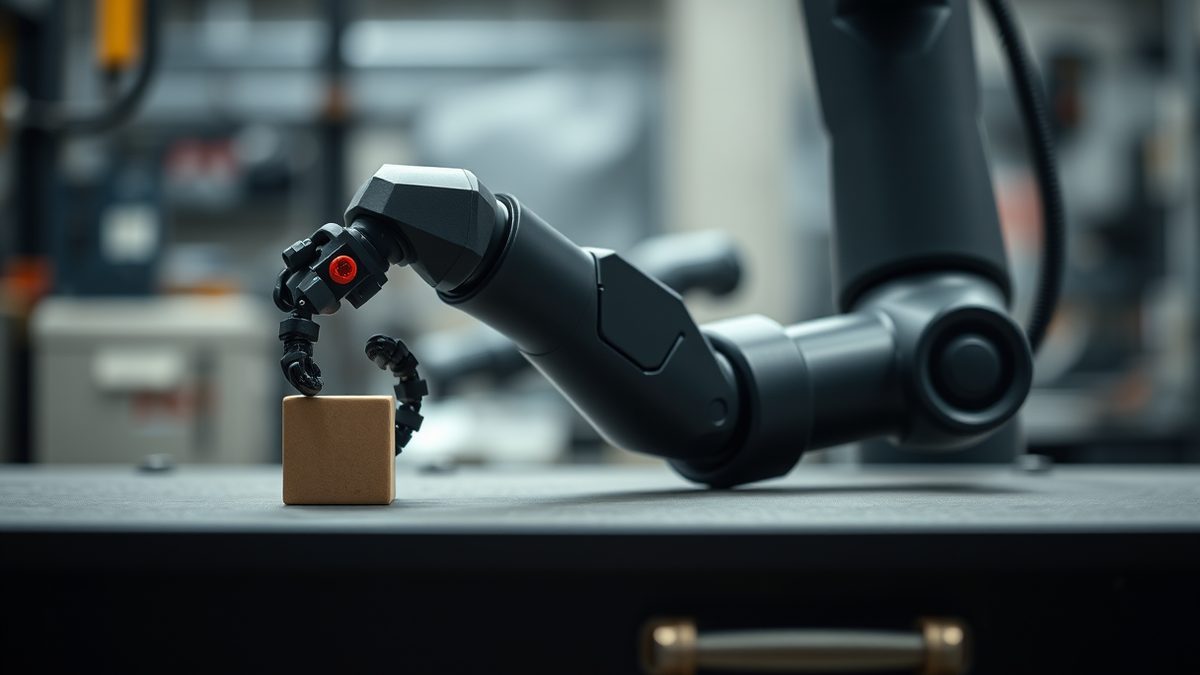
Reka's Rho-1 puts text, video and robot actions in one 19B model
Reka released a research preview of Rho-1 on 5 October, a 19B model that generates text, images and video and outputs robot actions inside a single network, the company says.

Reka released a research preview of Rho-1 on 5 October, a 19B model that generates text, images and video and outputs robot actions inside a single network, the company says.

Only 34% of enterprise agentic AI projects reach production, according to a survey of 300 technology executives published on 5 October by MIT Technology Review. The main barrier is not compute but a lack of organizational knowledge context.

Interfaze AI released Interfaze-1-lite on 5 October. The mixture-of-architectures model transcribes a 95-minute audio recording in about 90 seconds on a single 80 GB GPU.

Reflection published details on 5 October of Beam, a 501 billion parameter open-weight model with 23 billion active, pitched at coding and agent workloads on 3 to 4 times less inference compute than GLM-5.2. The weights are not out yet: the company says final red-teaming is still running.
Liquid AI launched d1, a decision model that now reads images as well as text, on 5 October, claiming it matches or beats GPT-6.1 Sol on four of six real applications at 19x to 200x lower cost.
Reflection published details of Beam on 5 October, a sparse open-weight model with 501 billion total parameters and 23 billion active, aimed at coding and agentic work. No company in the dossier shipped a new AI video generation model in the past 72 hours.
Reflection published benchmarks for Beam, its first open-weight model, on 5 October. Beam is a sparse Mixture-of-Experts design with 501 billion total parameters and 23 billion active, pitched at coding and agentic work. The weights are not out yet.

On October 5, Akka reported that a spec-driven AI workflow ported 65 open source projects. It used 9.41 billion tokens in 99.3 hours and improved code or performance in 57 of them.

A survey of 300 technology executives finds that only 34% of agentic AI projects reach production. Fragmented data and a lack of contextual knowledge are the main barriers.
Reflection released its 501B open-weight model Beam on 5 October, while developers shipped CLI tools that make small local models usable for coding.
New research published on 5 October argues that current benchmarks fail to test how AI agents organize long-term memory, a gap that exposes critical safety vulnerabilities in modern systems.
On 5 October, Reflection AI released Beam, a 501-billion-parameter open-weight model designed to match Chinese rivals like GLM-5.2 while using 3-4 times less inference compute.
On 5 October, Reflection AI released Beam, a 501-billion-parameter open-weight model claiming to match Chinese rivals on reasoning benchmarks while using 3-4x less compute, amid a surge in cyber-focused AI announcements.
On 5 October, developers released Reika, a CLI agent optimized for 8B-35B local models, alongside Jeff-Code, which uses a 0.8B model to speed up Qwen 3.8-27B by 47% without sacrificing accuracy.
A researcher ran 27,489 newly published CVEs through a local decision model. He found that 16.9% never state a security impact, a result that says as much about how AI systems grade text as about the bug reports themselves.
Google will cut free Gemini users to the Flash-Lite model and pull Pro from the $4.99 AI Plus plan, with the change taking effect on 9 October, according to an updated Google support document seen by 9to5Google.
Google will limit free Gemini app users to Flash-Lite from 9 October, cutting off Flash and Pro, according to a support document updated this week and reported by 9to5Google.
From 9 October, Google will limit personal Gemini accounts without a paid plan to the (3.5) Flash-Lite model, according to an updated Google support document reported by 9to5Google on 3 October. Free users lose access to (3.6) Flash and (3.1) Pro.