Physical Intelligence's reported $20bn round caps a week of robot model funding
Physical Intelligence is in talks to raise funding at a $20bn valuation, more than triple the $5.6bn it was worth in November 2025, according to Bloomberg reporting relayed by AI Magazine on 3 November.
 Grace OkonkwoAI, models and technology
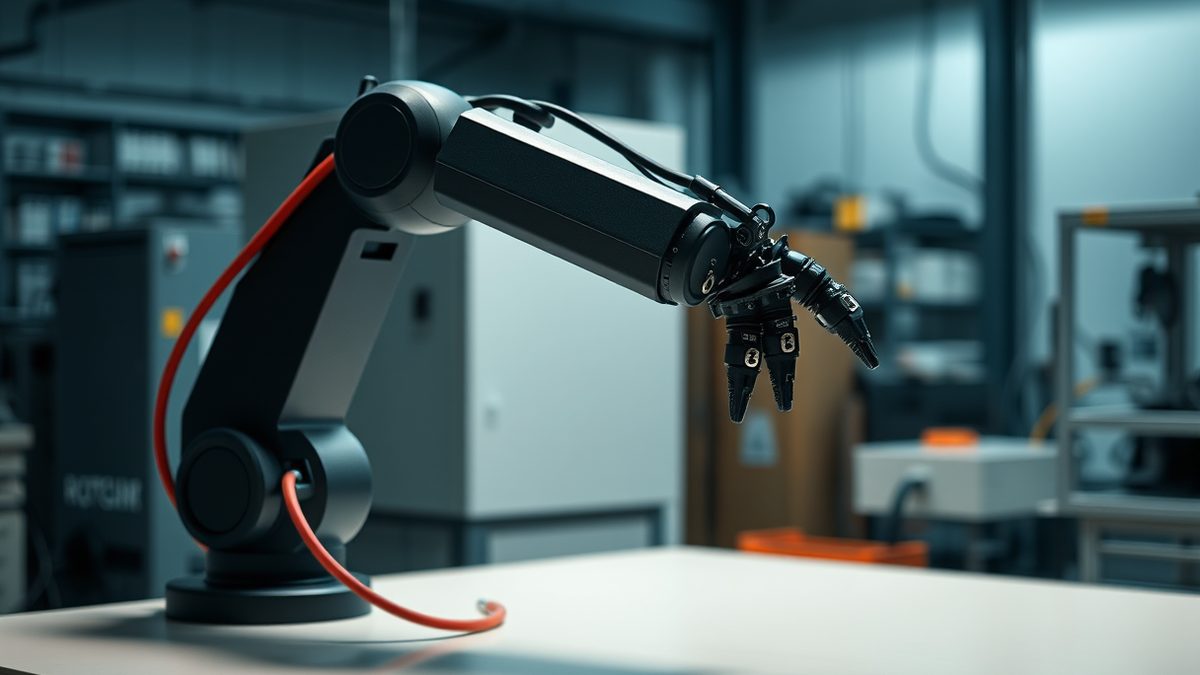
The two rounds announced on 2 November fund the same idea: one model that can drive many kinds of robot, rather than a bespoke controller for each arm. The bet is that the model, not the hardware, becomes the scarce asset.
Physical Intelligence has raised steadily since it was founded in March 2024. A $70m seed was followed by a $400m Series A at a $2.4bn valuation and a $600m Series B led by CapitalG, with Jeff Bezos, Thrive Capital, Lux Capital, Index Ventures and T. Rowe Price also investing. That Series B, in November 2025, set the $5.6bn mark the reported talks would leave far behind. Bloomberg reported that existing backers Avenir and Lux Capital are in discussions to lead the new round, citing people who asked not to be named, and that the company is seeking at least $1bn.
For all that capital, the company is small. Physical Intelligence had about 80 employees in March 2026.
The technical bet is a vision, language and action model trained across many robot types, rather than a controller written for one gripper. π*0.6, released in November 2025, uses reinforcement learning to improve from experience, and March 2026 research added long- and short-term memory for tasks lasting more than ten minutes.
The commercial evidence is narrow but specific. The π0.6 model packed e-commerce orders through a full warehouse shift at 96.4% autonomy for deployment partner Ultra in February 2026, and Ultra says it is scaling towards hundreds of deployments in US warehouses. Adding laundry-folding data from partner Weave cut missed grasps by 42% and human interventions by 50%, the company says. Sergey Levine, a co-founder, told TechCrunch: "Think of it like ChatGPT, but for robots".
Tutor Intelligence argues the data has to come from paid work. The Watertown, Massachusetts company announced a $75m Series B led by Andreessen Horowitz on 2 November, taking total funding to $117m.
Tutor deploys robots it calls Sonny and Cassie into customer sites, where remote operators known as tutors help them finish tasks, and the resulting experience trains the next model. Raghu Raghuram, the Andreessen Horowitz general partner and former VMware chief executive, said "continual learning across an expanding range of deployments is the path from specialized capabilities to general-purpose robotics". Josh Gruenstein, co-founder and chief executive, said the resulting intelligence makes robots "affordable on a whole new level" and that "we can hardly build robots fast enough". Union Square Ventures and Neo, which led earlier rounds, also participated.
Machenta goes the other way. The London company raised $40m in seed funding led by Creandum and Union Square Ventures, and says its models are pre-trained entirely on simulated data.
Imperial College London, where the research began about six years ago, called it the largest seed round raised by a UK robotics startup. Professor Edward Johns and PhD student Vitalis Vosylius founded the company out of the university's Robot Learning Lab, and it has opened an office and laboratory in King's Cross. The pitch is instant learning: a robot that picks up a new physical task after seeing it once, rather than after repeated demonstrations and model updates. Johns said in the announcement that "intelligence is not so much about what you can already do, it's about how quickly you can learn to do something new".
Simulated data is cheap and private. Deployment data is expensive and specific. Which one produces the better general model is the open question behind all three valuations.
The spread in cheque sizes is wide. Machenta's $40m seed and Tutor's $117m total are small next to the $1bn-plus Physical Intelligence is reported to be seeking, and smaller still next to the valuation under discussion.
The public market gets a vote first. Churchill Capital Corp XI shareholders approved its merger with Agility Robotics on 2 November, with more than 84% of votes cast in favour.
The combined company is expected to close the deal on 4 November and begin trading on Nasdaq on 5 November under the ticker AGLT. It expects about $465m in gross capital before expenses, down from the more than $620m anticipated when the merger was announced in June. That is roughly $164m from Churchill's trust account, $201m from a PIPE led by Foxconn and $100m in equity Agility raised after the announcement. Digit robots already work in nine customer environments, including a GXO Logistics site in Flowery Branch, Georgia, with two more GXO facilities added in October. Agility says it has more than $300m in committed multi-year orders for Digit 5, while cautioning that the figure is not current revenue.
Its RoboFab plant in Salem, Ore., is designed for up to 10,000 robots a year.
Digit 5, unveiled in September, is due for early customer access in the first half of 2027 and general availability at the end of that year. Agricultural equipment maker AGCO signed a commercial agreement in October to pilot Digit at its Hesston, Kansas plant from 2027.
Hardware choice is still narrow. RoboterAtlas listed 49 humanoid robots from 41 companies as of the end of October 2026, 26 of them from Chinese manufacturers, ten from the US and three from Germany, heise reported. Twenty-eight of the listed models were aimed at businesses, 18 at research and education, and only 16 at private households.
None of this settles whether general robot models earn their valuations. Physical Intelligence's partners report autonomy percentages, Tutor reports deployments, and Agility reports orders with a caveat attached. The next hard number arrives on 5 November, when AGLT starts trading.
Sources
28- 01Physical Intelligence: What are Robot Foundation Models? - AI MagazineEN
- 02Machenta Raises $40 Million Seed Round To Build Instant-Learning Robot Foundation ModelsEN
- 03Tutor Intelligence Raises $75 Million Series B Led by Andreessen Horowitz to Scale Frontier Robotics Model Training, Manufacturing and DeploymentEN
- 04Churchill Capital XI shareholders approve $2.5B Agility Robotics humanoid SPACEN
- 05Humanoide Roboter in Deutschland: Modelle, Preise und VerfügbarkeitEN
- 06QUAL: Quantile Alignment Improves Zero-Shot Time-Series Foundation ModelsEN
- 07Anthropic is working on a system to prove AI models’ identityEN
- 08Nvidia is happy to take your money whether you're using open or closed models, says Jensen HuangEN
- 09I Checked Out Tesla’s New Model YL, Standard Y, Model 3 In Person — Here’s What Surprised MeEN
- 10Training Foundation Models with a Single AlgorithmEN
- 11 Google reveals new Gemini 4 Carbon AI model, narrowly beating Claude Opus 5.5 EN
- 12Open models can do 90% of agentic work at a twentieth of the cost of a frontier LLM: GartnerEN
- 13Tutor Intelligence raises Series B to scale model training, robot deploymentsEN
- 14Gentherm designs ThermAffyx to secure, heat patients during robotic surgeriesEN
- 15Top 10 robotics developments of October 2026EN
- 16Jülich Hosts EVE Language Model for Earth Observation and Earth ScienceEN
- 17Google Launches LiteRT Tensor API for Building, Customizing, and Optimizing ML Models for On-DeviceEN
- 18Westward Ho! First Trip Cross Country with Our New 2026 Tesla Model Y & Full Self Driving V14EN
- 1928 Zero-Day Findings in Less Than Two Days: What AI-Speed Discovery Means for RoboticsEN
- 20Solving the Interconnect Challenge in Modern Robotics: How 3M Is Engineering for Motion, Density, and UptimeEN
- 21Klobot Wins State Project to Develop Spatial Intelligence Robot ModelEN
- 22Unusual robotic animals can prove their utilityEN
- 23Was I wrong about open models & cyber risks?EN
- 24Beyond Plausible Prediction: Safety Sufficiency in Web World ModelsEN
- 25Incongruence-Aware Evaluation of Multimodal Speech Emotion Recognition in Audio Large Language ModelsEN
- 26Agentic World Modeling for Agent Test-time Scaling without Environment ReplicaEN
- 27The psychophysics of affect in large language modelsEN
- 28Calibration of Large Model Quantization based on HiFloat4 FormatEN
All figures and quotations in this text come from the sources listed below.
Content prepared by the editorial team with AI assistance.
Grace Okonkwo
Comments
0- No comments yet — be the first.