China's Tech Push: From Melbourne Docks to Washington's AI Fight
A single ship carrying 5,000 Chinese-built electric vehicles into Melbourne in June 2026 has become the clearest sign yet of how China's technology policy is reshaping markets from Australia to the White House.
 Dr. Amara PatelEconomy, business and world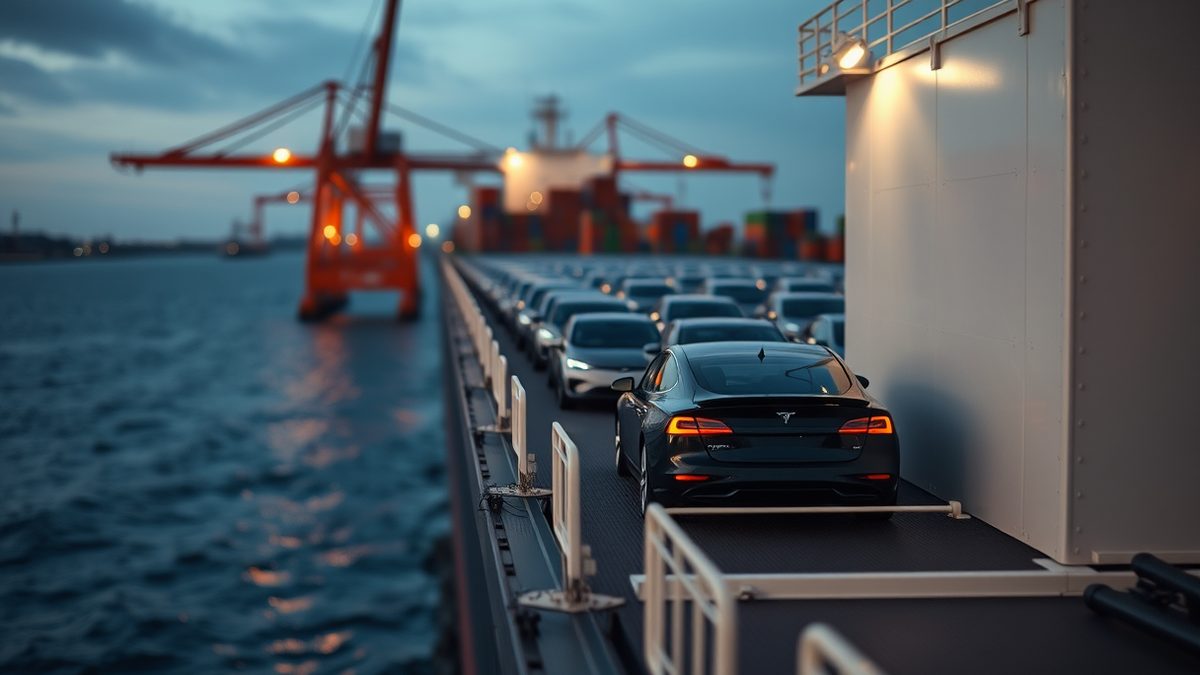
In June, the BYD Zhengzhou, an LNG-powered bulk carrier in red and white livery, docked at the Port of Melbourne on its first voyage to Australia. On board were 5,000 newly built electric vehicles, the largest single EV shipment ever sent to the country, according to ABC News analysis published by RNZ.
It was not an isolated delivery. In the first half of 2026, sales for every major Japanese automaker in Australia except Honda fell. Mazda was down 17 percent, Toyota 21 percent, Subaru and Mitsubishi 25 percent each, and Nissan 32 percent, the same analysis found. Chinese brands went the other way. BYD sales jumped 124 percent, Chery 77 percent and Geely 495 percent, all from much smaller bases.
Almost a quarter of cars sold in Australia last month were fully electric, up from 7 percent a year earlier. Add hybrids, and battery-powered vehicles now match petrol and diesel models.
Policy, not just products
The car numbers are the visible end of a policy that started in Beijing long before Chinese EVs reached Australian driveways. According to the RNZ analysis, China set out a strategic policy as far back as 2000, poured cash and incentives into the project in 2009, and encouraged battery firms such as BYD to move into automobiles. The aims were to cut reliance on imported oil and reduce pollution. Alongside that, China built dominance in refining and producing industrial metals, including lithium, cobalt, manganese and graphite. It now accounts for 90 percent of the world's battery production, the analysis states.
That control is now the centre of a fight in Washington. MIT Technology Review reported in September that the Trump administration declared a national emergency in late August, effectively banning Chinese batteries from grid-scale energy storage. Import taxes on batteries rose to 25 percent in January, up from 7.5 percent. From 2026, new storage projects must source 55 percent of material costs from outside China and other restricted countries to qualify for tax credits.
"An outright ban was a bit of a surprise, and it does create a bit of concern for domestic players in the US," Shan Tomouk of Benchmark Mineral Intelligence told MIT Technology Review.
BloombergNEF analysts told the same outlet the ban is likely to slow grid-connected storage projects in the near term, with some facing cancellation. The US may have enough domestic battery capacity by about 2030, though supply may not meet demand until later in the 2030s, and US-made cells remain significantly more expensive than Chinese ones.
Open models, closed arguments
The same pattern is playing out in AI. Moonshot's Kimi K3, a free open-weight model, is powerful enough to rival paid products from OpenAI and Anthropic, MIT Technology Review reported in July. That has split President Donald Trump's advisers. David Sacks, his former AI and crypto czar, criticised AI companies that "want the government to eliminate their open source competition," while Pentagon official Emil Michael attacked a former Trump adviser working for OpenAI as the industry's "supreme village idiot."
The Guardian reported on 1 August that Microsoft, Nvidia, Palantir and Meta signed a letter urging lawmakers not to restrict open models, and that Nvidia chief executive Jensen Huang went to Capitol Hill to lobby on the issue. Treasury secretary Scott Bessent suggested the US could sanction Chinese AI firms over alleged intellectual property theft, while commerce secretary Howard Lutnick received letters from startup founders asking him not to cut off access to open models.
Trump's own position, quoted by the Guardian, was cautious: "We have to be careful in both ways. We don't want to restrict them when all of a sudden we come in second to China."
Not every lever is economic. The Federal Communications Commission announced a ban on humanoid robots from China, citing national security risks, and a report that China had begun mass production of specialty AI chips erased $1tn in market value from other chipmakers, the Guardian reported.
The legal front is running in parallel. Huawei's US trial opened in Brooklyn federal court in September, where Justice Department attorney Taylor Stout described the company as a criminal enterprise that stole trade secrets from five US firms, including Cisco and T-Mobile. Defence lawyer Brian Heberlig countered: "It's about competition, not conspiracy. Innovation, not theft." China's foreign ministry said it "firmly opposes the US side's suppression and containment of Chinese enterprises."
Writing in The Conversation, a China expert and open-source researcher argued the contest over open-source standards, from RISC-V chips to 6G networks, will decide who holds a competitive edge for decades. Some Chinese model licences, such as Moonshot's Kimi K3 and MiniMax M3, impose extra compliance obligations, and bilingual licences give Chinese courts the final say in disputes. Cheap technology on offer, and the risk of depending on one supplier for it: that is the choice now facing everyone from Australian car buyers to the US grid.
Sources
6- 01How China won the car wars with cheap EVs loaded with technologyEN
- 02Can the US battery market untangle from China?EN
- 03China's AI models have Trump's AI world at war with itselfEN
- 04China's tech advances are causing chaos from Silicon Valley to the White HouseEN
- 05China's Huawei branded a criminal enterprise as tech firm's US trial opensEN
- 06China is shaping the future of open-source technology – including AIEN
All figures and quotations in this text come from the sources listed below.
Content prepared by the editorial team with AI assistance.
Dr. Amara Patel
Comments
0- No comments yet — be the first.