China Weighs Nvidia U-Turn as Exit Rules Tighten Around Its Own Engineers
China's tech ministry has told some firms it intends to approve purchases of Nvidia's new RTX Pro 5500 chip, The Information reported on Sunday, a possible loosening of Beijing's own curbs on advanced chips.
 Dr. Amara PatelEconomy, business and world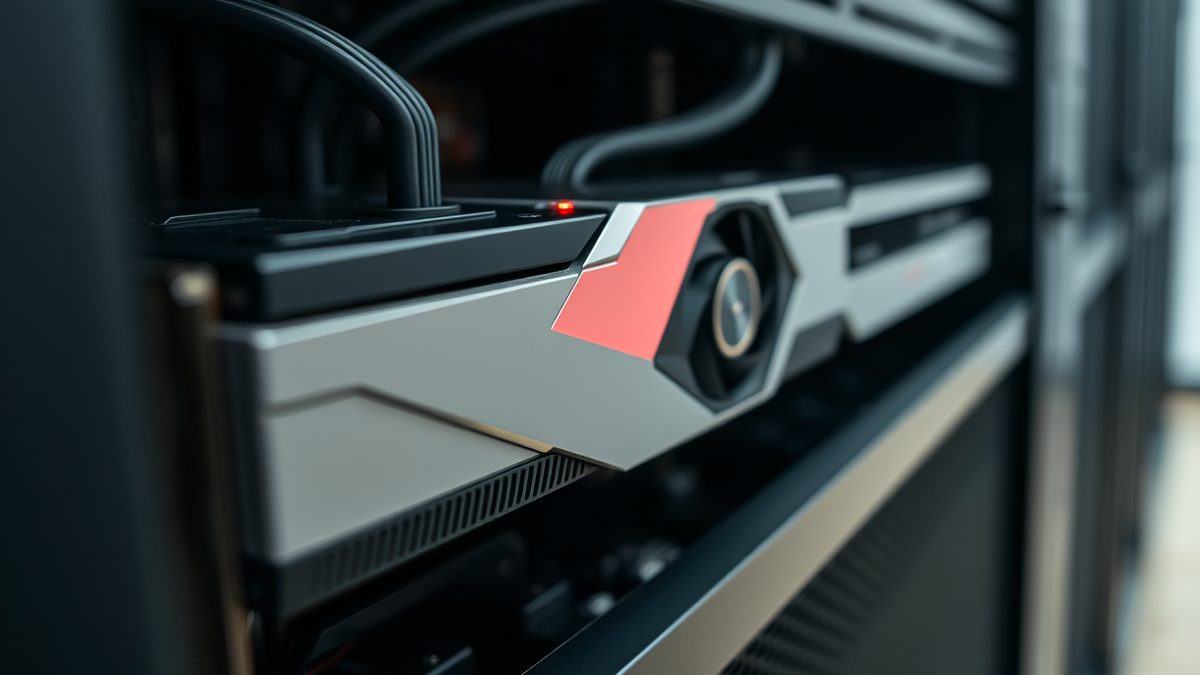
The Information reported the news on Sunday, citing two people familiar with the matter. According to the report, the tech ministry recently asked some companies how many of the chips they plan to buy, and what for. It then told some of those companies it intends to approve the purchases.
Reuters said it could not immediately verify the report. TNW has not independently verified it. By Sunday, none of Nvidia, Alibaba, ByteDance or the ministry had commented publicly.
The chip in question is a workstation graphics card Nvidia unveiled this month. It is built on the company's Blackwell design and carries 84GB of memory. That is not the kind of silicon that trains frontier models. It is the kind of hardware Chinese cloud and consumer firms have been unable to buy freely for years.
Washington loosened, Beijing tightened
Earlier this year, the US cleared sales of Nvidia's H200 chips to Chinese firms. But ByteDance and Tencent were told to keep the first shipments in Hong Kong, TNW reported in August, rather than bring them into mainland China.
That arrangement tells you where the friction actually sits. Washington's export controls set the outer limit. Beijing's own curbs decide what crosses the border. The H200 episode showed that a US green light is not the same thing as a Chinese one.
The RTX Pro 5500 report suggests that calculation may be shifting, at least for hardware that sits below the frontier. Nvidia's sales in China have been limited by US export controls and by curbs from Beijing, which wants to support its own chipmakers. Letting Alibaba and ByteDance buy a Blackwell-based workstation card would put imported silicon into the hands of the country's two most visible AI buyers while domestic suppliers such as Huawei continue to scale.
None of this is confirmed. The Information's sourcing is two people, and the ministry has not published anything. Treat Sunday's report as a signal, not a policy.
The other direction: people, not chips
Six days before that report, on 24 September, DW reported that China's new entry-exit rules had taken effect the previous week. The rules give authorities the power to stop engineers, founders and other specialists from leaving the country if their expertise in batteries, rare earths or artificial intelligence is judged a threat to "industrial and technological security."
The two stories pull in opposite directions, and that is the point. Beijing appears willing to import certain chips. At the same time, it is making it harder for the people who design them to leave.
DW also reported that China has tightened outbound-investment rules, cracked down on nationals holding wealth offshore and restricted the posting of technical staff overseas. Henry Gao, a law professor at Singapore Management University, told DW that taken together, the curbs "offer a rare glimpse into the true state of China's economy."
"These measures suggest that Beijing is deeply concerned about economic weakness and substantial capital outflows," Gao told DW, adding that authorities are also determined to stop "entrepreneurs and skilled personnel from leaving the country."
The economic backdrop DW cites is not subtle. Bank lending fell to a record low over the summer. New car sales in August dropped nearly a quarter year-on-year, even as export demand for high-tech goods stayed strong.
Bloomberg Intelligence estimated that some $1 trillion in Chinese wealth left the country last year, the largest outflow of "hot money" since records began in 2006. Beijing has not touched the annual $50,000 foreign-exchange quota that households may take out. What has tightened, according to Alicia Garcia-Herrero, chief economist for Asia-Pacific at Natixis, are the unofficial routes around that cap.
"They haven't changed the $50,000 quota. They are now squeezing the people and agents that money usually travels with," Garcia-Herrero told DW.
She argued the talent block will matter more than the squeeze on capital. "You can still move money slowly, with approvals," she told DW. "You cannot easily replace a process engineer who cannot board a plane, or who will not take an overseas job because of an indefinite ban."
Passports, approvals and the AI labs
The travel restrictions did not appear out of nowhere. In May, Bloomberg reported that Chinese authorities required top AI researchers, founders and executives at firms including Alibaba and DeepSeek to obtain approval before travelling abroad. Last year, some DeepSeek staff were asked to hand in their passports, according to The Information. Beijing has neither confirmed nor denied the practice.
The most prominent case DW cites is Manus, an AI startup founded in Beijing by two Chinese nationals. The company moved its headquarters to Singapore last year, partly to avoid US investment curbs and to expand abroad. When Meta tried to acquire Manus last December for $2 billion (about 1.74 billion euros), Beijing blocked the deal and barred the two founders from leaving the country.
This month, Chinese social media filled with rumours that Huawei founder Ren Zhengfei and his daughter, CFO Meng Wanzhou, had left the country. Taiwanese and Indian outlets picked the claims up. On Wednesday, Chinese-language media shared a photo of Ren in Shenzhen a day earlier, signing a cooperation deal with a Chinese automaker. That is the state of the information environment around all of this: rumour first, photograph later.
An AI race measured in trust
Rest of World published a piece on 22 September by Rumman Chowdhury and Konstantinos Komaitis arguing that Washington has misread the competition entirely. The authors write that in the US the "AI race" is understood as an anti-China battle framed around model performance, while China has built a more extensive regulatory environment for how AI interacts with users. They are explicit that China's approach is not a model for liberal democracies, since its rules sit inside extensive state control and censorship. They argue it would be a mistake to ignore the competitive lesson.
Their numbers are worth quoting precisely. They write that 87% of Chinese citizens trust AI, compared with 23% in the US. They also note that Airbnb CEO Brian Chesky said his company uses Alibaba's Qwen model because "it's very good. It's also fast and cheap," and that the OpenAI Sora deepfake episode cost the company a $1-billion licensing deal with Disney.
The same outlet ran a separate piece two days later, on 24 September, in which physician and consultant Ruby Wang described China's health tech ascent. Wang told Rest of World that more clinical trials are conducted in China than in the US, and that China now accounts for half of global drug licensing deals. She said China's share of global drug out-licensing deals could reach 60% this year.
Wang was candid about the limits. China is strongest in oncology, she said, and less mature in areas such as immunology. Chinese biotech firms, she added, are weak at commercialising: they know how to build a drug, but not how to sell it or build it into a health ecosystem.
Talks with no technicians in the room
The policy layer is thinner than the industrial one. Ars Technica reported on 23 September that before Donald Trump and Xi Jinping were due to meet on Thursday and Friday, Treasury Secretary Scott Bessent announced both sides had discussed setting up a new AI safety notification mechanism, an open line for either side to send alerts when their AI systems pose threats or behave unpredictably.
China has not publicly acknowledged the proposed alert system. People familiar with Bessent's plan told Politico the plan appears superficial, since it involves no officials with technical expertise who could assess the urgency of risks described in communications. One source mocked it to Politico, saying "the scientific, technical term is BS."
Sam Bresnick, a research fellow at Georgetown's Center for Security and Emerging Technology, told Ars that the absence of a technical body is a red flag. "It's an existing channel, which I think is better than creating a whole new channel," Bresnick said. He added: "I think it's better than nothing for sure, but I don't have a lot of confidence that that is going to make a major difference going forward."
Su Lian Jye, chief analyst at the research firm Omdia, told the South China Morning Post that the alerts may help "promote more transparency" without making either side less wary. "Turning the proposal into an effective tool would require both countries to agree on risk classifications, notification triggers, response protocols, and regular review procedures," he said.
So the picture on 28 September is a China that may allow two of its biggest companies to buy a new Nvidia workstation card, while refusing to confirm whether its own AI researchers can board a plane, and declining to say whether it will answer an American alert line staffed by people who do not build the systems they would be warning about. The chip report is the newest fact. The direction of travel is still anyone's guess.
Sources
5- 01China reportedly may let Alibaba and ByteDance buy new Nvidia chipsEN
- 02China's new travel rules unsettle tech giants and talentEN
- 03China is excelling in health tech. That's good news for the worldEN
- 04Trump's China rivalry and "AI race" delusion may endanger US, experts sayEN
- 05America is in the wrong AI race with ChinaEN
All figures and quotations in this text come from the sources listed below.
Content prepared by the editorial team with AI assistance.
Dr. Amara Patel
Comments
0- No comments yet — be the first.