Data centre power and cooling: states tighten rules as Equinix reports 5,000-gallon diesel spill
State regulators in five US states moved in late September 2026 to make data centre developers pay for grid upgrades. Equinix also confirmed a 5,000-gallon diesel spill at its Secaucus, New Jersey site.
 Grace OkonkwoAI, models and technology
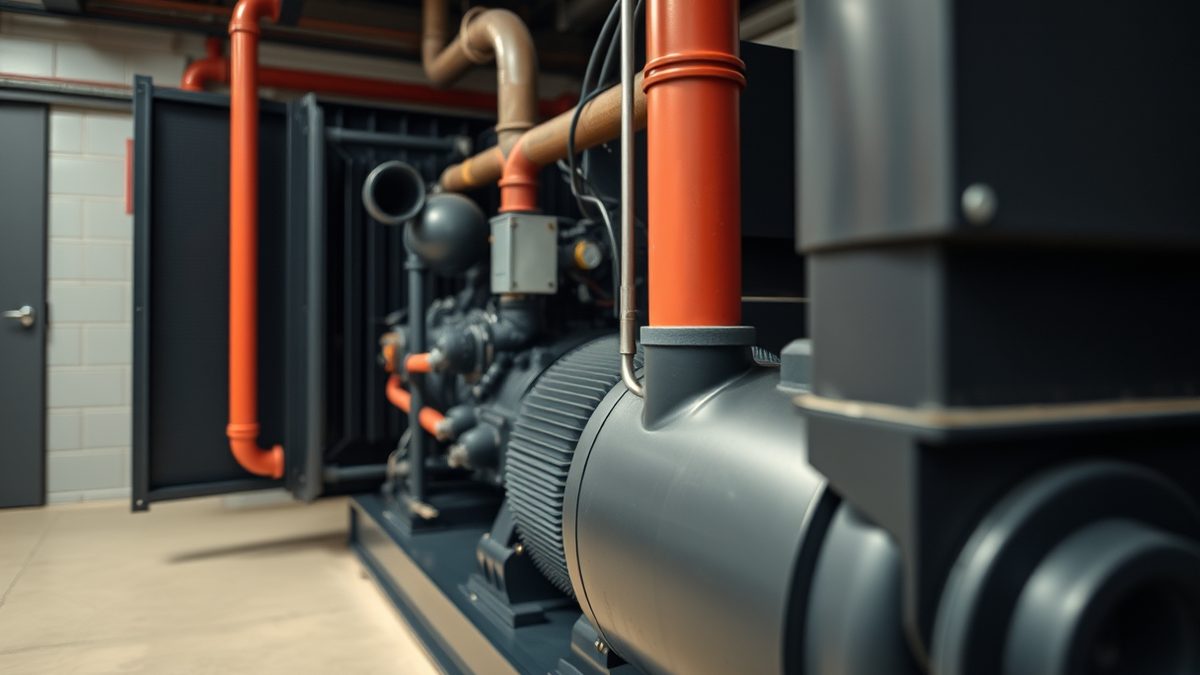
New Jersey officials and Equinix tell different stories about why thousands of gallons of diesel reached a Hackensack River tributary in September. The Times of India reported on 5 October that the New Jersey Department of Environmental Protection (NJDEP) traced a 5,000-gallon release to a storage tank at Equinix's NY2 facility in Secaucus. Crews recovered about 3,500 gallons over the weekend.
The disagreement matters. It lands in the middle of a wider fight over how data centres use power, water and land. That fight now decides whether projects get built at all. State regulators no longer treat a utility connection as permission to build. Developers face three separate approval fronts, according to Data Center Knowledge: grid cost responsibility, water transparency and local land use. Every one of those fronts asks the same question, and it is not about servers.
Secaucus Mayor Michael Gonnelli initially blamed a "computer glitch" in comments to local news outlets, according to a New Jersey News 12 report cited by the Times of India. Equinix said two broken valves in the facility's routine filtration process caused the release. The company said it is preparing a full incident response report. "We regret that this occurred and the concern it has caused the community," Equinix said in a statement quoted by the Times of India.
The NJDEP said the fuel flowed into an unnamed tributary and did not reach the Hackensack River itself. It reported no observed impact on local wildlife. It said no drinking water intakes were near the affected area. The site has operated since 2001, and Gonnelli said it had not seen a similar problem before. New Jersey has a record of these spills: about 600 gallons reached storm drains in Clifton in 2017. Another Equinix facility in North Bergen released about 1,800 gallons in 2022.
Why the diesel spill is a power story
Backup fuel sits on every large data centre site because the grid cannot be trusted to hold. Diesel tanks, generators and the permits around them are part of the same approval stack as the substation. When regulators and mayors start asking how a tank failed, the answer feeds directly into the next permit hearing.
The regulatory shift is already written into state law. California's newly enacted package, including AB 1577, AB 2383 and SB 887, requires data centre developers to cover the full incremental cost of electric grid upgrades needed to serve their facilities. It shields low-income residential ratepayers from rate rises, Data Center Knowledge reported on 5 October. Massachusetts Governor Maura Healey's Executive Order 658 requires large data centres with peak demand above 25 MW to bear all associated energy infrastructure costs.
The money involved is not small. In Oregon, large energy users served by Portland General Electric already face an average 29% rate increase under the state's POWER Act, according to the same Data Center Knowledge analysis. Alabama's Public Service Commission has opened proceedings requiring Alabama Power to show that large-load contracts recover incremental costs before they are approved. Pennsylvania's Public Utility Commission is revisiting ratemaking and emergency load-control rules amid a capacity shortfall in the PJM market.
Motors, not turbines
One of the cheapest ways to free grid capacity has nothing to do with building power plants. About 50 million electric motors drive fans, pumps and compressors in US factories and buildings. Together they consume enough electricity to equal nearly a third of total US power demand, Canary Media reported on 5 October, citing figures on motor stock.
Variable frequency drives (VFDs) adjust motor speed to match demand instead of running flat out. A 2021 market report by Lawrence Berkeley National Laboratory found that only 16% of motor systems at industrial facilities and 4% of commercial-sector motors use VFDs, according to Canary Media. Neal Elliott, director emeritus of the American Council for an Energy-Efficient Economy, told the outlet that the technology can cut a motor's energy use by around 40% to 60%. Toyota installed VFDs on more than 200 motors in the HVAC system at its Georgetown, Kentucky plant in a $1.25 million pilot in 2015. It saved more than $700,000 a year in electricity costs.
Data centre operators are now being asked to compete with that arithmetic at the permit table. Every megawatt saved on a factory floor is a megawatt that does not have to be generated, transmitted or defended in a rate case.
The planning fight moves to the city
Land use is the third front, and it is where design and cooling choices meet public opinion. Data Center Knowledge reported on 5 October that Microsoft has applied "biomimicry" at more than 20 sites in the US and Europe. It started with a Noord-Holland campus in 2022, where it planted 150 native trees and more than 2,000 square metres of shrubs and grasses. Kaitlin Chuzi, Microsoft's director of global land strategy, told the outlet the approach combines ecological research with community input to shape land, water and restoration plans.
Not every operator can move a site. A proposed 20-storey data centre tower in downtown Kansas City, Missouri, designed by Skidmore, Owings & Merrill for developer Revitalization Unlimited, would sit on about 0.23 acres and support 24 MW of IT load, Data Center Knowledge reported on 5 October. Only two of its 20 floors would hold computing equipment. Roughly 109,000 of its 141,000 gross square feet would go to mechanical space. Steve Austin, the developer's founder and CEO, put total development costs at $183 million, or about $1,300 per square foot. About $107 million of the $167 million in hard construction costs would go to mechanical, electrical, plumbing and fire protection systems. A related city development plan ordinance is on hold until 13 October.
Austin argued that inference workloads need to sit near users because latency matters. Luis Fernandes, IDC's senior research manager for cloud and data centres, told Data Center Knowledge that high-speed financial trading is one case where physical proximity can matter. He said the economics depend on the premium for building vertically. Michael Martin, managing director of data centre operations at JLL, said clients generally do not ask for a downtown site: "The reality is that clients don't come to us asking for a downtown data center," he said.
Storage becomes the bottleneck
Power and cooling get the headlines, but the same AI buildout is stretching the kit that holds the data. Toshiba plans to double production capacity for hard disk drives used in AI data centres within fiscal 2027 from its 2025 level, Nikkei Asia reported on 5 October. The expansion of its Philippine plant would be Toshiba's first major investment in its HDD business in about five years, the report said. The company did not disclose the size of the investment.
That detail matters for anyone planning a campus around a fixed power envelope. More storage per rack and per watt changes the ratio of compute to spinning disks. It also changes how much of a site's electrical capacity goes to cooling versus data. The same pressure shows up in the software layer. Datadog published an open-source framework called Distributed DataFusion on 5 October. It extends Apache DataFusion to run a single query across many machines, so that latency stays roughly flat as the amount of queried data grows.
The Danish data protection authority offered a reminder that data centre risk is not only physical. On 5 October, the CPR administration said unauthorised parties had abused a Danish company's lawful access to the Central Person Register. They obtained names, addresses and CPR numbers for about 8.8 million registered people, according to its own notice. The Copenhagen Post reported that the breach took place during September. It reported that the CPR administration became aware of it on the evening of Friday 2 October. Police are investigating and the case has been reported to Datatilsynet.
None of these threads has a settled answer. California and Massachusetts have written cost allocation into law, but Alabama and Pennsylvania are still in proceedings. Equinix has promised a full incident report, but has not said when it will publish one. Kansas City has not voted on the tower. One thing is clear: the era of picking a site because the megawatts were there is over. The operators who win approvals will be the ones who can answer questions about diesel, rates and trees in the same hearing.
Sources
9- 01Beyond the Megawatt: Why Data Center Site Selection Is Now a Three-Front BattleEN
- 02Equinix data center spills thousands of gallons of diesel in Hackensack RiverEN
- 03This hidden device could free up gigawatts of power for the US gridEN
- 04Vertical Data Centers Face Cost-Proximity Trade-OffsEN
- 05Can Data Center Design Choices Change Public Acceptance?EN
- 06Toshiba to double hard-disk drive supply to fill AI chip memory gapEN
- 07Distributed DataFusion: A library for building distributed query engines in RustEN
- 08Omfattende uautoriseret adgang til borgeres CPR-oplysningerDA
- 09CPR data breach exposes personal details of 8.8 million people in DenmarkEN
All figures and quotations in this text come from the sources listed below.
Content prepared by the editorial team with AI assistance.
Grace Okonkwo
Comments
0- No comments yet — be the first.