Equinix tests Honeywell thermal buffer as cooling caps AI rack density
Equinix has tested and installed Honeywell Aerospace's Thermal Response Module at its Co-Innovation Facility in Ashburn, Virginia. Urban Acres reported on 3 November that the device is built to steady coolant temperatures when GPU demand spikes.
 Grace OkonkwoAI, models and technology
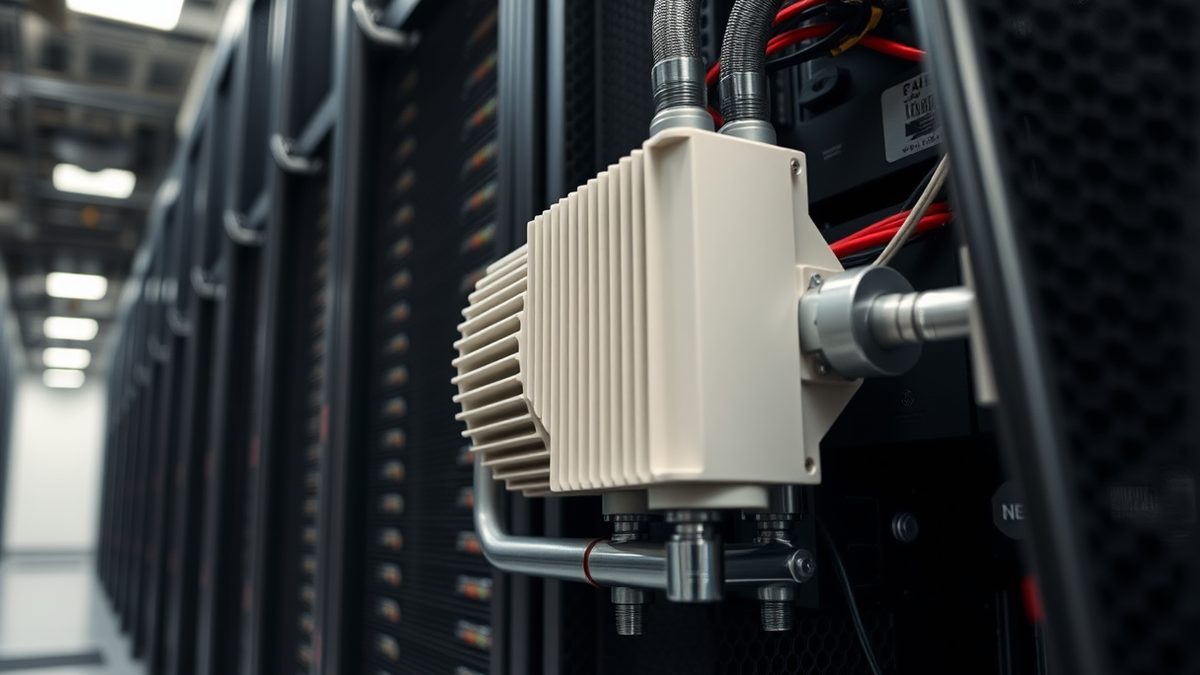
Equinix tests a thermal buffer for GPU spikes
Equinix has tested and installed a thermal buffer for liquid-cooled AI racks. Urban Acres reported on 3 November that Honeywell Aerospace said the module went into Equinix's Co-Innovation Facility in Ashburn, Virginia.
The module sits between the coolant distribution unit and the servers. Its job is to hold coolant temperatures steady during power disturbances, rapid swings in GPU demand and fluctuations elsewhere in the cooling loop. Honeywell says it drops into existing loops without a redesign. It works with different CDU vendors and architectures. The company claims it delivers 7.6 times more cooling power than chilled water. It stabilises the loop within seconds and can buffer heat for several minutes.
Pawel Wlodarczak, design innovation director for Global Design at Equinix, said testing at Ashburn showed the module handled rapid GPU cooling load swings. It also took less floor space than buffer tanks, he said.
Cooling transients are an uptime risk, not a comfort issue. A sudden GPU load change can throttle accelerators or stress the wider loop. The module's role is to absorb that. Honeywell has not published pricing for the module, and independent field data is not yet available.
Cooling becomes the limit on rack density
The pressure behind that work is measurable. The International Energy Agency found data center electricity demand rose 17% in 2025, against 3% growth in global power demand. Electricity use at AI-focused data centers climbed 50% last year. The agency expects data center electricity use to double by 2030, with AI-specific demand tripling over the same period. Every watt consumed becomes heat that has to leave the building. The industry's answer is increasingly liquid rather than air.
Dell'Oro Group's recap of the Open Compute Project Global Summit put NVIDIA's MGX 1.2 specification at racks up to 250 kW. Dell'Oro Group said the OCP community sees a clear path to 1 MW racks. Dell'Oro Group forecasts the data center liquid cooling market will reach about $7 billion in manufacturer revenue by 2029. It also projects leading-edge GPUs will exceed 4,000 W of thermal design power by 2029.
For operators, that turns cooling into a ceiling on density. A rack that cannot shed 250 kW cannot take the next generation of accelerators, whatever the power contract says.
Vendors ship factory-validated racks and bigger CDUs
Vertiv introduced its SmartIT pre-engineered architecture. It bundles rack infrastructure, DC power conversion and distribution, direct-to-chip liquid cooling, in-rack cooling distribution and monitoring into a factory-validated design. Vertiv says the system is available now. It supports NVIDIA GB300 NVL72, NVIDIA Vera Rubin NVL72, NVIDIA DGX Rubin NVL8 and NVIDIA HGX Rubin NVL8 on NVIDIA MGX and Open Compute Project ORV3 architectures. Factory validation replaces on-site integration, leaving only facility connections to commission, according to the company.
Cooler Master showed a 2.5 MW in-row CDU. It separates facility water from the IT coolant loop and has centralized management for up to 32 interconnected units. It also listed a 300 kW air-assisted liquid cooling system for sites without dedicated water infrastructure.
At the Open Compute Project Global Summit 2026 in San Jose, ASRock Rack displayed a fully liquid-cooled NVIDIA Vera Rubin NVL72 rack. The rack is the 48RU XGMRACK-VR/NVL72. It carries 18 compute trays and nine NVLink 6 switch trays, for 36 NVIDIA Vera CPUs and 72 NVIDIA Rubin GPUs. ASRock Rack also showed a 2U NVIDIA HGX Rubin NVL8 server with liquid cooling across E1.S drives, CPUs and GPUs, and no fans at all. Both designs point the same way: cooling is specified with the rack, not added after it arrives.
Retrofits and measurement slow the roll-out
Most existing data centers do not have a liquid-cooling design. Retrofits can require new piping routes, repositioned racks and more white space. The work is expensive and disruptive. Fully loaded AI racks can exceed 3,000 pounds. That is a problem for the raised floors common in older facilities. Reinforcement or redesign may come first. Downtime can run for months when servers must move or workloads shift elsewhere during structural and mechanical upgrades.
Measurement is the quieter change. Liquid cooling adds liquid temperature, pressure, flow rate and level to the operator's dashboard. It also adds leak detection and coolant health indicators such as pH, turbidity, conductivity and refractive index. A common practice is to keep coolant supply temperatures at least 2°C above the measured ambient dew point. Cold pipes in a conditioned hall condense water. Direct-to-chip cooling removes heat from the hottest components, but residual heat still needs air-side management.
Measurement is a new discipline, not an extension of air cooling.
What comes next: two-phase cooling and scale
An Open Compute Project thermal paper argued that the industry tends to adopt new cooling methods only after old ones fail, and pays for waiting. Dell'Oro Group expects two-phase direct liquid cooling to accelerate as chip-level power and heat flux exceed what single-phase systems can manage. Accelsius, an Austin-based company, says its NeuCool two-phase direct-to-chip platform can cool more than 4,500 W per socket.
Vendors are also arguing about scale rather than novelty. Honeywell says its Thermal Response Module can scale from edge deployments to large AI clusters. Vertiv says SmartIT can grow from a single rack to multi-rack deployments without redesign between phases.
What the numbers mean
- 17% growth in data center electricity demand in 2025, against 3% for global power demand.
- 50% growth in electricity use at AI-focused data centers last year, against 17% across data centers.
- 250 kW supported by NVIDIA MGX 1.2 today, against a path to 1 MW racks seen by the OCP community.
- 4,000 W projected GPU thermal design power by 2029, the level where Dell'Oro Group expects two-phase cooling to accelerate as single-phase systems run out of headroom.
- $7 billion projected liquid cooling market by 2029, counted as manufacturer revenue rather than total deployment spending.
- 2.5 MW in-row CDU capacity, managed centrally across up to 32 interconnected units.
- 3,000 pounds for a fully loaded AI rack, enough to strain raised floors in older sites.
- 7.6 times more cooling power than chilled water, Honeywell's claim for its Thermal Response Module.
- 2°C above ambient dew point, the common minimum coolant supply temperature.
Sources
15- 01As AI Chips Near 4,000 Watts, Liquid Cooling Becomes the Backbone of Data Center Design - MarketScaleEN
- 02Liquid Cooling Retrofits: Hard, but Sometimes Worth ItEN
- 03Liquid Cooling Is Changing What Data Centers Need to MeasureEN
- 04OCP 2026: Cooler Master Scales Liquid Cooling from Cold Plates to 2.5 MW CDUsEN
- 05AI Data Centre Cooling Gets Aerospace-Grade Thermal Buffer - Urban AcresEN
- 06Vertiv simplifies high-density AI infrastructure deployment across data center environmentsEN
- 07Liquid-Cooled NVIDIA Servers at the ASRock Rack OCP 2026 BoothEN
- 08 China deploys 'world's first' 800-volt DC power system for massive AI data center EN
- 09UK’s most polluting power plant could power country’s largest AI datacentreEN
- 10Tutor Intelligence raises Series B to scale model training, robot deploymentsEN
- 11ARIA’s Scaling Inference Lab Deploys Lumai’s Optical Compute TechEN
- 12 Astronauts deploy solar array on 100th US spacewalk by International Space Station crew members EN
- 13Technimove Boosts Data Centre Deployments with London Centre - Data Centre MagazineEN
- 14CATL signs deal with Germany's Intilion to deploy 3 GWh of sodium-ion storage over 5 yearsEN
- 15Can Evaporative Cooling in Data Centers Still Make Sense?EN
All figures and quotations in this text come from the sources listed below.
Content prepared by the editorial team with AI assistance.
Grace Okonkwo
Comments
0- No comments yet — be the first.