EU signs IRIS2 build contract for a 348-satellite constellation
The European Commission signed the Rendezvous 1 implementation agreement with the SpaceRISE consortium on 7 August 2026 [3][5][7]. IRIS2 is now a build order for 348 satellites [3][7].
 Rachel NwosuAI, models and technology
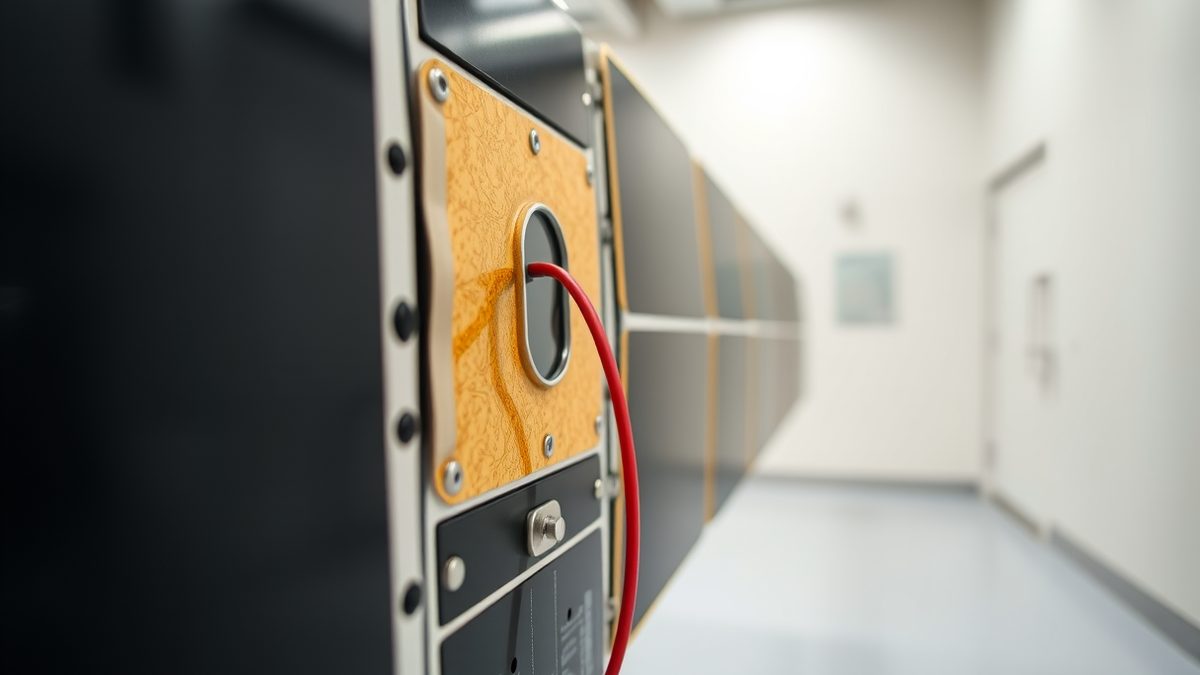
The European Commission signed the Rendezvous 1 implementation agreement with the SpaceRISE consortium on 7 August 2026 [3][5][7]. IRIS2 is now a build order for 348 satellites [3][7].
European governments, defence ministries and emergency services currently buy secure connectivity from commercial providers. They now have a publicly funded sovereign alternative on order. The award also redirects a large slice of European space spending to Hispasat, Eutelsat, SES and their subcontractors [3][4]. The Commission frames IRIS2 as a response to Starlink and other commercial networks, promising "sovereign, secure and highly reliable connectivity" for governments, defence forces and emergency services [8]. Total investment is €15.6 billion, including €4 billion from SpaceRISE, the consortium of Eutelsat, SES and Hispasat [4]. Andrius Kubilius, the Commissioner for Defence and Space, called the signing "a decisive step forward for Europe's security and digital sovereignty" [1][3].
Two questions stay open: who builds the largest satellite block, and how the funding gap after 2027 gets closed [3][5]. First launches are targeted for 2029 [5].
A bigger constellation than the contract specified
The confirmed total for the constellation is 348 satellites [3][7].
The Commission lists 330 satellites in low Earth orbit and 18 in medium Earth orbit, plus 66 high-capacity LEO satellites for defence and emergency response [1][3]. It says the expansion raises secure governmental communications capacity by 60% within the EU and 54% globally [1][3][5]. The size of the jump depends on the baseline. Anadolu Agency reported a rise from 282 satellites to 348 [5], while TechTimes said the December 2024 concession contract specified 290 [3]. Reuters put total investment at €15.6 billion, including €4 billion from SpaceRISE [4]. KeepTrack's space brief described a 20-satellite very-low-orbit segment led by Hispasat [2].
Hispasat takes the ground segment
Spain's Indra said its 89.68%-owned satellite operator Hispasat won the ground contract [4]. Hispasat will supply antennas, control systems and ground links on a budget above €1.6 billion ($1.74 billion) [4]. It will also lead a low Earth orbit layer for direct-to-device and Internet of Things connectivity, with up to €600 million committed [4]. That is the biggest such budget in European Commission programme history [3]. Hispasat chief executive Luis Mayo called the role "the largest and most complex system developed to date in Europe for a space programme" [3].
ESA will referee the build [3]. Director general Josef Aschbacher said the agency will act as qualification and validation authority [3].
Member states put money in
National contributions sit on top of the EU budget [5]. Poland has committed €656 million ($756 million), Hungary €500 million ($576 million) and Spain has announced €1.6 billion to €2 billion ($1.8 billion to $2.3 billion) [5]. The Commission said the accelerated deployment will need additional EU budget funding for 2028-2034, plus contributions from member states and participating third countries [5].
Norway and Iceland are among the participating countries [5].
What happens next
First satellite launches are targeted for 2029 [5]. The constellation is due to enter service in 2030 [4]. Airbus, Thales, OHB and Aerospacelab are among the industrial team now starting space and ground work [1][3].
The biggest manufacturing decision is still open. SpaceRISE is running competitive dialogues between Airbus Defence and Space and Belgium's Aerospacelab for the LEO-High prime contract [3]. That block covers the 270-plus satellites forming the backbone of capacity, and the selection remains pending [3].
Sources
36- 01EU expands IRIS² satellite constellation to 348 satellites as deployment beginsEN
- 02Long March 7A Explodes 80 Seconds After LiftoffEN
- 03IRIS2 Build Authorized: EU Adds Quantum-Secured Defense Layer to 348-Satellite NetworkEN
- 04Hispasat wins lead role in EU's €15.6 billion IRIS2 satellite networkEN
- 05EU moves IRIS2 satellite project into full-scale deploymentEN
- 06EU expands Iris2 constellation to 348 satellites, Hispasat named prime contractorEN
- 07EU Commission signs contract to expand IRIS2 satellite constellationEN
- 08Hispasat wins lead role in EU's €15.6 billion IRIS2 satellite networkEN
- 09 What is Starshield? A look at SpaceX's military satellite network EN
- 10 On this day in space! Nov. 4, 2015: A rail-launched Super Strypi rocket carrying 13 baby satellites failed during its debut launch for the US Air Force EN
- 11Griechischer Satellit testet Laserkommunikation zur ErdeEN
- 12SpaceX signs deal with Qualcomm to provide network technology for U.S. mobile serviceEN
- 13 Drone warfare in space: Swarms of autonomous, laser-shooting cubesats could defend Western satellites in orbit EN
- 14Adding Network Security to AI, HPC and Data CentersEN
- 15Who May Overrule the Agent? Evidence-Gated Authority in LLM Review InstitutionsEN
- 16Assurance-Conditioned Continuous Authorization for Autonomous AI AgentsEN
- 17Relevance Propagation as Entropic Optimal Transport on Filippov Neural Networks: Sinkhorn Propagation and Region Relevance in Image ClassifiersEN
- 18Adaptive Domain Decomposition for Finite Basis Physics-Informed Neural NetworksEN
- 19Qualcomm Dragonwing Nabs a Big SpaceX Starlink Mobile Nationwide US 5G Network WinEN
- 20Zyxel fixes zero-day exploited to hack nearly 1,000 network switchesEN
- 21SpaceX boldly goes into 'huge' 5G network rollout with QualcommEN
- 22 Rocket Lab launches Japanese Earth-observing satellite on 99th mission to date (video) EN
- 23Il satellite russo che fa il gatto con il topoEN
- 24 Planetary defense: How military and civil satellites are watching fireballs to help keep Earth safe from space rocks EN
- 25 Happy Halloween! SpaceX launches 27 Starlink satellites to orbit from California (video) EN
- 26 India launches next-gen navigation satellite to orbit (video) EN
- 27Barracuda Flaws Could Be Chained to Bypass Authorization and Gain Root AccessEN
- 28Launch Preview: Falcon 9 to launch USSF missions, China to launch internet satellitesEN
- 29Ukrainian startup, GomSpace test satellite for future communications networkEN
- 30Cloudflare Reports 18.2 Million Network-Layer DDoS Attacks in Q3, Up 38%EN
- 31FCC moves to knock down copper network retirement roadblocks in CaliforniaEN
- 32Lumen redefining networking for AI and quantum eras with three new initiativesEN
- 33French government mulled blocking social networks and mobile internet amid protestsEN
- 34AI traffic growth could strain India's networks as telcos face monetization challengeEN
- 35Astranis Upgrades Falcon 9 Launch Contract to Dedicated Mission for Entire Block 4 Production Run of SatellitesEN
- 36Nov. 5: Satellite Mission Management at the EdgeEN
All figures and quotations in this text come from the sources listed below.
Content prepared by the editorial team with AI assistance.
Rachel Nwosu
Comments
0- No comments yet — be the first.