Europe's Night Trains Are Back, But the Tunnels Tell a Slower Story
Europe's December timetable changes have reopened direct overnight links between Warsaw and Munich, Paris and Berlin, and Salzburg and Kraków, according to The Guardian. The infrastructure meant to underpin that revival is running years late and billions over budget.
 Peter LindqvistSport, cars and travel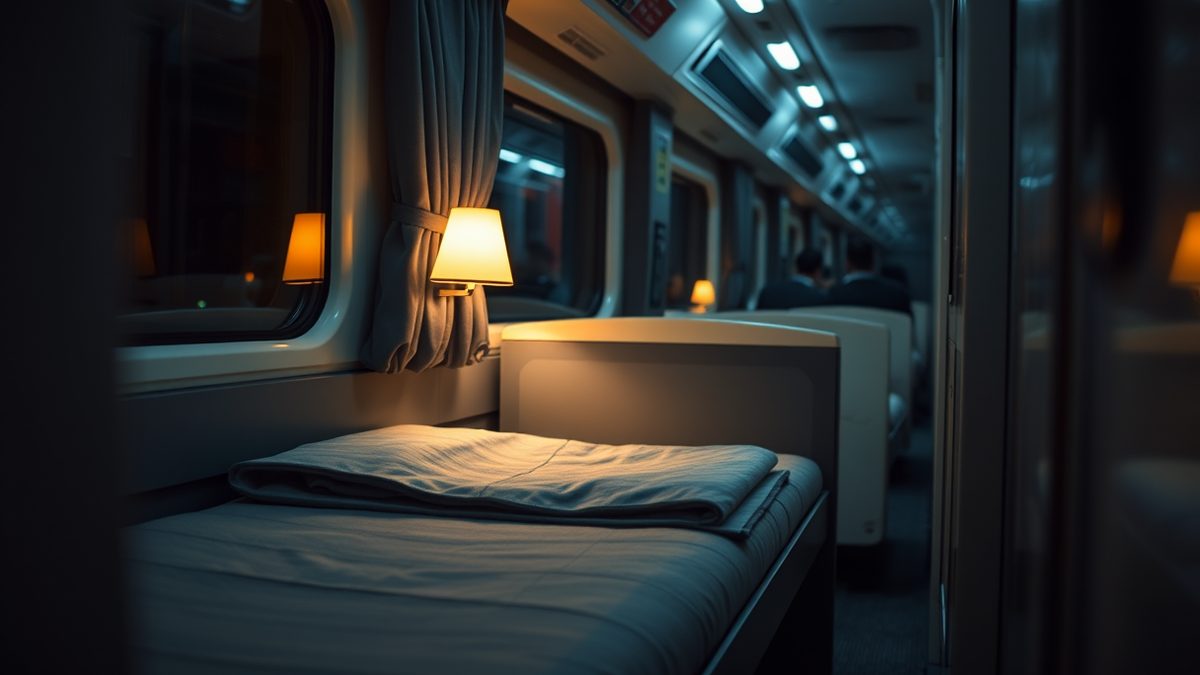
On the evening of 10 December, a night train left Munich for Warsaw. The Guardian reports it was the first direct departure from Bavaria to Poland since 2010. The same week's timetable change also restored a direct overnight link between Paris and Berlin. That connection had been severed when the Russian Railways service from Paris to Berlin and Moscow ran for the last time at the start of the pandemic.
None of those city pairs currently has direct daytime trains. The overnight options therefore create links where none existed before. They are not simply cheaper alternatives to services that already ran.
The Guardian's slow travel expert, writing on 14 December 2023, catalogued the changes as most European operators introduced their 2024 schedules on 10 December. Warsaw moved closer to Munich. Berlin nudged towards Paris. Aachen and Halle, two cities with little in common beyond German history, found themselves linked by a Nightjet that leaves Aachen just after 9pm and arrives in Halle 10 hours later.
Winners and losers exist inside the same timetable. Copenhagen secured more direct services to Hamburg. Aarhus lost its twice-daily direct trains to Hamburg entirely. The compensation, per The Guardian, is a connecting service every two hours from Denmark's second-largest city, with a same-platform change in Kolding that gets travellers to Hamburg faster than the direct trains did.
Demand is real, comfort is not guaranteed
The revival is not confined to the routes that make headlines. From that week, travellers could sleep from Dresden to Budapest, Vienna and Graz, three cities that already had daytime trains from Dresden. Kraków's direct daytime trains to both Vienna and Berlin doubled from one to two. Wrocław gained an early-morning direct train to Vienna, returning late afternoon. On the Berlin-Amsterdam route, journey time fell by 30 minutes to under six hours.
France, where Le Monde proclaimed "Le train de nuit: c'est fini!" in 2016, is part of the upswing. Béziers and Montpellier gained a direct link to Paris on some nights, and an Aurillac-Paris overnight service launched where no competing daytime train exists. The Guardian notes these French trains offer little by way of creature comforts: no sleeping cars, so passengers choose between a reclining seat and a couchette. Fares start at €19 for seats and €29 for couchettes.
Operators are watching. Cat Jones, chief executive of flight-free operator Byway Travel, told The Guardian that the new trains were creating a buzz at her company. "We're now able to pair places in holidays where direct trains didn't exist before," she said. "The new Euronight direct sleeper linking Salzburg with Kraków, for example, creates a real opportunity for culture vultures to combine [trips to] two very different cities."
That Salzburg-Kraków link takes almost 10 hours. It is one of several city pairs opened up by the new Munich-Warsaw night train.
Cross-border ambition remains uneven. The Guardian notes that rail operators often focus on domestic markets and neglect international connections, with ambition flagging as companies approach frontiers. But the same timetable change brought increased frequency between Munich and Zürich, following the November reinstatement of direct Stuttgart-Zürich trains. A second direct train from Vienna to Ukraine also began, with the morning Vienna-Romania departure gaining through-carriages to Chop in Ukraine's Transcarpathia region. Czech private operator RegioJet was reported to be exploring a Prague-Chop overnight service from early 2024.
The tunnels behind the timetables
Night trains need tracks, and the tracks need tunnels. Europe's geography is the constraint: mountain ranges slice through the continent and seas separate countries, and trains cannot skim over either. CNN reported on 26 May 2026 that the next decade will see the world's longest rail tunnels completed in Austria, France and Italy, with the aim of reshaping connectivity between northern Europe and the industrial hubs of northern Italy.
The record so far is mixed. Switzerland's Gotthard Base Tunnel opened in 2016 at a cost of $11.3 billion, cutting Zürich-Milan journey times from four hours via the old Gotthard route to two and a half hours. At its deepest, the tunnel lies more than 7,500 feet beneath the Alpine peaks. The old route is 25 miles longer and crosses the mountains at an altitude of 3,773 feet.
Delivery across the wider programme has been slower. CNN reported that the European Court of Auditors found in January that costs for eight major Trans-European Transport Network projects had risen by an average of 82% over initial estimates, with an average delay of 17 years across five projects. The EU will not meet its 2030 deadline for completing the core TEN-T network, which covers 10,850 miles of rail corridors.
Nick Brooks, secretary general of the rail operator lobby group ALLRAIL, told CNN that the big projects could still change the picture. "Mega-projects like the Brenner Base Tunnel, Lyon-Turin and the Fehmarn Belt can be transformative for European rail," he said.
The Fehmarn Belt is the clearest test of that claim. CNN reported in June 2024 that the 18-kilometre immersed tunnel between Denmark and Germany, officially the Fehmarnbelt Fixed Link, is scheduled to open in 2029 with a construction budget of over €7 billion ($7.1 billion). It will carry two double-lane motorways and two electrified rail tracks, making it the longest combined road and rail tunnel in the world.
The numbers that matter for passengers are the crossing times. The ferry from Rødby to Puttgarden takes 45 minutes; the tunnel will cut that to seven minutes by train and 10 by car. Jens Ole Kaslund, technical director at the state-owned Danish company Femern A/S, said in 2022 that a Copenhagen-Hamburg train trip would fall from around four and a half hours to two and a half. "Today a lot of people fly between the two cities," he said, "but in the future it will be better to just take the train."
Germany and Denmark signed the treaty in 2008. More than a decade passed before both countries passed the necessary legislation and completed geotechnical and environmental studies. Ferry companies, environmental groups and local municipalities in Germany appealed against approval on competition and environmental grounds; a federal court in Germany dismissed the complaints in November 2020, attaching conditions on monitoring noise and sediment spill during construction.
Free tickets and full carriages
Not every expansion depends on concrete. Croatia's government confirmed the continuation of its free public rail transport programme, HŽ Passenger Transport said in a statement reported by Croatia Week on 6 January 2026. Free travel remains available to children, primary and secondary school pupils, full-time students, pensioners and citizens over 65.
From 1 January 2026, the scheme was extended to people with disabilities holding a National or European Disability Card marked as eligible for train travel. Eligible categories residing in Istria County can also travel free on direct Pula-Zagreb services, even though the route passes through Slovenia. Those direct trains were reintroduced on 20 June 2025, running Fridays from Zagreb to Pula and Sundays from Pula to Zagreb.
Put the two halves of the story together and the shape of European rail policy becomes clearer. Timetable changes can restore a link in a single December, as Munich and Warsaw showed. Tunnels take decades, cost billions and can be delayed by a court case about sediment. The night train network is expanding faster than the infrastructure that will eventually have to carry it.
Sources
4- 01Night trains and border crossings: Europe's best new rail routesEN
- 02The underground mega tunnels redrawing the railway map of EuropeEN
- 03World's longest road and rail tunnel is being built under the Baltic SeaEN
- 04Croatia extends free train travel to more groupsEN
All figures and quotations in this text come from the sources listed below.
Content prepared by the editorial team with AI assistance.
Peter Lindqvist
Comments
0- No comments yet — be the first.