Europe's Night Trains Find New Routes As Alps and Baltic Tunnels Face Delays
Europe's rail map is being redrawn by a patchy mix of new sleeper services and record-breaking tunnels, with the EU already missing its 2030 deadline for 10,850 miles of core corridors.
 Daniel FisherSport, cars and travel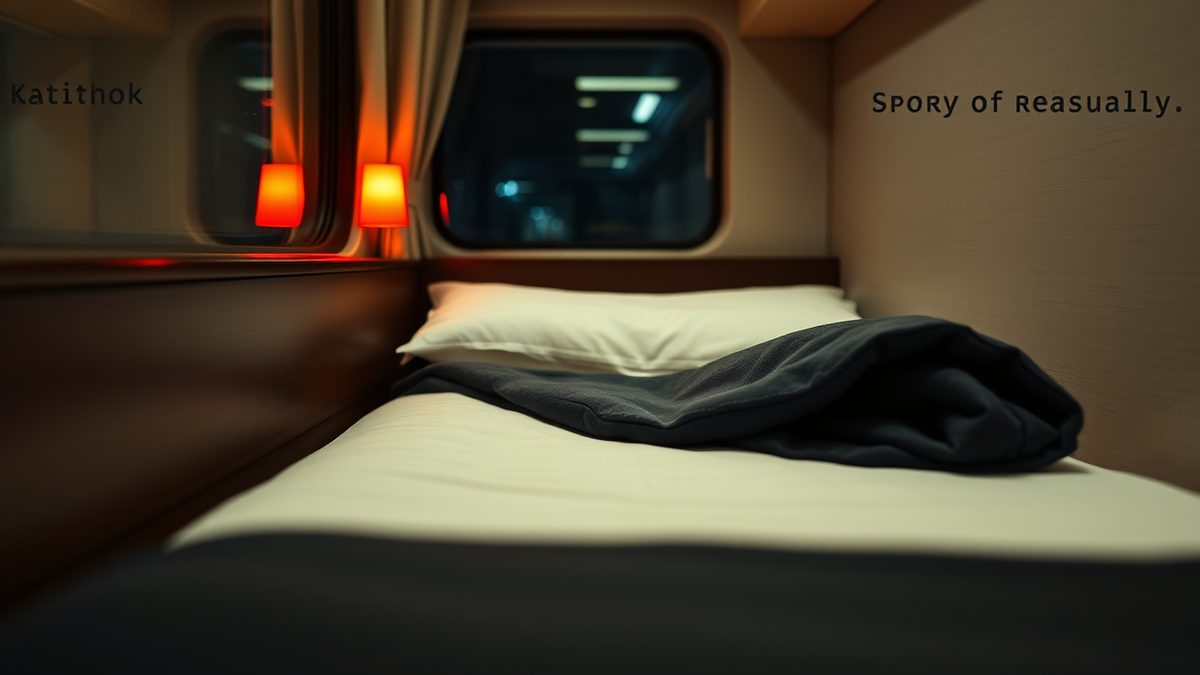
New night trains keep arriving on Europe's timetables even as the giant tunnels meant to carry them run years late. The European Court of Auditors reported in January that costs across eight major Trans-European Transport Network projects rose by an average of 82% against initial estimates, with an average delay of 17 years across five of them, according to CNN.
The EU will not hit its 2030 deadline for completing the core TEN-T network, a plan to upgrade 10,850 miles of rail corridors that link major cities, regions and ports.
It is an awkward split. Sleepers are multiplying on existing tracks. The megaprojects meant to speed up daytime rail between northern Europe and the industrial hubs of northern Italy are still grinding through mountains and under seas, on budgets that no longer resemble the original plans.
Sleeper links return to old city pairs
The most visible change is not in a tunnel but in a timetable. The Guardian reported on 14 December 2023 that new 2024 schedules introduced on 10 December created direct night links between Warsaw and Munich, Berlin and Paris, and Aachen and Salzburg. None of those city pairs had direct daytime trains, so the overnight options opened routes that did not previously exist.
Some of these are restorations rather than novelties. The Warsaw-bound train that left Munich on the evening of 10 December 2023 was the first direct departure from Bavaria to Poland since 2010, the Guardian reported. Paris and Berlin regained a direct night train that had been severed at the start of the pandemic, when the Russian Railways service from Paris to Berlin and Moscow ran for the last time.
Others are entirely new combinations. Cat Jones, chief executive of flight-free operator Byway Travel, told the Guardian that the new Euronight direct sleeper linking Salzburg with Kraków, a run of almost 10 hours, created a chance to pair "two very different cities" in one trip. Dresden gained sleeping-car services to Budapest, Vienna and Graz, all of which already had daytime trains from the Saxon city.
Even France, where Le Monde declared in 2016 that the night train was finished, added overnight services. Béziers and Montpellier gained direct links to Paris on some nights, competing with TGVs that cover Montpellier to the capital in a little over three hours. The Aurillac-Paris service has no competing daytime train at all. French night trains offer no sleeping cars, only reclining seats and couchettes, with fares from €19 and €29 respectively.
Not every route is a gain
There are losers in each December's timetable. Aarhus lost its twice-daily direct trains to Hamburg. A connecting service every two hours replaced them, with a same-platform change at Kolding that gets travellers to Hamburg faster than the direct train did. Nuremberg, long a jumping-off point for Czech destinations, went from five direct trains a day to the Czech Republic to none.
Cross-border ambition remains uneven. The Guardian noted that some operators flag as they approach international frontiers, though Berlin to Amsterdam was trimmed by 30 minutes to under six hours, and Kraków gained a second daily direct train to both Vienna and Berlin. Wrocław acquired a new early-morning direct service to Vienna, returning late afternoon. A second direct train from Vienna to Ukraine began running, with through-carriages to Chop in Transcarpathia.
Britain's changes were minor by comparison, with weekday extras between Nottingham and Birmingham and further thinning of TransPennine Express schedules. A new high-speed line through Spain's Cantabrian mountains opened in late November 2023, and some Polish and Baltic timetables came into effect a week or two later.
Tunnels promise speed, deliver delay
The tunnels are where the map is meant to change shape permanently. The 35-mile Gotthard Base Tunnel in Switzerland opened in June 2016 at a cost of $11.3 billion. It cut Zürich to Milan to two and a half hours from four hours on the older route, which is 25 miles longer and crosses the mountains at 3,773 feet. At its deepest, the twin-bore tunnel runs more than 7,500 feet below the Alpine peaks, CNN reported.
Three more base tunnels are under construction in Austria, France and Italy, with the aim of raising speeds and freight capacity on the Alpine corridors. Denmark is building the 18-kilometre Fehmarnbelt Tunnel under the Baltic Sea, an immersed link between the German island of Fehmarn and the Danish island of Lolland with a construction budget of over 7 billion euros, or $7.1 billion.
The first tunnel element was inaugurated on 17 June by King Frederik X of Denmark, four years after construction began in 2020 and more than a decade after planning started. The state-owned Danish company Femern A/S is building 89 concrete sections, each 217 metres long, 42 metres wide and 9 metres tall, weighing 73,000 metric tons. They will be placed just beneath the seabed, about 40 metres below sea level at the deepest point, a positioning job expected to take roughly three years.
"Today, if you were to take a train trip from Copenhagen to Hamburg, it would take you around four and a half hours," Jens Ole Kaslund, technical director at Femern A/S, said in 2022. "When the tunnel will be completed, the same journey will take two and a half hours."
The crossing that takes 45 minutes by ferry will take seven minutes by train and 10 minutes by car when the tunnel opens in 2029. It will be the longest combined road and rail tunnel in the world, carrying two double-lane motorways separated by a service passageway and two electrified rail tracks. Kaslund said the link creates a land route between Sweden and Central Europe 160 kilometres shorter than today's options.
Germany and Denmark signed a treaty for the project in 2008, then spent over a decade passing legislation and completing geotechnical and environmental studies. Ferry companies, environmental groups and local municipalities appealed against the German approval on competition and environmental grounds before a federal court dismissed the complaints in November 2020, with conditions on monitoring noise and sediment spill. Up to 2,500 people will work directly on construction.
Nick Brooks, secretary general of the rail operator lobby group ALLRAIL, told CNN that megaprojects like the Brenner Base Tunnel, Lyon-Turin and Fehmarn Belt "can be game-changers for European rail."
Where night trains fit in the meantime
Sleepers are not only a European story. In the United States, train hopping has drawn a new generation of content creators to freight cars, with a tradition that predates them by more than 150 years. Will, a 25-year-old software engineer who posts as transient.xplorer and asked to use only his first name because the practice is illegal, told NPR he studies open railway data and forums to work out which trains to take and where to hide. He prefers hopper cars, also called grainers, and dislikes autoracks because there is nowhere to hide.
James Payne, staff director at the Federal Railroad Administration's Office of Safety, told NPR that trespassing incidents, injuries and deaths have climbed steadily since 2014, and that social media mimicry is a growing concern for the agency. A train-hopping YouTuber, James "Stobe the Hobo" Stobie, died in 2017 in an apparent rail accident. George Graham, 68, who has hopped trains for decades, told NPR the lifestyle is "much more difficult than perhaps the videos convey."
Back in Europe, the climate argument for rail keeps getting stronger on paper. Britain's Rail Delivery Group said in February 2024 that on average across the top 100 business travel routes, a diesel or petrol car produced nine times more carbon than a train, a plug-in hybrid four times more, and a battery electric car almost two and a half times more. Edinburgh to London Kings Cross would emit 116kg of CO2 in a diesel car, 31.8kg in a battery car and 12.7kg per person by train, according to the group's data.
The catch is cost. A single LNER fare on that route was £183 without pre-booking at the time, though advance fares were much cheaper, and average fuel for a small petrol car over the 400 miles came to roughly £50. Rail fares in England were due to rise by 4.9% from the Sunday after the analysis was published.
Jacqueline Starr, chief executive of the Rail Delivery Group, said: "We all have a responsibility to reduce our carbon footprint, and the data that we have published reveals that rail is the green choice for travel between our towns and cities."
Michael Solomon Williams of the charity Campaign for Better Transport said travelling by train is always greener than driving and getting greener as more routes are electrified, but that fares need to come down. "Next week's rail fare rise will do little to address the rising cost of rail travel," he said.
Free travel and new member state links
Some governments are pushing ridership by other means. Croatia has confirmed the continuation of its free public rail transport programme for children, primary and secondary school pupils, full-time students, pensioners and citizens over 65, according to a statement from HŽ Passenger Transport reported by Croatia Week.
From 1 January 2026, the scheme also covers people with disabilities who hold a National or European Disability Card marked as eligible for train travel. From the same date, eligible passengers living in Istria County can travel free on direct Pula to Zagreb services, a route that passes through Slovenia via Ljubljana. Those direct trains were reintroduced on 20 June 2025 and run on Fridays from Zagreb to Pula and Sundays from Pula to Zagreb, removing the need for transfers.
For now, that is the shape of European rail: more overnight city pairs on tracks that already exist, free travel widening in some countries, and the tunnels that will decide the next decade still being dug, delayed and paid for.
Sources
6- 01Night trains and border crossings: Europe's best new rail routesEN
- 02Electric cars produce twice as much CO₂ as trains, says rail group dataEN
- 03Train hoppers ride the rails across America – and you can tag alongEN
- 04Croatia extends free train travel to more groupsEN
- 05The underground mega tunnels redrawing the railway map of EuropeEN
- 06Longest road and rail tunnel is being built under the Baltic SeaEN
All figures and quotations in this text come from the sources listed below.
Content prepared by the editorial team with AI assistance.
Daniel Fisher
Comments
0- No comments yet — be the first.