Geely's 1,100 kW Battery, GM's LMR Bet: EV Battery Race Splits From US Policy
Geely Auto Group says its new Ultra Short Blade Battery can peak at nearly 1,100 kilowatts, and on 30 September InsideEVs detailed how the company plans to stop that speed from wrecking the cells. The same week, GM confirmed an LMR chemistry bet, and BNEF logged a record 158,000 electric truck sales in the first half of 2026.
 Daniel FisherSport, cars and travel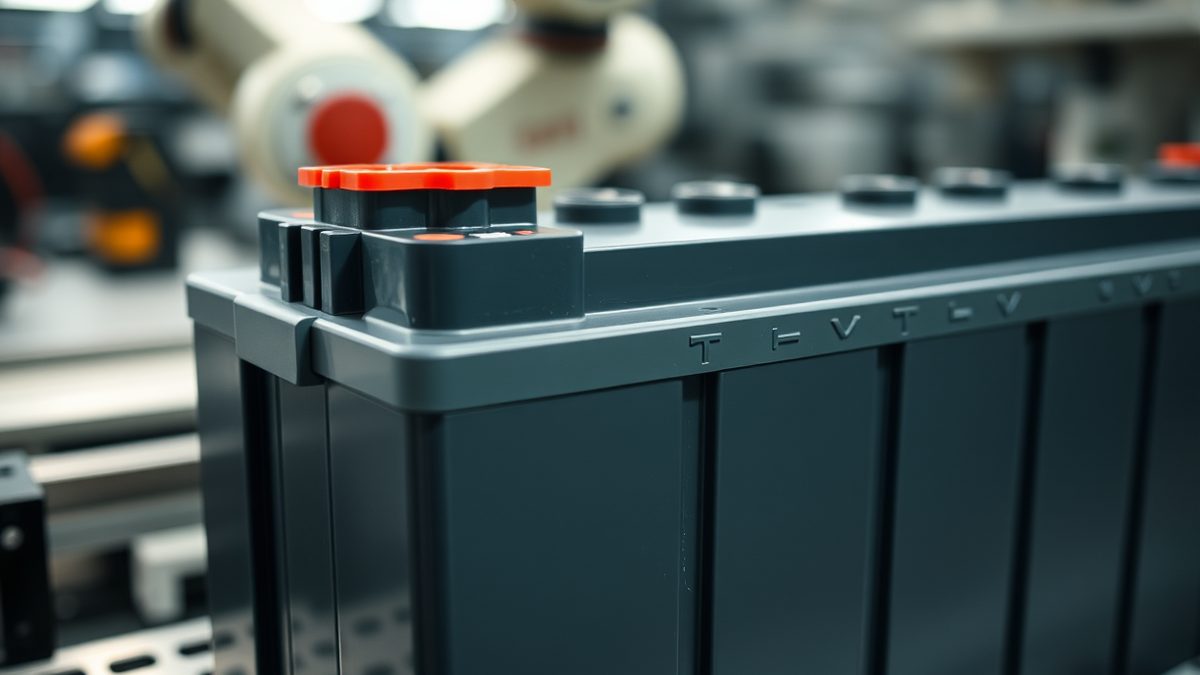
The newest battery claim in the dossier does not come from Detroit or Stuttgart. It comes from Ningbo, China. Geely Auto Group says its Ultra Short Blade Battery can peak at nearly 1,100 kilowatts. On 30 September, InsideEVs published a detailed explanation of how the automaker intends to keep that charging speed from destroying the pack.
Geely's numbers are not subtle. In a demo, the company charged a Lynk & Co 10 from 10 to 97 percent in 8 minutes and 40 seconds, according to InsideEVs. The fastest-charging EVs in the US, by contrast, peak at 400 kilowatts, the report notes. Most mass-market models in the US average around 30 minutes for a 10 to 80 percent charge.
Fast charging is easy to advertise. Keeping the battery alive is the hard part.
Geely's answer is a mix of cell geometry and chemistry. The Ultra Short Blade cell comes in two lengths, 395 mm and 370 mm. Both are shorter than Geely's previous 580 mm cell, and far shorter than the roughly 960 mm the company says is common in the industry. A shorter cell shortens the distance ions travel during charging and discharging, which lowers internal resistance and reduces heat. The company also changed the cathode and anode structure, added what it calls high entropy elements on the cathode to widen ion pathways, and introduced a lithium pulse restoration technique, according to InsideEVs.
The warranty tells its own story. Geely raised coverage from eight years and 150,000 kilometers to eight years and 200,000 kilometers. That is 124,000 miles, up from 93,205 miles. Jerry Gan, the CEO of Geely Auto Group, was blunt about the trade-off. "We do not advocate fast-charging technologies at the expense of lifespan," Gan said. "If a battery frequently fast-charged is not maintained or repaired, its lifespan suffers irreversible decline," he added. Ren Xiangfei, chief engineering scientist at Geely Auto Group, described the cell changes in simpler terms. In an ideal world, he said, the ions settle into the graphite evenly and smoothly. The company also added an AI-powered charger management system to keep the pack from crossing thermal limits.
GM goes the other way, on purpose
On 29 September, General Motors announced that its Ultium Cells plant in Spring Hill, Tennessee will be upgraded to build LMR, or lithium manganese rich, battery cells. CleanTechnica reported the announcement on 30 September. It noted that GM has kept the chemistry on the back burner through a period when US EV policy turned hostile and the $7,500 federal EV tax credit was eliminated.
GM's framing is about cost, not speed. The company says LMR delivers improved performance at a lower cost than other batteries in the affordability bracket, while its existing high-nickel chemistry stays on the roster for long-range vehicles. Kurt Kelty, GM's VP of battery and sustainability, has indicated that the high-nickel packs continue to address markets where range is the priority, according to CleanTechnica. GM says combined LFP and LMR investments will total $2 billion by 2030. It aims to be the first automaker to deploy LMR batteries in EVs, with commercial production of LMR prismatic cells planned in the US by 2028 and pre-production at an LG Energy Solution facility expected by late 2027.
Two automakers, two answers to the same problem. Geely is chasing charge rate. GM is chasing sticker price.
The policy backdrop matters here. CleanTechnica's 30 September piece argues the US is blocking competitive Chinese EVs through protectionism while its own market stalls, and that the country risks finishing last in light-vehicle electrification. The article cites a US BEV share of 5.9 percent in the first half of 2026, against 45 percent in China in August and 26 percent in Europe in July.
Trucks are the quiet growth story
While passenger-car headlines bounce between chemistry announcements, the commercial side is moving faster than most coverage suggests. Global sales of medium- and heavy-duty electric trucks hit a record 158,000 vehicles in the first half of 2026, up 75 percent year over year, according to BloombergNEF. More than nine out of 10 of those trucks were sold in China, and electric trucks now account for about 20 percent of total truck sales worldwide.
Europe is not standing still. Electric trucks made up 5.5 percent of European truck sales in the first half of 2026, with shares above 10 percent in Denmark, the Netherlands and Sweden, BNEF reports. Norway and Switzerland have higher shares still. The US battery-electric truck market, by contrast, has slowed to a near standstill. BNEF says Tesla's Semi appears priced competitively at between $250,000 and $300,000 per vehicle. That could let it undercut the total cost of ownership of equivalent diesel trucks in some duty cycles, depending on charging costs.
Financing is shifting with it. BNEF interviews indicate that deals are increasingly underwritten against a truck's contracted transport operation rather than its resale value alone. Lenders are responding to uncertain residual values driven by battery degradation.
Charging infrastructure remains the bottleneck. BNEF notes that megawatt-scale station operators would need to charge roughly $0.10 to $0.22 per kilowatt-hour to recover their investment, and utilization still varies widely.
The supply chain is not settled
None of this happens in a vacuum. The BBC reported on 29 September on US startups trying to bring battery manufacturing home, including San Diego-based Unigrid, which sells a nine kilowatt-hour sodium ion home battery. CEO Darren Tan told the BBC the company has shipped its first 100 units and expects to ship 1,000 before the end of the year, with requests coming from Spain, France, Germany and the Netherlands. The BBC notes that Unigrid's battery currently uses sodium ion cells made in China, and that the cell contains chromium-3 in its cathode. Professor Dame Clare Grey at the University of Cambridge warned that under certain conditions chromium-3 may form chromium-6, a toxic, cancer-causing material. Tan called concerns about the materials "overblown" and said third-party tests could not produce chromium-6.
For context on cost, the BBC reports that LFP batteries traded at $81 per kilowatt-hour last December, while Unigrid's sodium ion battery pricing is roughly $100 per kilowatt-hour. Sodium ion is also less energy dense than lithium ion, which points it toward stationary storage rather than small devices.
Data centers are becoming part of the same story. NL Times reported on 30 September that most European data centers refuse to disclose their water and electricity use, with fewer than a quarter of larger Dutch facilities publishing figures. Statistics Netherlands says data centers used 5.1 billion kilowatt-hours in the Netherlands in 2024, or 4.6 percent of national electricity consumption, nearly double the level five years earlier. Grid operator TenneT projects 10 to 15 percent by 2030.
The through-line is straightforward. Battery technology is advancing fastest where policy and charging infrastructure allow it, and slowing where they do not. Geely's megawatt demo and GM's LMR pivot are not competing answers to the same question. They are answers to two different markets, and the gap between them is the story to watch.
Sources
6- 01How Geely's New Battery Handles A Megawatt Of Charging Power Without Crazy DegradationEN
- 02GM Really Wasn't Kidding About Those New LMR EV BatteriesEN
- 03The Electric Trucking Market's Record Rise: Three Things to KnowEN
- 04The start-ups hoping to return battery making to the USEN
- 05Most data centers refusing to say how much water, electricity they useEN
- 06Is The US Going To End DEAD LAST In Vehicle Electrification?EN
All figures and quotations in this text come from the sources listed below.
Content prepared by the editorial team with AI assistance.
Daniel Fisher
Comments
0- No comments yet — be the first.