Grid software is getting crowded, and most of the newest ideas are not grid software at all
On 4 October, CNX Software reported that open-source ESP-SDR firmware turns a sub-$5 ESP32 into a 2.4/5 GHz software-defined radio without extra hardware. That is the most concrete grid software news here, and it is a firmware trick, not a platform launch.
 Grace OkonkwoAI, models and technology
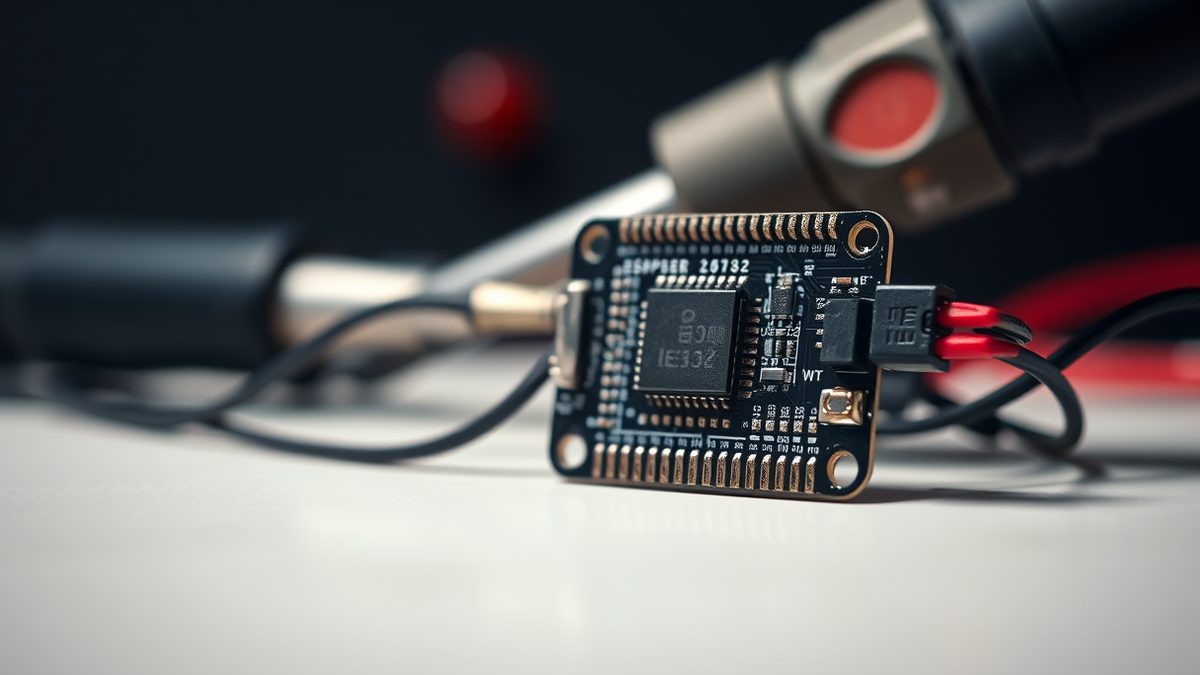
That is not a utility control room tool. It is a reminder that cheap silicon and code are instrumenting the energy transition. The software layer around the grid is being rebuilt from below as much as from above.
CNX Software reported on 4 October that developers Florian Euchner and Zoltan Doczi found the sampling path while working on ESPARGOS One, an eight-antenna Wi-Fi sensing setup. The firmware taps the ESP32's internal ADC chain to capture raw I/Q samples. The numbers are small and specific. CNX says supported chips include the ESP32-C5, which tunes 4.8 to 6.0 GHz. The ESP32-C61 can reach 2.7 GHz and capture LTE Band 7 and 5G NR Band n7 signals. Sample rates go up to 80 MSa/s, with roughly 13 to 54 MHz of bandwidth depending on the chip.
Why does that matter to grid software? Distributed energy resources are increasingly monitored and controlled at the edge. The cost of a sensing node keeps falling.
A board that costs less than $5, as CNX notes, changes what a utility or an aggregator can afford to deploy at a substation, a rooftop or a food cart.
The platform launches are the easy part
MIT Technology Review published a piece on 1 October that describes the same shift from the hardware side. It reports that PopWheels has about 50 battery-swap cabinets across New York City and about 2,500 batteries in circulation. Cofounder David Hammer gave those figures at a New York Climate Week event on 24 September. The company has started supplying food cart operators. About four of its batteries supply five kilowatt-hours, roughly a day's operation for many carts.
Copper is building induction stoves with integrated batteries. Sam Calisch, cofounder and CEO, said at the same event that the company is "not just selling a battery for resilience" but "selling it for cost savings." Every Electric and David Energy sell plug-in batteries for homes and businesses. James McGinniss, cofounder and CEO of David Energy, told the publication that this is "the biggest thing to happen in the power grid sector in the last 20 years."
Those are vendor claims at a climate event, not audited figures.
But the direction is clear. A lot of the new capacity will arrive as consumer devices, not as utility-scale plants. The software that aggregates them will sit outside the traditional SCADA stack. The grid software market is responding with launches and certifications. Context headlines include Grid Rails launching an enterprise virtual power plant platform for energy management, control and real-time settlement. Texture raised $12.5 million for grid software for utilities. FlexGen's HybridOS energy management system received ISO 9001:2015 certification, and Siemens Energy is expanding its grid software portfolio. None of those items is in the full-text report, so treat them as signposts rather than verified detail.
What the engineering debate says about platform risk
The more interesting question is what kind of software these platforms will be. On 4 October, Nolan Lawson published an essay asking why more developers do not "use the platform." He argues that the answer is partly historical. Browsers spent years catching up with libraries like jQuery, and developers learned to reach for npm packages first. Documentation was scattered before MDN became the default reference. Many tutorials told people to install a library rather than use a browser API.
That argument applies directly to grid software. A utility buying an energy management platform makes the same bet a web developer makes when choosing a framework: speed now, portability later.
The difference is that a substation has a 20-year life, and a framework does not. Tim Kadlec made the permanence case in a 2019 post that resurfaced on 4 October. Quoting Jen Simmons on the Shop Talk Show, he wrote that with the web "we don't get to change it and ship it again later, almost ever." Simmons' example was subgrid: ship it badly and "we're stuck with it." Kadlec's point is that the web platform is built for every site and every script at once. That is why browser features move slowly.
"The number-one challenge that large-scale centralized energy storage providers have is the fact that their benefits are abstract and their costs are concrete." David Hammer, cofounder of PopWheels, at a New York Climate Week event on 24 September, as reported by MIT Technology Review.
Grid software has the opposite problem. Vendors ship fast, utilities integrate slowly, and the cost of a bad abstraction lands on ratepayers rather than on a browser tab.
The distributed battery firms in the MIT Technology Review piece avoid that trap partly by keeping their hardware small enough to plug in. They need no grid upgrades or extensive permitting.
Agents, bugs and the limits of automation
The software labour market around all this is moving too. Laurie Voss co-founded npm and now runs developer relations at Arize. He told the Chain of Thought podcast that a bakery owner "just want[s] something that does the things they want to do" and is "not interested in finding out" how the software works. The episode, published on 4 October, frames the shift as a move from software engineering to product engineering.
Thorsten Ball went further in a blog post dated 19 September and republished on 4 October. He predicts that code review will die, that unit tests might die, and that the terminal is dead. He also predicts that some people will be priced out of producing software. These are predictions, not findings, and Ball says so himself.
For grid operators, the cautionary tale is Formula 1.
The Race reported on 4 October that a software bug caused the aborted start of the Bahrain Grand Prix in Malaysia. An alternative wet-weather engine mode capped deployment at 250kW instead of 350kW. A bug then put cars into a 60-second emergency lockdown called "continuous offset." The FIA distributed updated software during the rain delay. Nikolas Tombazis, the FIA's single-seater director, told reporters that "we didn't manage to test the software as extensively as we would have liked, because there's been very little wet running this year." That sentence could be lifted into almost any grid software post-mortem.
Aviation has its own version. CNBC reported on 2 October that the FAA determined a software glitch on some Boeing 737 Max aircraft is not a safety of flight issue. The glitch could affect certain landing procedures after a missed approach. The FAA's Corrective Action Review Board said pilots retain full control and the indications are clear. The determination removes a hurdle to certifying the 737 Max 10.
None of these stories is about energy management platforms. Together they describe the environment those platforms will operate in: cheaper sensors, faster shipping, thinner testing, and more devices that need to be aggregated and settled in real time. The grid software vendors in the context headlines are competing on features. The harder contest is over who can prove, years later, that the thing still works.
Sources
8- 01ESP-SDR firmware turns ESP32 into a 2.4/5 GHz Software-Defined Radio (SDR)EN
- 02How smaller, distributed batteries could help the gridEN
- 03Why don't more developers "use the platform"?EN
- 04Using the Platform (2019)EN
- 05Software Engineering Is Dead. Long Live Product EngineeringEN
- 06What I believe about the future of software developmentEN
- 07Software bug that triggered F1's Malaysia chaos explainedEN
- 08FAA says Boeing 737 Max software glitch not a flight-safety issueEN
All figures and quotations in this text come from the sources listed below.
Content prepared by the editorial team with AI assistance.
Grace Okonkwo
Comments
0- No comments yet — be the first.