HomeBody robot runs GPT-6 Astra directly, no trained control layer
Stanford and Caltech researchers have built HomeBody, a system that lets a Unitree G1 robot tidy an unfamiliar kitchen by calling a vision-language model directly into a skill library, according to The Decoder on 27 September.
 Sofia MarchettiScience and health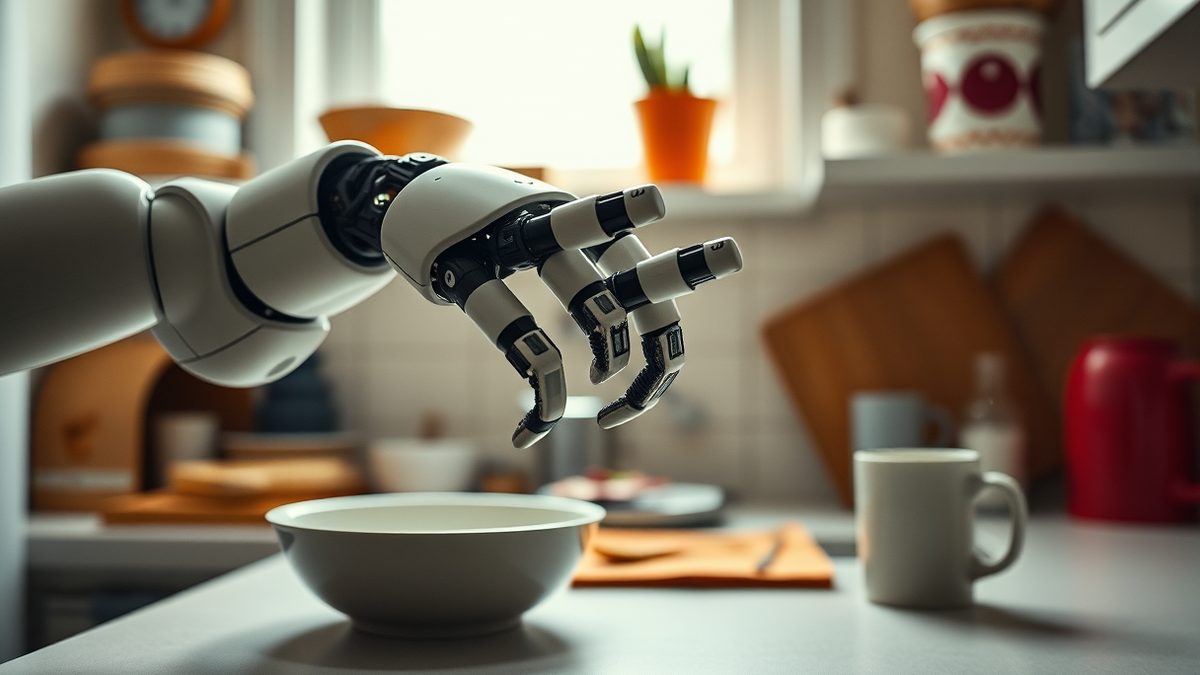
Stanford and Caltech researchers built HomeBody. The system lets a Unitree G1 robot navigate an unfamiliar kitchen on its own, tidy up, and fetch items from drawers. The Decoder reported on Sunday, 27 September, that the work drops the trained control layer that usually sits between a language model and a robot.
Instead, a swappable vision-language model, in this case GPT-6 Astra, calls directly into an extensible skill library for grasping, navigating, or opening drawers. The robot explores the room first, builds a digital twin in Nvidia's Isaac Sim, and logs objects and locations in spatial memory. That lets it find items even after they leave its field of view, according to the same report. For tasks like "clean up the kitchen," the language model plans each step and corrects itself when it makes mistakes. The Decoder lists the limitations plainly: Astra's latency, overheating finger servos, and high compute costs. The code is on GitHub.
This is not the first time GPT-6 Astra has been pointed at a robot. Earlier benchmarks showed greatly improved spatial reasoning, while another flagged safety issues when Astra controls a robot, The Decoder noted. OpenAI has already announced plans to get back into robotics, including for personal use.
HomeBody arrives as OpenAI's research priorities shift further out. Boris Power, the company's Head of Applied Research, said on 27 September that 80 to 90 percent of OpenAI's research goes toward GPT 7, GPT 8, and beyond, because that is where "most of the value" comes from.
According to The Decoder, Power described incremental updates such as GPT 5.1 to 5.2 as intentionally short-term bets. He added that they "are seen as extremely shortsighted" inside the company, even though they help OpenAI iterate faster today. Power also said the main challenge with today's AI assistants is not model quality but onboarding: most ChatGPT users do not know what they can do with AI.
The gap between lab claims and production value shows up elsewhere. Azeem Azhar, founder of the research group Exponential View, described speaking to about 160 IT vice presidents in Las Vegas, The Decoder reported on 26 September. Asked who could point to measurable AI results, two-thirds stayed standing. Asked who had results good enough to interrupt the CEO's summer vacation, only about eight remained on their feet.
Power generation is the other constraint. The Register reported on 25 September that Fervo Energy, an enhanced geothermal systems provider backed by Google, achieved first power at its Cape Station plant in Beaver County, Utah. The first of three 33 MW GeoBlocks has begun supplying electricity to the grid, with another 66 MW expected by New Year and half a gigawatt by 2028.
CleanTechnica reported on 26 September that the US Department of Energy announced a $99 million round for next-generation geothermal systems on 21 September, spread across 21 projects. Quaise Energy is in line for up to $25 million for its Project Obsidian showcase in central Oregon.
Not every recent result is about machines. Tohoku University researchers reported in ScienceDaily on 26 September that brain blood volume starts rising about 50 seconds before REM sleep begins, while neuronal ATP then drops. "Ever felt exhausted after a vivid dream?" Professor Ko Matsui asked in the release. The finding suggests dreaming may consume energy faster than it can be replenished.
Sources
6- 01Researchers plug GPT-6 Astra directly into a robot and let it clean up an unfamiliar kitchenEN
- 02OpenAI says 80 to 90 percent of its research already targets GPT 7 and beyondEN
- 03Two-thirds of IT leaders report AI results, but few would interrupt the CEO's vacation over themEN
- 04Google-backed energy outfit brings 33 MW of 4 GW geothermal potential online in UtahEN
- 05The Geothermal Energy Wild Card Is Getting WilderEN
- 06REM sleep paradox: Dreaming may drain the brain's energy even as fuel supply risesEN
All figures and quotations in this text come from the sources listed below.
Content prepared by the editorial team with AI assistance.
Sofia Marchetti
Comments
0- No comments yet — be the first.