Huawei claims Ascend outsells Nvidia in China as DeepSeek opens up its software
Huawei's rotating chairman Eric Xu said this week that the company's Ascend NPUs have passed Nvidia in Chinese market share, while DeepSeek released open-source tools for the same chips.
 Grace OkonkwoAI, models and technology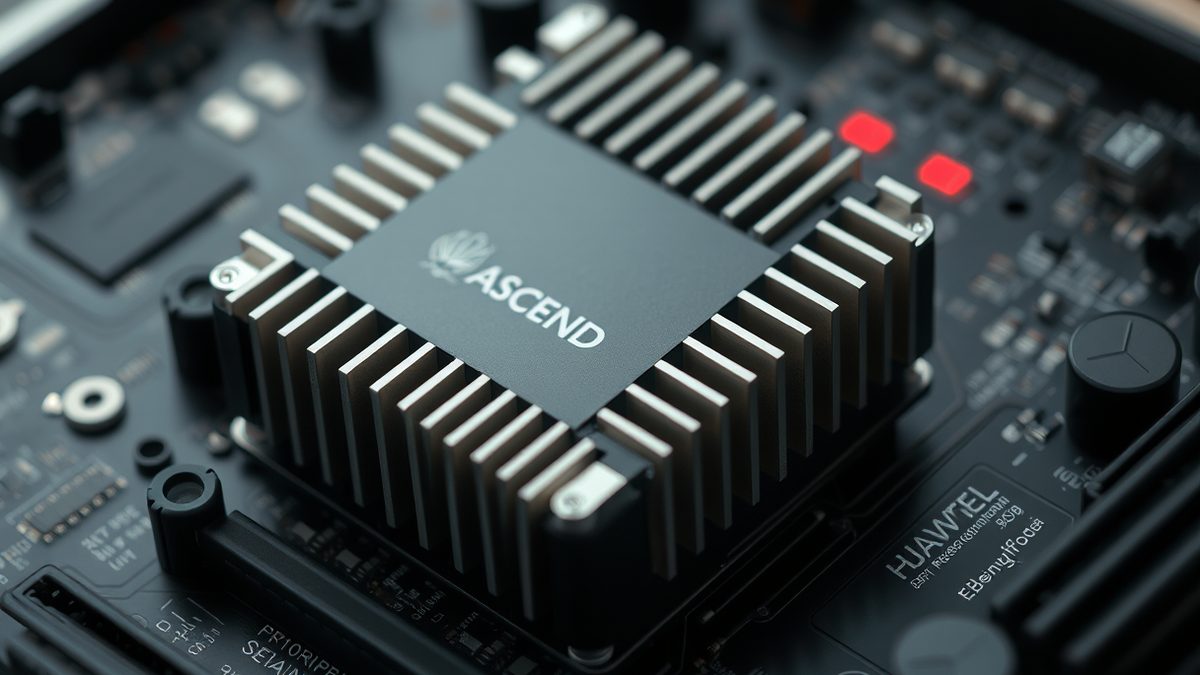
Huawei published a Q&A-style release this week. The Register reported on 30 September that rotating chairman Eric Xu claimed Ascend has surpassed Nvidia in Chinese market share. "It's pretty hard to collect data about the market share of Nvidia in China, but based on the data we have collected, Ascend has surpassed Nvidia," Xu said. He gave no independent figures, and Huawei has not published the underlying data.
The backdrop matters more than the claim. US export controls on AI accelerators to China have flip-flopped since April 2025, and the whiplash pushed Beijing to tell datacenter operators to move off foreign silicon. Nvidia's own Q2 earnings call, cited by The Register, said H200 shipments to the region amounted to less than 1 percent of datacenter revenues. Xu's pitch is political as much as technical: "Even though our chips may be less advanced, at least their supply is assured, so that you don't have to worry about chip supply day in and day out."
Software was the real wall
The hardware gap is real, and Xu admits it. Huawei argues the software gap is closing faster than expected. Liao Heng, chief scientist of Huawei's HiSilicon, told The Register that "the first barrier encountered by Ascend is actually not hardware itself. It's primarily the ecosystem barrier." That barrier is the CUDA moat, Nvidia's estimated four million developers. The Decoder notes this is what has kept AMD out even when its silicon looked competitive on paper.
On 30 September, DeepSeek released open-source programming tools for Ascend, according to The Decoder, citing a post on DeepSeek's official WeChat channel and Reuters. The centrepiece is TileLang, a language developed by researchers at Peking University that DeepSeek has used for about a year and now calls its main tool for AGI work, per The New York Times. DeepSeek and Huawei also optimised a supernode of 128 Ascend 950 chips. Liao said the picture shifted "over the past 18 months" as frontier labs moved to mega-kernel-style programming and stopped treating CUDA as the only path.
Scale is Huawei's other answer. The Register reports the company is deploying a 256,000-card Atlas 950 SuperCluster, with a newer architecture designed to scale to as many as one million NPUs. Xu was blunt about the limits: "We don't have enough capacity to satisfy the demand in China." On Malaysia's sovereign AI work, he said Huawei prioritises Chinese customers and "outside of China we only supply a very limited number of customers."
Meanwhile, the tooling layer is being rebuilt
On the same day, OpenAI and Synopsys signed a multi-year partnership to build GPT-Synopsys, a model meant to reason about chip design and verification and operate Synopsys' EDA tools directly, The Decoder reported on 30 September. Engineers delegate objectives and approve output. Synopsys CEO Sassine Ghazi says AI could speed up design; OpenAI's Greg Brockman frames it as better chips and better AI. The model runs on OpenAI infrastructure, customer data stays out of training, and early tests with semiconductor customers are already running.
Tom's Hardware's AI Chip Design Week, running 28 September to 2 October, frames the same shift. Cadence, Synopsys and Siemens all offer agentic AI for chip design, largely on Nvidia's stack, with what the outlet calls varying claims of autonomy. Synopsys unveiled seven AgentEngineer agents on its Autopilot platform, with general availability planned for the end of 2026. SemiEngineering published pieces on 1 October on LLM acceleration metrics, PCIe over UCIe verification and LLMs in chip design, the last estimating over 1,000 engineering months for an ASIC of typical complexity.
Not every route to Chinese compute is domestic. Tom's Hardware reported on 23 September that Nscale's S-1 filing revealed a ByteDance subsidiary, Spring (SG) Pte Ltd, accounted for $24 million of the UK neocloud's $33 million 2025 revenue and accessed 2,304 Nvidia B200 chips at a Norway datacenter. The FT reported the arrangement was legal and used loopholes in US export controls. Macquarie required Nscale to monitor Spring's usage for anomalies.
One caveat on the CUDA narrative: SemiAnalysis, cited by The Decoder, tested OpenAI's Jalapeño chip and called the CUDA moat "potentially dead," but only on relatively easy scenarios of about 8,000 input and 1,000 output tokens. On agent workloads, Nvidia was still well ahead in August.
Sources
6- 01Huawei boss claims homegrown AI chip sales top Nvidia in ChinaEN
- 02China's AI industry closes ranks as Deepseek ships open-source software for Huawei's Ascend chipsEN
- 03OpenAI and Synopsys team up to build an AI model that designs chips like a seasoned engineerEN
- 04AI Chip Design WeekEN
- 05China's ByteDance gained access to over 2k Nvidia B200 chips through NorwayEN
- 06Why LLMs Are The Best Thing To Happen To Chip DesignEN
All figures and quotations in this text come from the sources listed below.
Content prepared by the editorial team with AI assistance.
Grace Okonkwo
Comments
0- No comments yet — be the first.