Zeekr deploys dozens of Walker S1 humanoids in Ningbo as factory robot stock hits 5.08 million
Geely's Zeekr 5G smart factory in Ningbo is running dozens of UBTECH Walker S1 humanoid robots on collaborative assembly work, the Beijing Post reported on 1 October, the same week new industry data put the global stock of industrial robots at a record 5.08 million units.
 Rachel NwosuAI, models and technology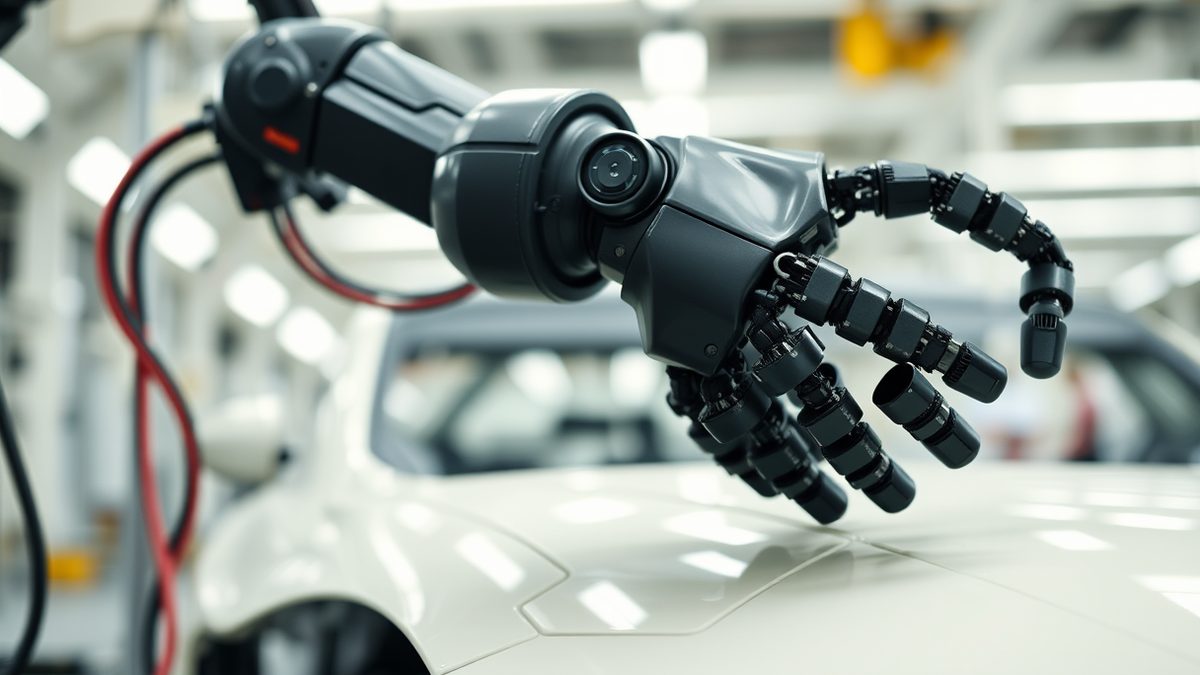
The robots sort materials, move boxes and handle delicate car components, according to the Beijing Post on 1 October. The report calls it the first real-world factory setting where multiple humanoids have been trained to work together across different tasks and zones.
UBTECH runs the fleet through a two-tier control system: a central "super brain" that allocates work, and per-robot "mini-brains" that handle real-time perception and grip control. Jiao Jichao, UBTECH's vice president, told the outlet the setup has already generated "hundreds of millions" of data points from industrial scenarios, which the company uses to retrain the robots for new roles. UBTECH already has deals with BYD, BAIC and logistics firm SF Express, and Jiao said more manufacturing partnerships are planned. The report comes from an outlet that labels its own copy as AI-generated, so the deployment details should be treated with caution until someone confirms them independently.
That caution matters, because the wider numbers point the other way.
The International Federation of Robotics said in its annual World Robotics report, published last Thursday and covered by Euronews on 29 September, that the global operational stock of industrial robots rose 9% last year to roughly 5.08 million units. Annual installations climbed 11% to 603,000, crossing 600,000 for the first time. China installed 354,000 units, up 20%, and now accounts for 59% of global deployments. The US overtook Japan as the second-largest market with almost 38,500 installations, up 12%.
Humanoids are a rounding error next to those figures. The IFR counted about 7,000 humanoid units sold worldwide last year for industrial and professional use, the first time it has tracked the category, and said many were bought to generate training data rather than to do work. Car manufacturers running pilots typically operate fewer than ten machines. Bank of America forecasts 90,000 humanoid shipments this year and 1.2 million by 2030, a projection the current installed base does not yet support.
The financial mood has cooled in parallel. Boston Dynamics, owned by Hyundai, is unlikely to pursue a stock listing next year because its Atlas humanoid has not been deployed at scale and the company remains unprofitable, a senior Hyundai executive said this month, according to Euronews. In China, regulators have reportedly used informal guidance to slow humanoid IPOs after Unitree's shares rose more than fivefold on their 19 August Shanghai debut and then fell 55% from their peak. Elon Musk told investors on Tesla's second-quarter earnings call that Optimus will be "the hardest product to scale manufacturing that we've ever made at Tesla, because everything on the robot is new," adding that "there is no supply chain."
Consultancies are drawing the same line. A report this year from Brussels-based Arthur D. Little puts the broader physical AI market at around $18bn today, of which humanoids account for just $2bn to $3bn, and projects $60bn to $100bn by 2030. "Humanoid robots will capture attention; specialised physical AI will capture value," the report states, warning that many humanoid demonstrations "are fake, AI-generated, or heavily staged."
Where the money is actually moving is less glamorous and more measurable.
Innodata, the New Jersey data engineering firm founded in 1988, opened a motion-capture lab on 30 September, according to The Robot Report, to produce training data for humanoids, industrial robots and other physical AI systems. The facility uses infrared optical tracking cameras from Vicon that measure movement to sub-millimetre accuracy, and Innodata says it captures 3D data directly from bodies rather than inferring motion from 2D video. Franklin Tanner, the company's vice president of robotics and physical AI, told the outlet that robot data has to be collected "one interaction at a time," and that a robot weighing almost 200 lb needs readings that are precise, not approximate. Tanner also flagged a gap: "We don't have training data right now where humans and robots are interacting."
Latency is the other bottleneck getting attention. On 30 September, MindOn introduced Mind-1, a physical AI model it says cuts robot inference latency from 82ms to 32ms, which it frames as the difference between a working demo and a deployable system. At an end-effector speed of 3 m/s, the company notes, 10ms of latency corresponds to roughly 3cm of travel, enough to affect precise grasping or insertion.
There is a counterargument to all the humanoid framing. Destro AI emerged from stealth on 30 September with an $8m seed round led by Base10 Partners and Bonfire Ventures, pitching an intelligence layer that coordinates robots and human warehouse staff rather than a robot body. Yusen Logistics helped steer the product toward cross-dock operations, and the pilot is expanding from three cart-moving robots to 26, with a second 17-robot pilot in Southern California. Founder Manthan Pawar told TechCrunch that his advantage is not being a robotics company at all.
For all the activity, the numbers still favour the boring machines. Five million industrial robots are at work. A few thousand humanoids are, mostly, still learning.
Sources
6- 01Humanoid Robots Revolutionize Manufacturing at Geely's Zeekr Factory in ChinaEN
- 02Five million robots now work in factories as humanoid hype faces reality checkEN
- 03Five million robots now work in factories as humanoid hype faces reality checkEN
- 04Innodata opens motion-capture lab to help humanoids move more like peopleEN
- 05Mind-1: Cutting robot inference latency from 82ms to 32msEN
- 06Destro AI's secret sauce is getting robots and humans on the same pageEN
All figures and quotations in this text come from the sources listed below.
Content prepared by the editorial team with AI assistance.
Rachel Nwosu
Comments
0- No comments yet — be the first.