Humanoid robot factories: data, not joints, is the bottleneck
Innodata opened a motion-capture laboratory on 30 September to generate training data for humanoid and industrial robots, saying the shortage of real-world interaction data is what slows robot deployment. The same day, another supplier published a model it says cuts inference latency from 82 ms to 32 ms.
 Grace OkonkwoAI, models and technology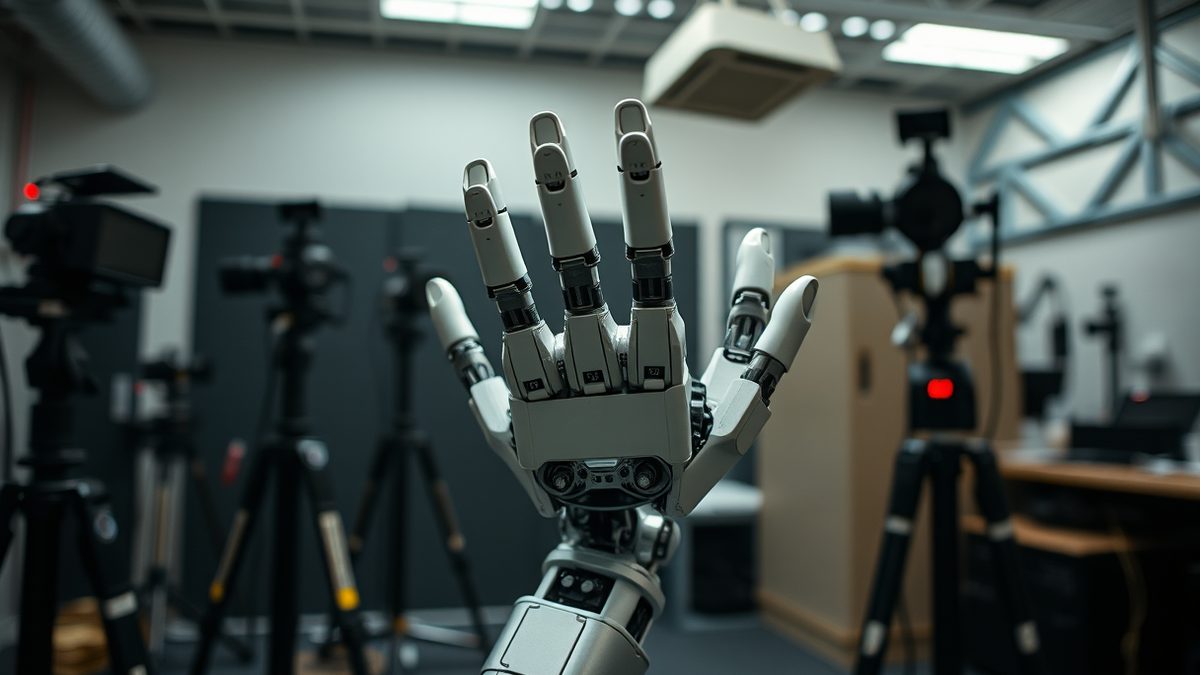
The newest piece of robot-factory infrastructure is not a production line. It is a capture stage. On 30 September, the data engineering company Innodata opened a research and development lab that records 3D motion directly from human or mechanical bodies, rather than inferring it from 2D video, according to The Robot Report.
"Physical AI is growing faster than any other segment in AI, but every robotics team hits the same wall: There isn't enough real-world interaction data, and what exists is expensive and slow to produce," Innodata CEO Rahul Singhal said in a statement carried by the outlet. The facility will also validate performance data that robots generate internally.
Why a factory still needs a human in the loop
Franklin Tanner, Innodata's vice president of robotics and physical AI, told The Robot Report that physical AI "has to earn its tokens one interaction at a time, and they have to be deliberate." He gave the example of a robot picking up a mug: gripping the handle is usually correct, but lifting a mug full of hot liquid by the base can burn the user. That context, he said, is often missing even from existing datasets. Innodata says its sensors register the motion of every joint and that it collects data across humanoids, teleoperated hardware, wearable systems, sensor rigs and Universal Manipulator Interface grippers.
Latency is the other half of the problem. Also on 30 September, MindOn published Mind-1, a physical AI model it says brings robot task execution to human-level speed and cuts inference latency from 82 ms to 32 ms. The company argues that at an end-effector speed of 3 m/s, 10 ms of delay equals roughly 3 cm of movement, enough to spoil precise grasping or insertion. It also points at training data itself: much of today's manipulation data comes from teleoperation, which is slower than natural human motion, so models learn slow tempo as well as the task.
Independent evaluation suggests the gap is not closing evenly. A technical report published on 30 September by Fig Inc. evaluated frontier models including Astra and Opus 5.5 across web automation and four physical domains, and found that in every model pair tested, the lower-scoring model solved at least one task the higher-scoring one failed. The authors call this a "jagged" performance profile and released item-level results under the name RIDGE.
"There's just no substitute for direct 3D motion capture," Tanner stated. "When a computer vision model tries to make sense of a 2D grid of pixels, mistakes inevitably creep in."
Money keeps moving toward the factory floor
Investment is following the same thesis. On 30 September, Paris-based Inbolt said it raised 11 million euros, led by Shift4Good with Bridges Climate Transition Partners and existing investors BNP Paribas Développement and Ora Global, bringing its total to 30 million euros, according to Tech.eu. Inbolt combines 3D vision with a hardware-agnostic AI layer that lets robots adjust control loops in real time, and says its software runs on more than 200 robots in over 100 factories across three continents, with customers including Bosch, Beko, Flex, Ford, Stellantis and Toyota.
Not every announcement in the sector is an engineering one. Electrek reported on 30 September that KIDZ AI, a Nasdaq-listed company formerly known as Classover Holdings, sent Tesla a "procurement inquiry" for 500 Robotaxis. The company reported service revenue of $0.48 million in Q2 2026, down 34% year over year, and a $2.5 million quarterly loss; its own release says the inquiry is not a binding order. Electrek noted that 500 Cybercabs, even at Elon Musk's "under $30,000" target, would cost about $15 million, roughly six times the company's market value.
The hardware supply chain has its own disputes. Electrek also reported on 30 September that Linton Crystal Technologies sued Zhejiang Jingsheng in a Texas federal court on 22 September over two US patents covering a seed lifting and rotating system for crystal growth. Chinese industry reports say Jingsheng won a roughly 3 billion yuan (about $420 million) Tesla order for crystal pullers earlier this year, though Tesla is not a party to the suit and neither Tesla nor Jingsheng has confirmed the order. Jingsheng told investors on 24 September that its products use "technical solutions entirely different" from the patents.
For makers outside the industrial market, the constraint is more mundane. On Hackster.io, Petoi founder Rongzhong Li wrote on 30 September that the company has shipped more than 30,000 quadruped robots since its 2018 Nybble campaign, and described deriving a formula that plots a product's feasibility against its active degrees of freedom. His current product, Quaddle, starts at $99 on Kickstarter.
Arrowfly, the parent company of The Robot Report, used the same day to launch AI for Engineers, an editorial and events platform backed by more than 20 engineering brands. Its flagship conference is scheduled for 20 to 22 September 2027 in Henderson, Nevada, with an expected 700 attendees.
Sources
8- 01Innodata opens motion-capture lab to help humanoids move more like peopleEN
- 02Tesla's solar factory dragged into patent war between Chinese suppliersEN
- 03The Robot Report parent Arrowfly launches AI for Engineers platformEN
- 04Tesla Robotaxi fleets are the new crypto treasury for zombie companiesEN
- 05Inbolt raises EUR11M to bring real-time vision and intelligence to industrial robotsEN
- 06Mind-1: Cutting robot inference latency from 82ms to 32msEN
- 07How Do Astra and Opus 5.5 Perform on Robotics and Web TasksEN
- 08What 30k robot dogs taught me about degrees of freedom, shipping a real productEN
All figures and quotations in this text come from the sources listed below.
Content prepared by the editorial team with AI assistance.
Grace Okonkwo
Comments
0- No comments yet — be the first.