Humanoid robots hit the factory floor: China ships 77.9% as Tesla and Maven push automation
China shipped more than 19,000 humanoid robots in the first half of 2026, accounting for 77.9% of global shipments, according to figures attributed to IDC and reported by TechNode on 29 September.
 Rachel NwosuAI, models and technology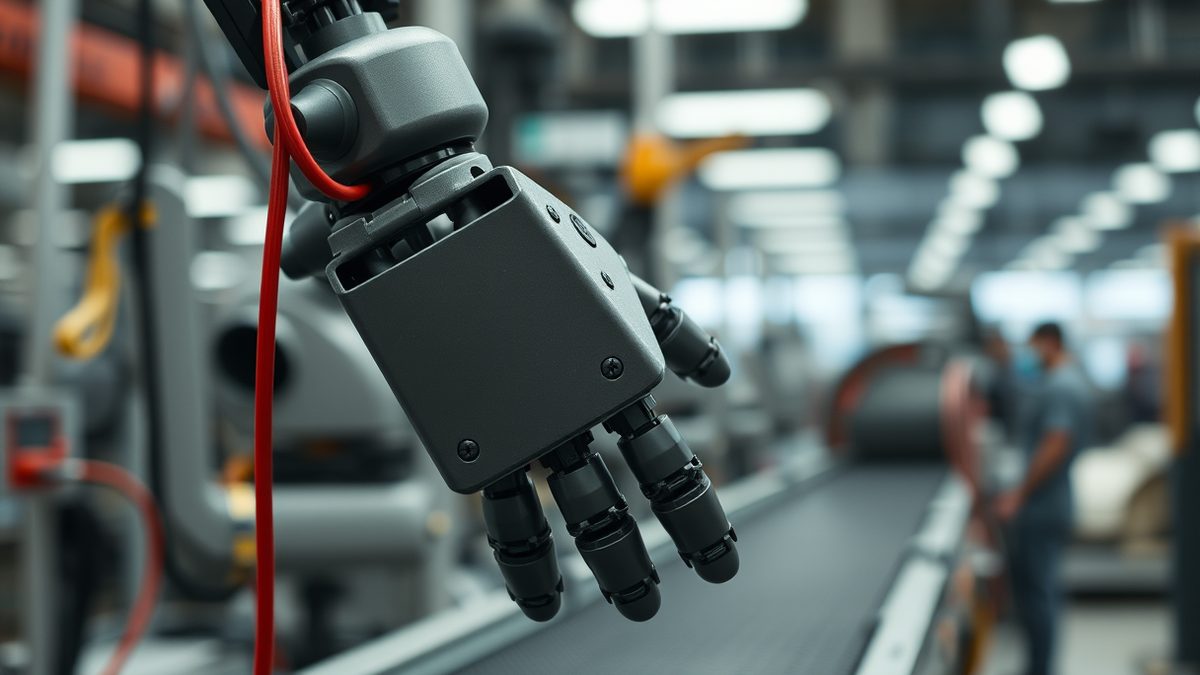
China shipped more than 19,000 humanoid robots in the first half of 2026, accounting for 77.9% of global shipments, according to figures attributed to IDC and reported by TechNode on 29 September. Global shipments reached nearly 25,000 units in the period, up 432.1% year over year, and IDC raised its forecast for 2030 to more than 750,000 units. The numbers land as the robot industry argues about where humanoids actually belong: in factories, in warehouses, or in the home. The most recent reporting in the dossier, dated 1 October, points in several directions at once. It ranges from memory architecture for joint controllers to a $3,555 wheeled robot aimed at parents.
Tesla's production problem
On the factory side, Tesla remains the loudest test case. Ars Technica reported on 26 September that Tesla's pivot from electric cars to humanoid robots is running into trouble with complex robot hands and with employees who object to training their own replacements. The Information's reporting, cited by Ars Technica, describes problems getting production line equipment to line up components precisely and limitations in running the line too fast.
Tesla has reportedly scaled production to hundreds of robots per week, but is targeting more than 1,000 robots per week by the end of 2026. That gap matters. Tesla's Fremont factory in California stopped making the Model S sedan and Model X SUV as of May 2026, with line workers and engineers switched over to Optimus, according to The Information. CEO Elon Musk has described Optimus as potentially "the biggest product ever" during Tesla's second-quarter 2026 earnings call. He also acknowledged that making an autonomous humanoid capable of handling many different tasks is "one of the hardest things to solve."
The hands are the clearest bottleneck. Human workers must manually assemble Optimus hands and forearms that together contain more than 100 small components such as screws, and newly produced robots require immediate fixes. Touch sensors for the hands have proven unreliable enough that Tesla developed a glove-like sensor layer that can be replaced without replacing the entire hand.
Workers, meanwhile, pushed back. The Information described some employees complaining because they "knew the robots were designed to eventually replace them," after Tesla had workers in Texas and California wear special suits to record their movements. Tesla has since shifted that data collection to dedicated teams and set up "training hubs."
None of this is unique to Tesla. The same reporting notes continued reliance on Chinese suppliers for robot components, and competition from Chinese, Japanese and South Korean automakers, plus dedicated robotics companies. Toyota plans to invest billions in upgrading factories with robots, including some humanoids. Hyundai plans to deploy up to 25,000 Atlas humanoid robots developed by US subsidiary Boston Dynamics over the next several years.
Maven bets on wheels, not legs
The counterargument to the humanoid form factor came from a Santa Clara company on 1 October. Maven Robotics, founded in 2024, has built four iterations of a mobile manipulator, raised $100 million, and moved from pilots to a production contract with its first customer, The Robot Report reported. Its robots run 16 hours a day, five days a week, with up to 99% uptime, according to co-founder and CEO Hamza Derbas.
Derbas told The Robot Report that humanoid companies "were starting with the human form factor and trying to work backwards into a problem to be solved." Maven started from the tasks instead. Its first two workflows were mixed-case palletizing and tote handling. The company says its wheeled base can reach the back of a 48-inch (121.9 cm) pallet or into a shelf up to 3 m (9.8 ft) high while carrying 30 kg (66.1 lb) payloads.
"Industrial work is not for the faint of heart," Derbas said. "The bar for reliability is very high. There's less demand on wanting a robot to be perfectly generalizable in its intelligence on Day 1. Generalization is a journey; reliability is not. It's required from Day 1."
That view is not confined to startups. Bruno Siciliano, professor of automation and robotics at the University of Naples Federico II, told Il Sole 24 Ore on 1 October that the fully anthropomorphic version, legs included, is not always productive in an industrial plant, citing costs, stability, movement agility in confined spaces and regulation. He pointed to BMW's rethink of its use of Figure AI humanoids at its South Carolina plant. Siciliano also floated a European policy push: an AI-based robotics act with a budget of 30 billion euros, modeled on the Chips Act, targeting a 33% share of the global market by 2035.
The memory and sensor layer underneath
Whatever the form factor, the electronics underneath are getting attention. Semiengineering published a sponsor blog on 1 October describing how distributed non-volatile memory supports telemetry logging, functional safety and time-sensitive networking in humanoids. The piece cites analyst reports from Goldman Sachs suggesting annual humanoid robot shipments could reach more than 6 million units by 2035, up from fewer than 15,000 units in 2025.
The engineering detail is concrete. Standard Flash and EEPROM devices introduce a 5 to 10 ms page-write delay, during which data sits in a volatile buffer while internal charge pumps program the cells. If a humanoid loses power or triggers an emergency stop in that window, the active position log fractures and joint controllers lose absolute coordinates, forcing a mechanical homing sequence on reboot. Logging motor torque, velocity and limb position at sampling rates above 10 kHz can also exceed the endurance limits of conventional non-volatile memory.
Thermal stress adds another constraint. Mechanical friction and electrical power dissipation inside compact joint housings drive internal temperatures above +100°C, which degrades the oxide insulation layer in legacy charge-based memories and shortens data retention. High-torque brushless DC motors generate EMI and stray magnetic fields near joint-control electronics, which can induce bit errors in telemetry.
Safety is not only a hardware question. The Robot Report published a piece on 1 October from VicOne LAB R7 arguing that a robot can follow its safety rules and still act on manipulated information. The researchers cite published work on vision-language-action models, including a study where a patch in a camera's view reduced task success in simulated robot tests, and FreezeVLA, where an adversarial image caused tested models to ignore later instructions.
In VicOne LAB R7's own tests, text on a poster was treated as an instruction and changed a robot dog's movement. Crafted audio inaudible to people changed the simulated behavior of a hospital-service robot running Nemotron on an NVIDIA Jetson AGX Orin. At a robotics bug bounty event, researchers injected a ROS 2/DDS message into a robot that organizers expected to remain still under a safe-control setting. The robot moved. The piece also notes that researchers demonstrated an acoustic attack against drones with vulnerable gyroscopes, but did not demonstrate the same attack chain causing a humanoid to fall.
Data, inspection and the home
Training data remains the sector's shared constraint. Innodata opened a motion-capture laboratory, The Robot Report reported on 30 September, built with motion-capture vendor Vicon, using infrared optical tracking cameras that measure movement down to the sub-millimeter level. "Physical AI has to earn its tokens one interaction at a time, and they have to be deliberate," Franklin Tanner, Innodata's vice president of robotics and physical AI, told the publication.
Tanner pointed to a gap that is easy to miss: "We don't have training data right now where humans and robots are interacting. It's one area we're working on in the lab, instrumenting it so multiple agents can work together."
Elsewhere on 1 October, ANYbotics launched Shift, a cloud platform for planning and running multi-robot inspection missions with its ANYmal quadrupeds, tying field data into enterprise systems such as SAP, IBM Maximo, GE Vernova APM, Cognite and Oracle. "Robotic inspection delivers the most value when field data flows directly into maintenance action," said co-founder and CEO Péter Fankhauser.
And at the consumer end, Flourish, a startup split between San Francisco and Paris, is preparing to sell Flourish One, a $3,555 wheeled humanoid-style home robot, The Robot Report reported on 29 September. Each arm has a 1.5 kg (4 lb) payload, the battery is designed for 12 hours of arm operation, and the unit runs on a Raspberry Pi with cloud GPUs handling training and higher-level inference. Founder Antoine Marcel told the publication that owners can teach chores in under 30 minutes using only a smartphone, with the phone's inertial measurement units driving teleoperation.
All of these bets depend on a supply chain and a policy environment that are still unsettled. The dossier's own reporting shows China dominating current shipments, US automakers testing humanoids on real lines, European researchers arguing for a different model, and component and data suppliers racing to fill gaps. Which of those layers turns out to be the bottleneck is, for now, an open question.
Sources
9- 01China accounts for 77.9% of global humanoid robot shipments in H1, IDC saysEN
- 02Tesla workers balk at training Optimus humanoid robots as replacementsEN
- 03How Maven Robotics plans to automate industrial work, one task at a timeEN
- 04Umanoidi, il professore di robotica Bruno Siciliano: «L'Ue punta sull'interazione tra uomo e macchina»EN
- 05Memory At The Edge: Non-Volatile Memory Challenges And Requirements For Humanoid RobotsEN
- 06Your Robot's Safety Functions Already Work. What If the Input Lies?EN
- 07Innodata opens motion-capture lab to help humanoids move more like peopleEN
- 08ANYbotics launches Shift to streamline robot fleet operations, scale inspectionsEN
- 09Meet Flourish One, the Raspberry Pi-powered humanoid built for busy parentsEN
All figures and quotations in this text come from the sources listed below.
Content prepared by the editorial team with AI assistance.
Rachel Nwosu
Comments
0- No comments yet — be the first.