Hyundai's Ulsan plant becomes the first car factory to strike over humanoid robots
Thousands of unionized Hyundai workers walked off the job at the company's Ulsan complex in South Korea after talks over humanoid robot deployment broke down. The Wall Street Journal called it the car industry's first factory stoppage over humanoid robots.
 Grace OkonkwoAI, models and technology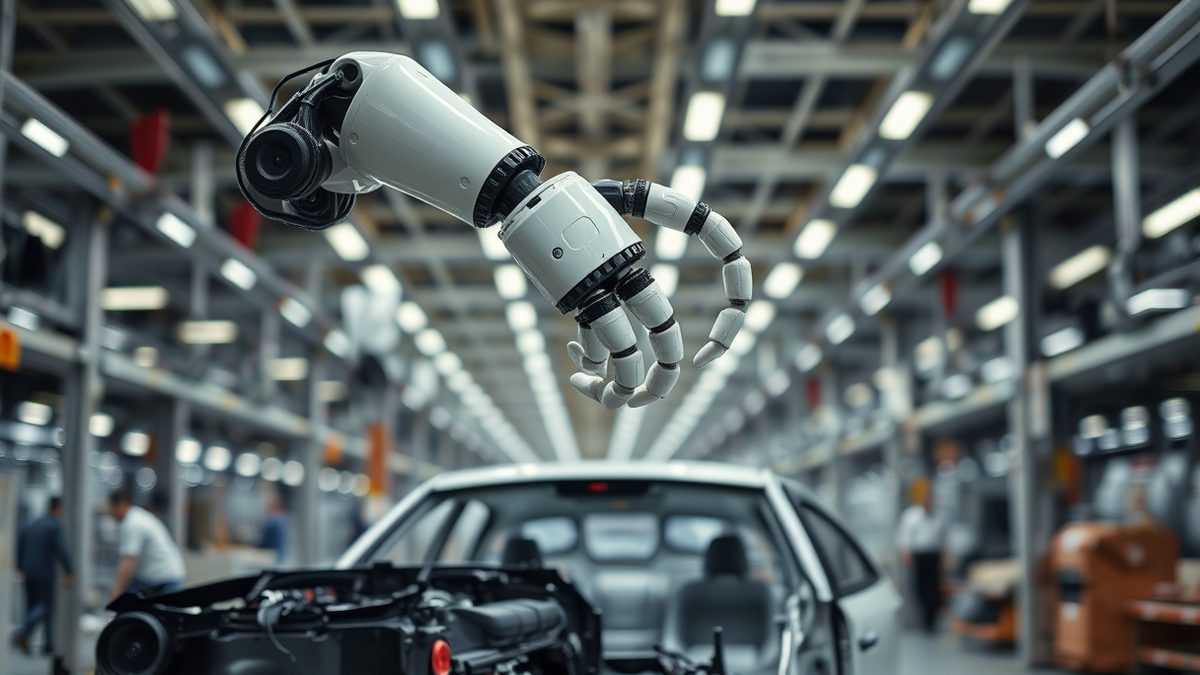
Thousands of unionized Hyundai auto workers began walking off the job early after negotiations with the South Korean automaker broke down over plans to deploy humanoid robots, according to Ars Technica. The partial strike at Hyundai's production complex in Ulsan, South Korea, is the strongest pushback organized labor has mounted so far against the latest wave of robotic automation.
The Wall Street Journal described the action as "the car industry's first factory stoppage addressing humanoid robots," Ars Technica reported.
Workers ended day and night shifts two hours early at the world's largest automotive plant from July 13 through July 15. They plan four-hour strikes from July 20 to 22 after 15 rounds of negotiations failed to produce an agreement, according to The Korea Times. The Hyundai Motor union represents more than 39,000 South Korean workers. It wants the automaker to move production workers from hourly pay to a fixed salary, so that any automation-driven cut in work hours does not hit their income. The union is also demanding a higher retirement age, from 60 to 65, and bigger bonuses, The Wall Street Journal reported.
What Hyundai plans to build, and where
Union pushback began as soon as Hyundai Motor Group unveiled the latest version of the Atlas humanoid robot at the start of this year. Atlas is made by Boston Dynamics, the US robotics company that is about to become a wholly owned subsidiary of Hyundai. The two-legged robot stands more than 6 feet tall and can lift more than 100 pounds.
Hyundai aims to deploy more than 25,000 Atlas robots across various Hyundai and Kia manufacturing plants, according to The Korea Herald. It plans to start with its US factories in 2028 but has not disclosed a timeline for deploying elsewhere. Each Atlas robot costs an estimated $130,000 but may pay for itself within about two years of operations, according to Samsung Securities analyst Esther Yim in a Bloomberg interview. If the robot cost eventually falls to $100,000, James Hong at Macquarie Securities Korea Ltd. suggested its operational cost could fall below the US federal minimum wage of $7.25 and significantly undercut a typical auto worker's salary.
Hyundai plans to put Atlas to work first at Metaplant America, an electric vehicle factory outside Savannah, Georgia, starting in 2028. Metaplant America is already considered the most heavily automated automotive factory in the United States. The facility has more than 850 robots unloading auto parts, stamping out steel components, putting together car frames, and installing car doors, according to IEEE Spectrum. It also uses 300 automated guided vehicles to carry auto parts to work stations while avoiding human workers.
Boston Dynamics' four-legged robot, Spot, has also been deployed onsite to perform "exterior quality inspection" at Metaplant America's weld shop. During a July 2026 visit, an Atlanta Journal-Constitution reporter described seeing the Spot "robotic dogs probe their sensor-embedded noses to sniff out defects."
The US site, and a smaller union presence
Hyundai may face less organized pushback on its initial deployment because workers at the Georgia factory are not unionized. However, the United Auto Workers, which represents about 400,000 autoworkers across the US, Canada, and Puerto Rico, has been attempting to organize workers at Hyundai's Georgia facility.
Atlas robots would start out by sorting and organizing automotive parts when they first deploy to Metaplant America in 2028. But Jerald Roach, a general assembly executive at Hyundai's Metaplant, told The AJC that the humanoid robots won't pose a threat to the human workforce. Roach described human hands with their sense of feel and touch as necessary for handling soft car parts such as hoses, wires, carpets, and trim panels.
Hyundai has committed to employing 8,100 human workers in full-time roles at Metaplant America by 2031 as part of its economic development deal with Georgia. State and local leaders provided an incentive package worth an estimated $2.1 billion to set up shop in Georgia. The AJC's reporting found the facility already employed more than 3,800 workers by the end of 2025. Labor unions in both South Korea and the United States want stronger commitments from automakers in the face of automation efforts. The UAW recently criticized General Motors for installing about 50 new robot arms at its flagship electric vehicle factory in Detroit after laying off more than 1,300 workers as a supposedly temporary measure.
Where the robots are being built
Hyundai is one of many automakers attempting to deploy humanoid robot workers. Tesla is developing its own Optimus robot for use in its electric vehicle factories. Electrek reported in September 2022 that a Tesla job listing said the company planned to use "thousands of Humanoid Robots within its factories" to automate repetitive and boring tasks. BMW has been running pilot tests with humanoid robots made by Figure AI at its automotive plant in Spartanburg, South Carolina. Multiple Chinese automotive companies, including leading EV maker BYD, are also trying out humanoid robots and sometimes developing their own.
The broader automation trend has a long history. The global automotive industry has been a leading adopter of industrial robots, such as large robotic arms, for decades. More than 1 million robots were already in automotive factories around the world by 2021 and accounted for one-third of robots across all industries, according to the International Federation of Robotics. The United States had deployed 38,000 industrial robots as of 2025, with the automotive industry alone having installed 13,500 units.
Industrial robots are usually designed for one specific task. Some robotics companies are now pitching humanoid robots powered by the latest AI models as capable of eventually doing a wide variety of tasks while fitting more easily into workplaces designed for humans. That vision will require overcoming multiple challenges in AI training and hardware development before humanoid robots can become general-purpose machines working autonomously in workplaces or homes.
The training side is already a business. Google DeepMind said in January 2026 that it is teaming up with Boston Dynamics to deploy its Gemini Robotics model on Atlas and Spot, with plans to test Gemini-powered Atlas robots at Hyundai auto factories in the coming months, WIRED reported. "The real value going forward is for our robots to be contextually aware of their environment and able to use their hands to manipulate any object," Robert Playter, CEO of Boston Dynamics, told WIRED ahead of the announcement. "And we think manufacturing environments, like in Hyundai factories, are a perfect place to deploy that today."
In China, local governments have funded more than 40 robot data collection centers as of December, according to the intelligence firm Interact Analysis, with about two dozen already in operation. At those facilities, human trainers mimic movements like folding clothes and wiping a table to teach robots, Rest of World reported. "We call ourselves cyber-laborers," one 20-year-old trainer, speaking under a pseudonym, told the publication. "It's a fine gig, though a bit boring."
Robot factories are scaling too. Agility Robotics said in September 2023 that its RoboFab facility in Salem, Oregon, had the capability to produce more than 10,000 robots per year, with hundreds of Digit robots expected in the first year. In China, UBTECH began operations at a factory in Liuzhou, Guangxi, designed to produce more than 10,000 humanoid robots annually, with a production line built to complete one robot every 10 minutes, according to Interesting Engineering. Each finished robot requires more than 2,000 screws of different specifications.
The question the Ulsan strike raises is not whether the robots arrive, but on what terms. Hyundai's economic development deal in Georgia promises 8,100 human jobs by 2031; its Atlas plan promises 25,000 robots. The union at Ulsan has already decided those two numbers cannot be negotiated separately.
Sources
6- 01Fear of humanoid robots spurs human workers to strike at Hyundai auto factory - Ars TechnicaEN
- 02Tesla plans 'thousands of Humanoid Robots within factories' - ElectrekEN
- 03Google Gemini Is Taking Control of Humanoid Robots on Auto Factory Floors - WIREDEN
- 04In Chinese data factories, workers teach humanoid robots boring tasks - Rest of WorldEN
- 05Opening RoboFab: World's First Factory for Humanoid Robots - Agility RoboticsEN
- 06UBTECH starts 10,000-unit robot factory that can build humanoid every 10 minutes - Interesting EngineeringEN
All figures and quotations in this text come from the sources listed below.
Content prepared by the editorial team with AI assistance.
Grace Okonkwo
Comments
0- No comments yet — be the first.